Huffman Kim M, Jessee Ryan, Andonian Brian, Davis Brittany N, Narowski Rachel, Huebner Janet L, Kraus Virginia B, McCracken Julie, Gilmore Brian F, Tune K Noelle, Campbell Milton, Koves Timothy R, Muoio Deborah M, Hubal Monica J, Kraus William E
Department of Medicine, Duke Molecular Physiology Institute, Duke School of Medicine, Durham, NC, USA.
Biomedical Engineering, Duke University, Durham, NC, USA.
Arthritis Res Ther. 2017 Jan 23;19(1):12. doi: 10.1186/s13075-016-1215-7.
To identify molecular alterations in skeletal muscle in rheumatoid arthritis (RA) that may contribute to ongoing disability in RA.
Persons with seropositive or erosive RA (n = 51) and control subjects matched for age, gender, race, body mass index (BMI), and physical activity (n = 51) underwent assessment of disease activity, disability, pain, physical activity and thigh muscle biopsies. Muscle tissue was used for measurement of pro-inflammatory markers, transcriptomics, and comprehensive profiling of metabolic intermediates. Groups were compared using mixed models. Bivariate associations were assessed with Spearman correlation.
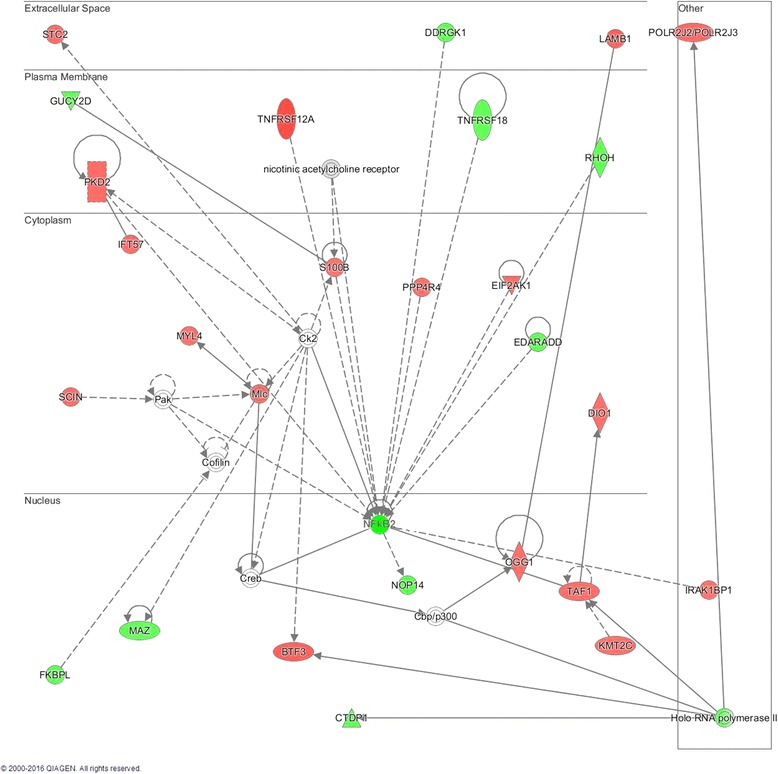
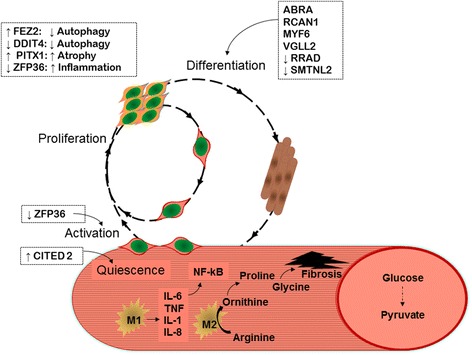
Compared to controls, patients with RA had 75% greater muscle concentrations of IL-6 protein (p = 0.006). In patients with RA, muscle concentrations of inflammatory markers were positively associated (p < 0.05 for all) with disease activity (IL-1β, IL-8), disability (IL-1β, IL-6), pain (IL-1β, TNF-α, toll-like receptor (TLR)-4), and physical inactivity (IL-1β, IL-6). Muscle cytokines were not related to corresponding systemic cytokines. Prominent among the gene sets differentially expressed in muscles in RA versus controls were those involved in skeletal muscle repair processes and glycolytic metabolism. Metabolic profiling revealed 46% higher concentrations of pyruvate in muscle in RA (p < 0.05), and strong positive correlation between levels of amino acids involved in fibrosis (arginine, ornithine, proline, and glycine) and disability (p < 0.05).
RA is accompanied by broad-ranging molecular alterations in skeletal muscle. Analysis of inflammatory markers, gene expression, and metabolic intermediates linked disease-related disruptions in muscle inflammatory signaling, remodeling, and metabolic programming to physical inactivity and disability. Thus, skeletal muscle dysfunction might contribute to a viscous cycle of RA disease activity, physical inactivity, and disability.
识别类风湿关节炎(RA)患者骨骼肌中的分子改变,这些改变可能导致RA患者持续的功能障碍。
对血清学阳性或有侵蚀性病变的RA患者(n = 51)以及年龄、性别、种族、体重指数(BMI)和体力活动相匹配的对照受试者(n = 51)进行疾病活动度、功能障碍、疼痛、体力活动评估及大腿肌肉活检。肌肉组织用于测量促炎标志物、转录组学以及代谢中间体的综合分析。使用混合模型对组间进行比较。采用Spearman相关性评估双变量关联。
与对照组相比,RA患者肌肉中IL - 6蛋白浓度高75%(p = 0.006)。在RA患者中,炎症标志物的肌肉浓度与疾病活动度(IL - 1β、IL - 8)、功能障碍(IL - 1β、IL - 6)、疼痛(IL - 1β、TNF - α、Toll样受体(TLR)- 4)和体力活动不足(IL - 1β、IL - 6)均呈正相关(所有p均<0.05)。肌肉细胞因子与相应的全身细胞因子无关。与对照组相比,RA患者肌肉中差异表达的基因集中,参与骨骼肌修复过程和糖酵解代谢的基因集最为突出。代谢分析显示,RA患者肌肉中丙酮酸浓度高46%(p < 0.05),且参与纤维化的氨基酸水平(精氨酸、鸟氨酸、脯氨酸和甘氨酸)与功能障碍之间存在强正相关(p < 0.05)。
RA伴有骨骼肌广泛的分子改变。对炎症标志物、基因表达和代谢中间体的分析将肌肉炎症信号、重塑和代谢程序中与疾病相关的破坏与体力活动不足和功能障碍联系起来。因此,骨骼肌功能障碍可能导致RA疾病活动度、体力活动不足和功能障碍的恶性循环。