Yang Y J Daniel, Sukhodolsky Denis G, Lei Jiedi, Dayan Eran, Pelphrey Kevin A, Ventola Pamela
Autism and Neurodevelopmental Disorders Institute, The George Washington University and Children's National Health System, 2300 I St NW, Washington, DC 20052 USA ; Child Study Center, Yale University School of Medicine, New Haven, CT 06519 USA.
Child Study Center, Yale University School of Medicine, New Haven, CT 06519 USA.
J Neurodev Disord. 2017 Jan 17;9:1. doi: 10.1186/s11689-017-9183-z. eCollection 2017.
Disruptive behavior in autism spectrum disorder (ASD) is an important clinical problem, but its neural basis remains poorly understood. The current research aims to better understand the neural underpinnings of disruptive behavior in ASD, while addressing whether the neural basis is shared with or separable from that of core ASD symptoms.
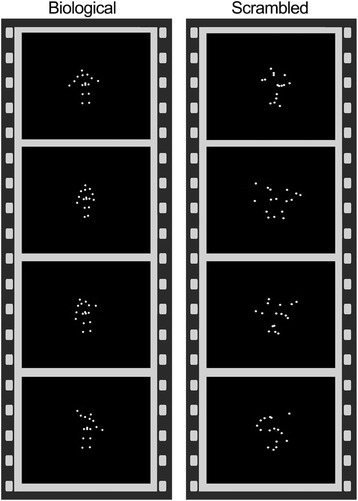
Participants consisted of 48 male children and adolescents: 31 ASD (7 had high disruptive behavior) and 17 typically developing (TD) controls, well-matched on sex, age, and IQ. For ASD participants, autism symptom severity, disruptive behavior, anxiety symptoms, and ADHD symptoms were measured. All participants were scanned while viewing biological motion (BIO) and scrambled motion (SCR). Two fMRI contrasts were analyzed: social perception (BIO > SCR) and Default Mode Network (DMN) deactivation (fixation > BIO). Age and IQ were included as covariates of no interest in all analyses.
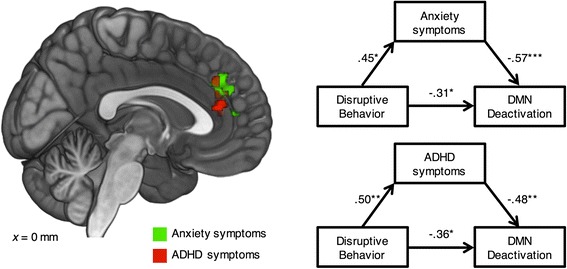
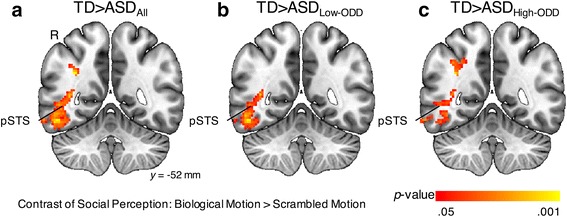
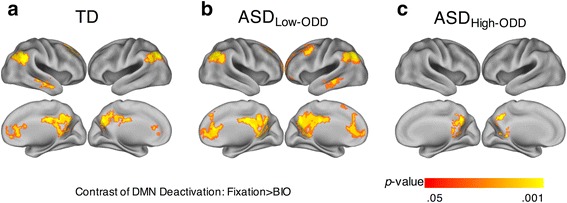
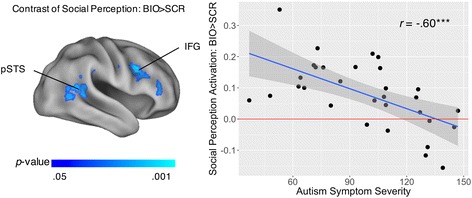
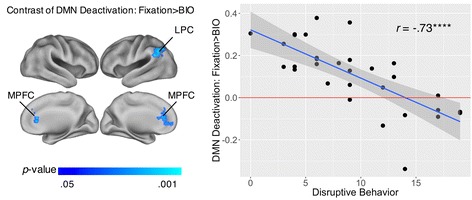
First, the between-group analyses on BIO > SCR showed that ASD is characterized by hypoactivation in the social perception circuitry, and ASD with high or low disruptive behavior exhibited similar patterns of hypoactivation. Second, the between-group analyses on fixation > BIO showed that ASD with high disruptive behavior exhibited more restricted and less DMN deactivation, when compared to ASD with low disruptive behavior or TD. Third, the within-ASD analyses showed that (a) autism symptom severity (but not disruptive behavior) was uniquely associated with less activation in the social perception regions including the posterior superior temporal sulcus and inferior frontal gyrus; (b) disruptive behavior (but not autism symptom severity) was uniquely associated with less DMN deactivation in the medial prefrontal cortex (MPFC) and lateral parietal cortex; and (c) anxiety symptoms mediated the link between disruptive behavior and less DMN deactivation in both anterior cingulate cortex (ACC) and MPFC, while ADHD symptoms mediated the link primarily in ACC.
In boys with ASD, disruptive behavior has a neural basis in reduced DMN deactivation, which is distinct and separable from that of core ASD symptoms, with the latter characterized by hypoactivation in the social perception circuitry. These differential neurobiological markers may potentially serve as neural targets or predictors for interventions when treating disruptive behavior vs. core symptoms in ASD.
自闭症谱系障碍(ASD)中的破坏性行为是一个重要的临床问题,但其神经基础仍知之甚少。当前的研究旨在更好地理解ASD中破坏性行为的神经基础,同时探讨其神经基础与ASD核心症状的神经基础是共享的还是可分离的。
参与者包括48名男性儿童和青少年:31名ASD患者(其中7名有高度破坏性行为)和17名发育正常(TD)的对照者,在性别、年龄和智商方面进行了良好匹配。对于ASD参与者,测量了自闭症症状严重程度、破坏性行为、焦虑症状和注意力缺陷多动障碍(ADHD)症状。所有参与者在观看生物运动(BIO)和打乱运动(SCR)时进行扫描。分析了两个功能磁共振成像(fMRI)对比:社会感知(BIO>SCR)和默认模式网络(DMN)失活(注视>BIO)。在所有分析中,年龄和智商作为无关协变量纳入。
首先,对BIO>SCR的组间分析表明,ASD的特征是社会感知回路激活不足,有高或低破坏性行为的ASD患者表现出相似的激活不足模式。其次,对注视>BIO的组间分析表明,与低破坏性行为的ASD患者或TD对照者相比,有高破坏性行为的ASD患者表现出更受限且DMN失活更少。第三,在ASD患者内部的分析表明:(a)自闭症症状严重程度(而非破坏性行为)与包括后颞上沟和额下回在内的社会感知区域激活减少独特相关;(b)破坏性行为(而非自闭症症状严重程度)与内侧前额叶皮质(MPFC)和外侧顶叶皮质的DMN失活减少独特相关;(c)焦虑症状介导了前扣带回皮质(ACC)和MPFC中破坏性行为与较少DMN失活之间的联系,而ADHD症状主要在前扣带回皮质中介导这种联系。
在患有ASD的男孩中,破坏性行为的神经基础是DMN失活减少,这与ASD核心症状的神经基础不同且可分离,后者的特征是社会感知回路激活不足。这些不同的神经生物学标志物可能潜在地作为治疗ASD中破坏性行为与核心症状时干预的神经靶点或预测指标。