Johnson Allison E, Mitchell Jonathan S, Brown Mary Bomberger
Department of Ecology and Evolution University of Chicago Chicago IL USA.
Department of Ecology and Evolutionary Biology University of Michigan Ann Arbor MI USA.
Ecol Evol. 2016 Dec 20;7(2):550-560. doi: 10.1002/ece3.2641. eCollection 2017 Jan.
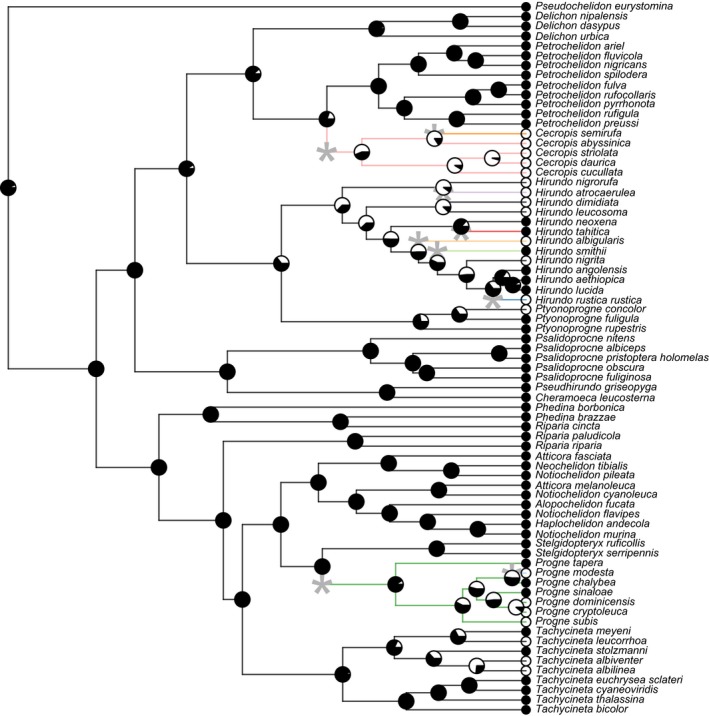
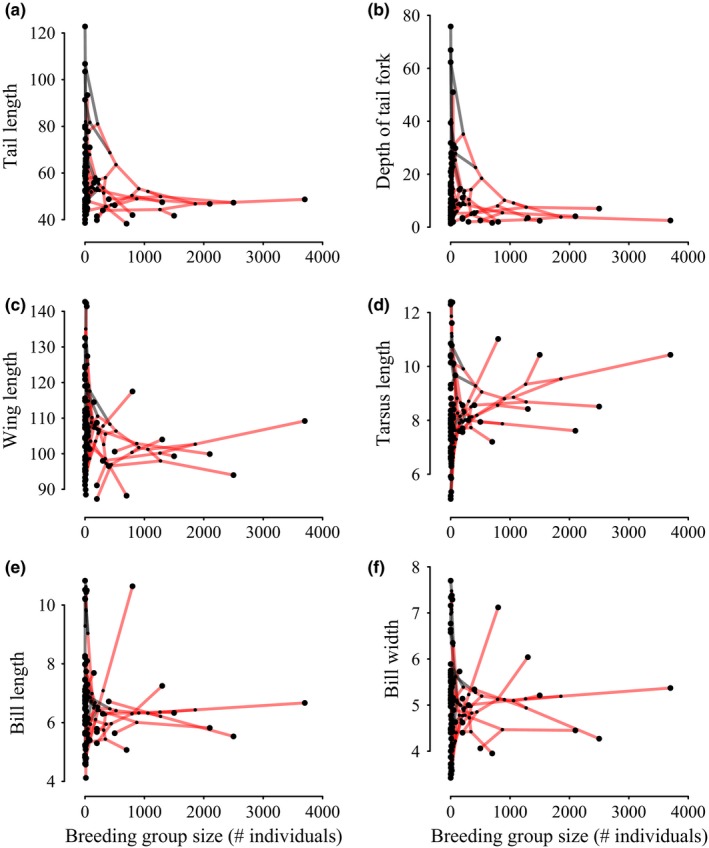
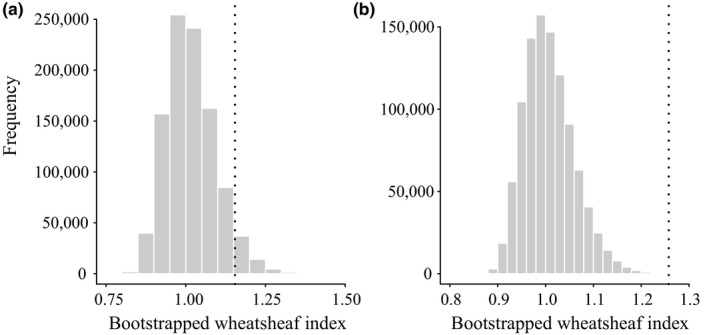
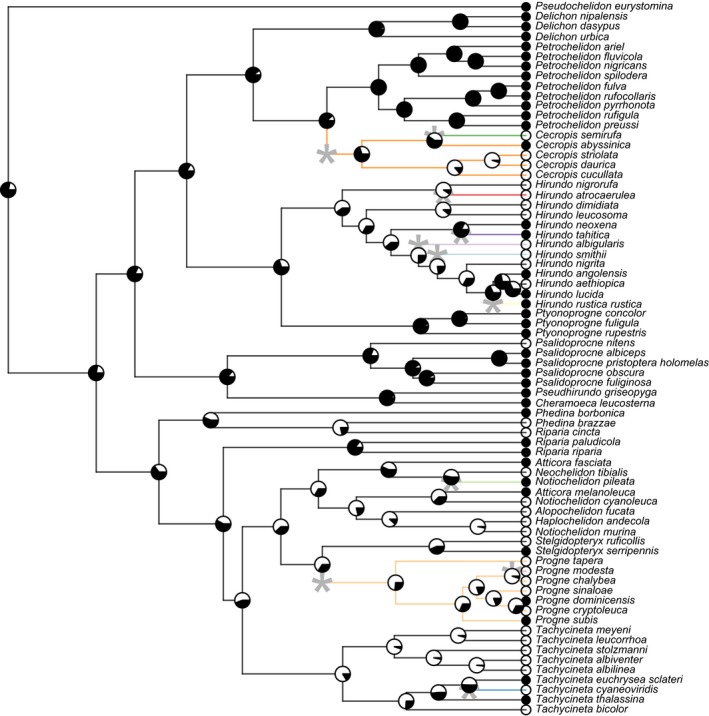
Behavioral shifts can initiate morphological evolution by pushing lineages into new adaptive zones. This has primarily been examined in ecological behaviors, such as foraging, but social behaviors may also alter morphology. Swallows and martins (Hirundinidae) are aerial insectivores that exhibit a range of social behaviors, from solitary to colonial breeding and foraging. Using a well-resolved phylogenetic tree, a database of social behaviors, and morphological measurements, we ask how shifts from solitary to social breeding and foraging have affected morphological evolution in the Hirundinidae. Using a threshold model of discrete state evolution, we find that shifts in both breeding and foraging social behavior are common across the phylogeny of swallows. Solitary swallows have highly variable morphology, while social swallows show much less absolute variance in all morphological traits. Metrics of convergence based on both the trajectory of social lineages through morphospace and the overall morphological distance between social species scaled by their phylogenetic distance indicate strong convergence in social swallows, especially socially foraging swallows. Smaller physical traits generally observed in social species suggest that social species benefit from a distinctive flight style, likely increasing maneuverability and foraging success and reducing in-flight collisions within large flocks. These results highlight the importance of sociality in species evolution, a link that had previously been examined only in eusocial insects and primates.
行为转变可以通过将谱系推向新的适应区来启动形态进化。这主要在诸如觅食等生态行为中得到研究,但社会行为也可能改变形态。燕科鸟类是空中食虫动物,表现出一系列社会行为,从独居到群居繁殖和觅食。利用一个解析度高的系统发育树、一个社会行为数据库和形态测量数据,我们探究从独居到群居繁殖和觅食的转变如何影响燕科鸟类的形态进化。使用离散状态进化的阈值模型,我们发现繁殖和觅食社会行为的转变在燕科鸟类的系统发育中很常见。独居的燕子形态差异很大,而群居的燕子在所有形态特征上的绝对差异要小得多。基于社会谱系在形态空间中的轨迹以及按系统发育距离缩放的社会物种之间的总体形态距离的趋同度量表明,群居燕子,尤其是群居觅食的燕子,存在很强的趋同现象。在群居物种中普遍观察到的较小身体特征表明,群居物种受益于独特的飞行方式,这可能会提高机动性和觅食成功率,并减少大群体内的飞行碰撞。这些结果凸显了社会性在物种进化中的重要性,此前这一联系仅在真社会性昆虫和灵长类动物中得到研究。