Welty Leah J, Hershfield Jennifer A, Abram Karen M, Han Hongyun, Byck Gayle R, Teplin Linda A
Health Disparities and Public Policy, Northwestern University Feinberg School of Medicine, Chicago.
Health Disparities and Public Policy, Northwestern University Feinberg School of Medicine, Chicago; Children's Hospital Los Angeles, University of Southern California Center for Excellence in Developmental Disabilities, Los Angeles.
J Am Acad Child Adolesc Psychiatry. 2017 Feb;56(2):140-148. doi: 10.1016/j.jaac.2016.10.018. Epub 2016 Dec 7.
To identify trajectories of substance use disorders (SUDs) in youth during the 12 years after detention and how gender, race/ethnicity, and age at baseline predict trajectories.
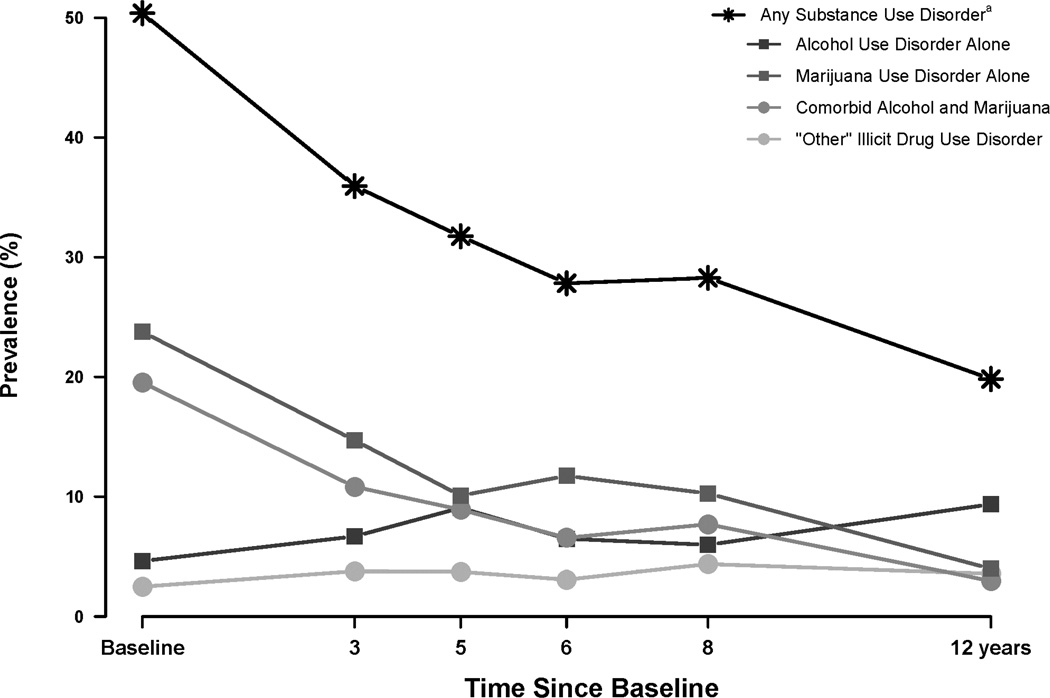
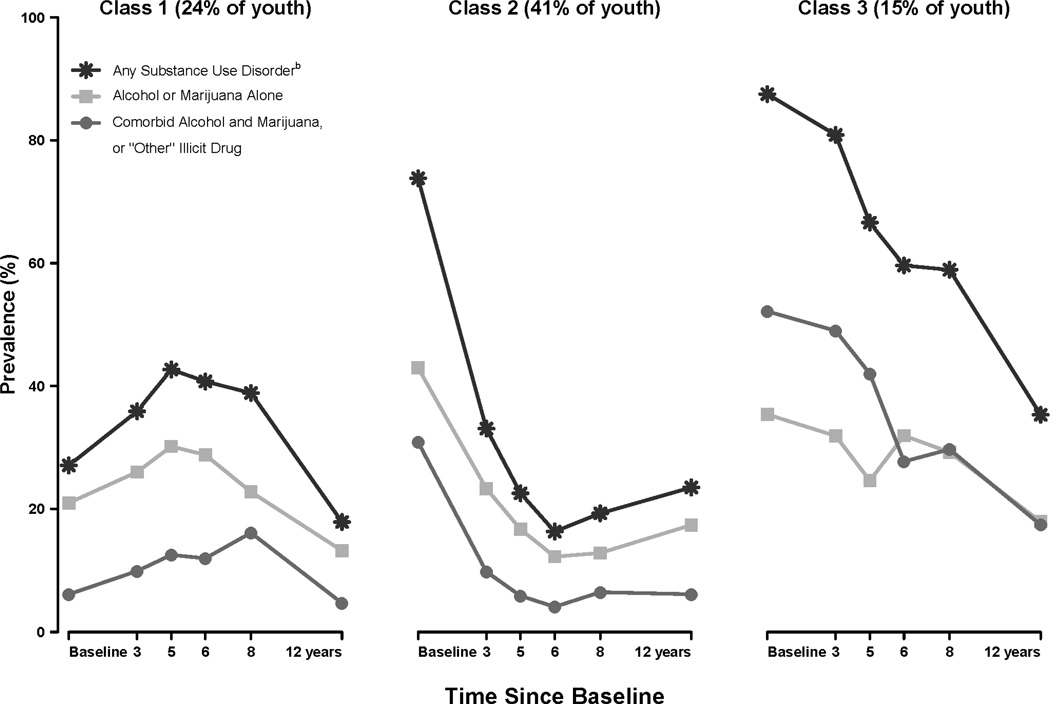
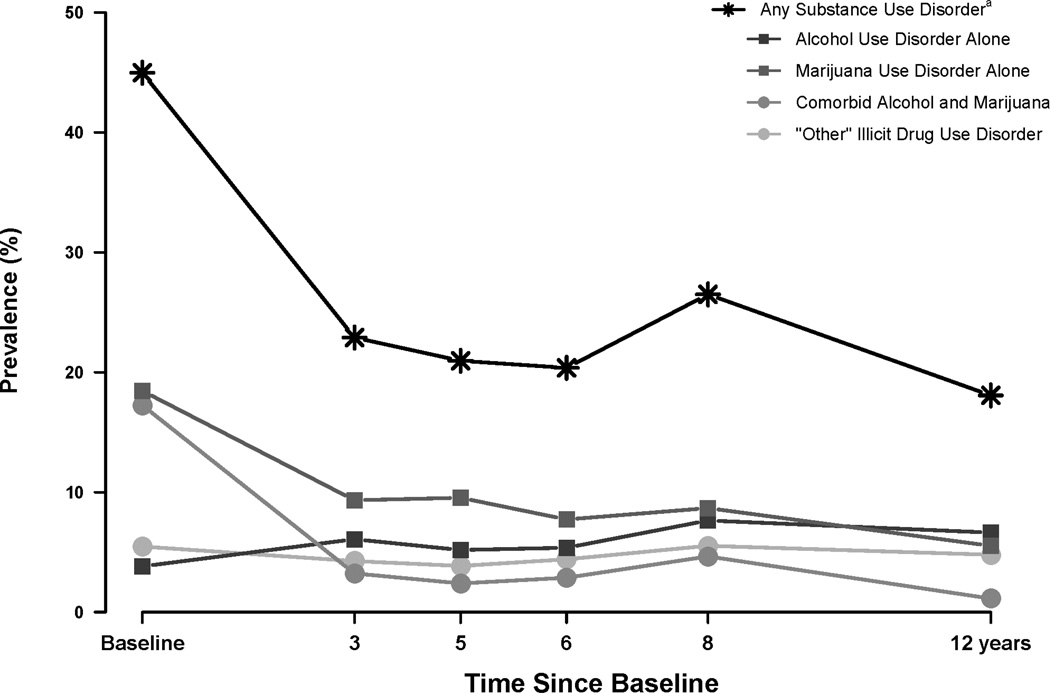
As part of the Northwestern Juvenile Project, a longitudinal study of 1,829 youth randomly sampled from detention in Chicago, Illinois from 1995 through 1998, participants were reinterviewed in the community or correctional facilities up to 9 times over 12 years. Independent interviewers assessed SUDs using the Diagnostic Interview Schedule for Children 2.3 (baseline) and the Diagnostic Interview Schedule IV (follow-ups). Primary outcome was a mutually exclusive 5-category typology of disorder: no SUD, alcohol alone, marijuana alone, comorbid alcohol and marijuana, or "other" illicit ("hard") drug. Trajectories were estimated using growth mixture models with a 3-category ordinal variable derived from the typology.
During the 12-year follow-up, 19.6% of youth did not have an SUD. The remaining 81.4% were in 3 trajectory classes. Class 1 (24.5%), a bell-shaped trajectory, peaked 5 years after baseline when 42.7% had an SUD and 12.5% had comorbid or "other" illicit drug disorders. Class 2 (41.3%) had a higher prevalence of SUD at baseline, 73.8%. Although prevalence decreased over time, 23.5% had an SUD 12 years later. Class 3 (14.6%), the most serious and persistent trajectory, had the highest prevalence of comorbid or "other" illicit drug disorders-52.1% at baseline and 17.4% 12 years later. Males, Hispanics, non-Hispanic whites, and youth who were older at baseline (detention) had the worst outcomes.
Gender, race/ethnicity, and age at detention predict trajectories of SUDs in delinquent youth. Findings provide an empirical basis for child psychiatry to address health disparities and improve prevention.
确定青少年在被拘留后12年期间物质使用障碍(SUDs)的轨迹,以及性别、种族/族裔和基线年龄如何预测轨迹。
作为西北青少年项目的一部分,该项目对1995年至1998年从伊利诺伊州芝加哥的拘留所中随机抽取的1829名青少年进行了纵向研究,在12年里,参与者在社区或惩教设施中接受了多达9次重新访谈。独立访谈者使用儿童诊断访谈量表2.3(基线)和诊断访谈量表IV(随访)评估物质使用障碍。主要结果是一种相互排斥的5类障碍类型:无物质使用障碍、仅酒精使用障碍、仅大麻使用障碍、酒精和大麻共病使用障碍或“其他”非法(“硬性”)药物使用障碍。使用生长混合模型估计轨迹,该模型有一个从类型学导出的3类有序变量。
在12年的随访期间,19.6%的青少年没有物质使用障碍。其余81.4%分为3个轨迹类别。第1类(24.5%),呈钟形轨迹,在基线后5年达到峰值,此时42.7%的人有物质使用障碍,12.5%的人有共病或“其他”非法药物障碍。第2类(41.3%)在基线时物质使用障碍的患病率较高,为73.8%。尽管患病率随时间下降,但12年后仍有23.5%的人有物质使用障碍。第3类(14.6%)是最严重和持续时间最长的轨迹,共病或“其他”非法药物障碍的患病率最高——基线时为52.1%,12年后为17.4%。男性、西班牙裔、非西班牙裔白人以及基线(被拘留时)年龄较大的青少年结局最差。
性别、种族/族裔和被拘留时的年龄可预测违法青少年物质使用障碍的轨迹。研究结果为儿童精神病学解决健康差异问题和改进预防措施提供了实证依据。