School of Electrical Engineering, Tel-Aviv University, Tel-Aviv 69978, Israel.
Sagol School of Neuroscience, Tel-Aviv University, Tel-Aviv 69978, Israel.
Sci Rep. 2017 Jan 25;7:41243. doi: 10.1038/srep41243.
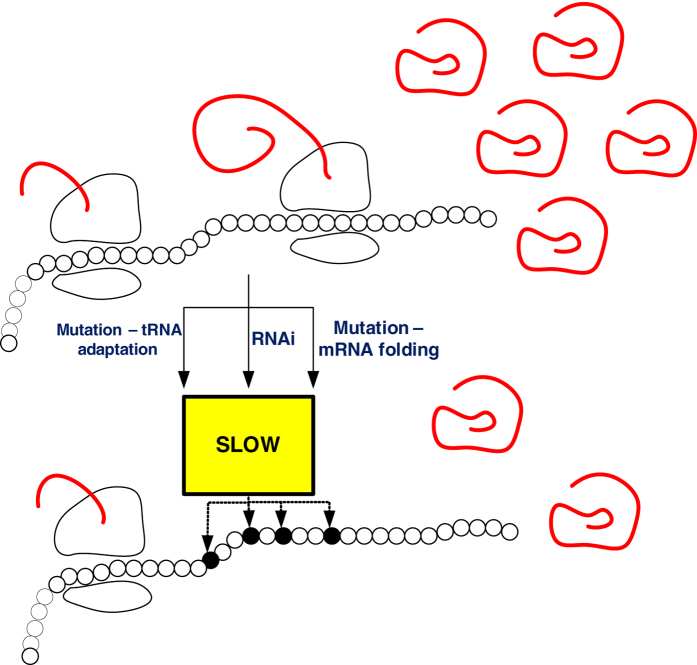
Down regulation of mRNA translation is an important problem in various bio-medical domains ranging from developing effective medicines for tumors and for viral diseases to developing attenuated virus strains that can be used for vaccination. Here, we study the problem of down regulation of mRNA translation using a mathematical model called the ribosome flow model (RFM). In the RFM, the mRNA molecule is modeled as a chain of n sites. The flow of ribosomes between consecutive sites is regulated by n + 1 transition rates. Given a set of feasible transition rates, that models the outcome of all possible mutations, we consider the problem of maximally down regulating protein production by altering the rates within this set of feasible rates. Under certain conditions on the feasible set, we show that an optimal solution can be determined efficiently. We also rigorously analyze two special cases of the down regulation optimization problem. Our results suggest that one must focus on the position along the mRNA molecule where the transition rate has the strongest effect on the protein production rate. However, this rate is not necessarily the slowest transition rate along the mRNA molecule. We discuss some of the biological implications of these results.
mRNA 翻译的下调是从开发针对肿瘤和病毒疾病的有效药物到开发可用于疫苗接种的减毒病毒株等各个生物医学领域的一个重要问题。在这里,我们使用核糖体流模型(RFM)这一数学模型来研究 mRNA 翻译下调的问题。在 RFM 中,mRNA 分子被建模为 n 个位点的链。核糖体在连续位点之间的流动由 n+1 个转换率来调节。给定一组可行的转换率,这些转换率模拟了所有可能突变的结果,我们考虑通过改变这个可行的转换率集合中的速率来最大程度地下调蛋白质的产生。在可行集合的某些条件下,我们证明可以有效地确定最优解。我们还对下调优化问题的两个特殊情况进行了严格分析。我们的结果表明,必须关注对蛋白质产生速率影响最强的 mRNA 分子上的位置。然而,该速率不一定是 mRNA 分子上最慢的转换速率。我们讨论了这些结果的一些生物学意义。