Seccombe Leigh M, Chow Vincent, Zhao Wei, Lau Edmund M T, Rogers Peter G, Ng Austin C C, Veitch Elizabeth M, Peters Matthew J, Kritharides Leonard
Department of Thoracic Medicine, Concord Repatriation General Hospital, Concord, New South Wales, Australia; Sydney Medical School, The University of Sydney, Sydney, Australia.
Sydney Medical School, The University of Sydney, Sydney, Australia; Department of Cardiology, Concord Repatriation General Hospital, Concord, New South Wales, Australia.
Open Heart. 2017 Jan 20;4(1):e000532. doi: 10.1136/openhrt-2016-000532. eCollection 2017.
Patients with pulmonary arterial hypertension (PAH) are often recommended supplemental oxygen for altitude travel due to the possible deleterious effects of hypoxia on pulmonary haemodynamics and right heart function. This includes commercial aircraft travel; however, the direct effects and potential risks are unknown.
Doppler echocardiography and gas exchange measures were investigated in group 1 patients with PAH and healthy patients at rest breathing room air and while breathing 15.1% oxygen, at rest for 20 min and during mild exertion.
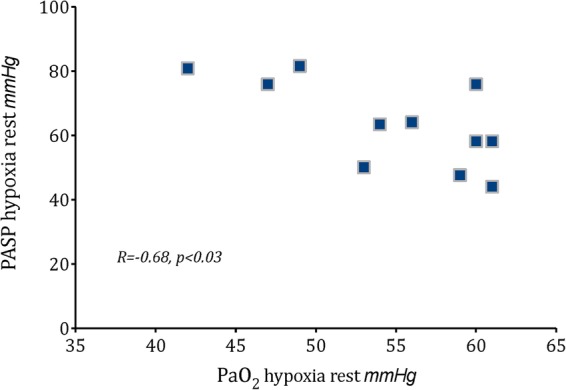
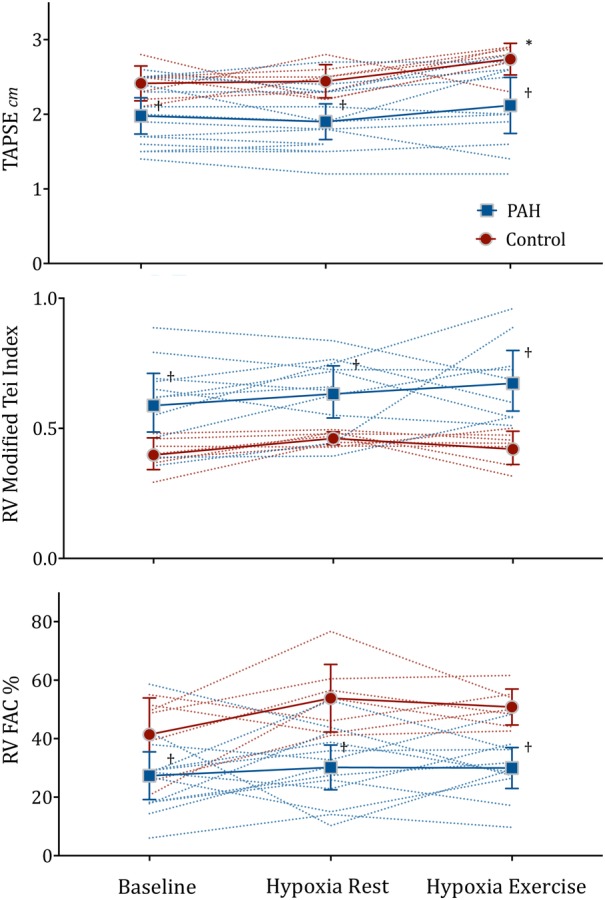
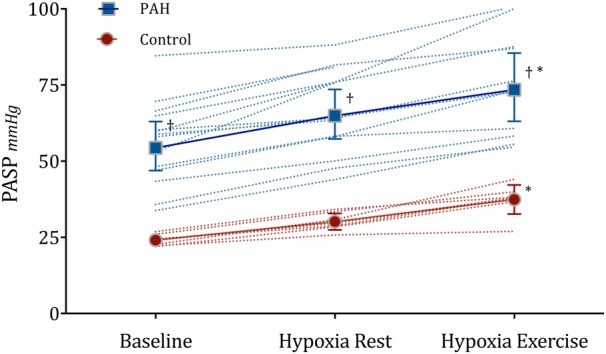
The 14 patients with PAH studied were clinically stable on PAH-specific therapy, with functional class II (n=11) and III (n=3) symptoms when tested. Measures of right ventricular size and function were significantly different in the PAH group at baseline as compared to 7 healthy patients (p<0.04). There was no evidence of progressive right ventricular deterioration during hypoxia at rest or under exertion. Pulmonary arterial systolic pressure (PASP) increased in both groups during hypoxia (p<0.01). PASP in hypoxia correlated strongly with baseline PASP (p<0.01). Pressure of arterial oxygen correlated with PASP in hypoxia (p<0.03) but not at baseline, with three patients with PAH experiencing significant desaturation. The duration and extent of hypoxia in this study was tolerated well despite a mild increase in symptoms of breathlessness (p<0.01).
Non-invasive measures of right heart function in group 1 patients with PAH on vasodilator treatment demonstrated a predictable rise in PASP during short-term simulated hypoxia that was not associated with a deterioration in right heart function.
由于缺氧可能对肺血流动力学和右心功能产生有害影响,肺动脉高压(PAH)患者在海拔旅行时通常被建议补充氧气。这包括乘坐商业飞机旅行;然而,其直接影响和潜在风险尚不清楚。
对第1组PAH患者和健康患者在静息呼吸室内空气、呼吸15.1%氧气时、静息20分钟以及轻度运动期间进行多普勒超声心动图和气体交换测量。
研究的14例PAH患者在接受PAH特异性治疗后临床稳定,测试时功能分级为II级(n = 11)和III级(n = 3)症状。与7名健康患者相比,PAH组在基线时右心室大小和功能的测量值有显著差异(p < 0.04)。在静息或运动时缺氧期间,没有证据表明右心室进行性恶化。两组在缺氧期间肺动脉收缩压(PASP)均升高(p < 0.01)。缺氧时的PASP与基线PASP密切相关(p < 0.01)。动脉血氧分压与缺氧时的PASP相关(p < 0.03),但在基线时不相关,3例PAH患者出现明显的氧饱和度下降。尽管呼吸急促症状略有增加(p < 0.01),但本研究中缺氧的持续时间和程度耐受性良好。
对接受血管扩张剂治疗的第1组PAH患者进行右心功能无创测量显示,在短期模拟缺氧期间PASP可预测性升高,且与右心功能恶化无关。