Lagrutta Lucía C, Montero-Villegas Sandra, Layerenza Juan P, Sisti Martín S, García de Bravo Margarita M, Ves-Losada Ana
Instituto de Investigaciones Bioquímicas de La Plata "Profesor Doctor Rodolfo R. Brenner" (INIBIOLP), La Plata, Buenos Aires, Argentina.
Cátedra de Biología, Facultad de Ciencias Médicas, Universidad Nacional de La Plata; La Plata, Buenos Aires, Argentina.
PLoS One. 2017 Jan 26;12(1):e0170608. doi: 10.1371/journal.pone.0170608. eCollection 2017.
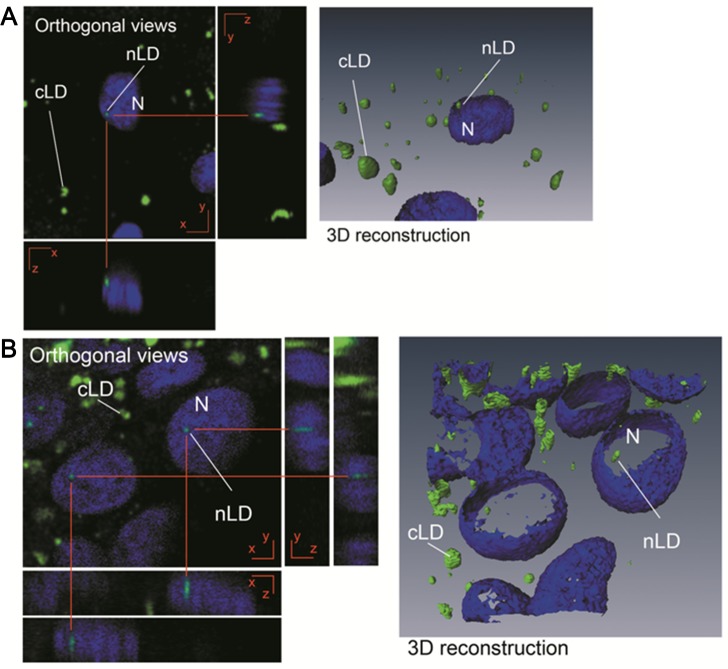
Neutral lipids-involved in many cellular processes-are stored as lipid droplets (LD), those mainly cytosolic (cLD) along with a small nuclear population (nLD). nLD could be involved in nuclear-lipid homeostasis serving as an endonuclear buffering system that would provide or incorporate lipids and proteins involved in signalling pathways as transcription factors and as enzymes of lipid metabolism and nuclear processes. Our aim was to determine if nLD constituted a dynamic domain. Oleic-acid (OA) added to rat hepatocytes or HepG2 cells in culture produced cellular-phenotypic LD modifications: increases in TAG, CE, C, and PL content and in cLD and nLD numbers and sizes. LD increments were reversed on exclusion of OA and were prevented by inhibition of acyl-CoA synthetase (with Triacsin C) and thus lipid biosynthesis. Under all conditions, nLD corresponded to a small population (2-10%) of total cellular LD. The anabolism triggered by OA, involving morphologic and size changes within the cLD and nLD populations, was reversed by a net balance of catabolism, upon eliminating OA. These catabolic processes included lipolysis and the mobilization of hydrolyzed FA from the LD to cytosolic-oxidation sites. These results would imply that nLD are actively involved in nuclear processes that include lipids. In conclusion, nLD are a dynamic nuclear domain since they are modified by OA through a reversible mechanism in combination with cLD; this process involves acyl-CoA-synthetase activity; ongoing TAG, CE, and PL biosynthesis. Thus, liver nLD and cLD are both dynamic cellular organelles.
参与许多细胞过程的中性脂质以脂滴(LD)的形式储存,其中主要是胞质脂滴(cLD)以及少量的核脂滴(nLD)。nLD可能参与核脂质稳态,作为一种核内缓冲系统,它可以提供或整合参与信号通路的脂质和蛋白质,如转录因子以及脂质代谢和核过程的酶。我们的目的是确定nLD是否构成一个动态区域。向培养的大鼠肝细胞或HepG2细胞中添加油酸(OA)会导致细胞表型脂滴发生改变:甘油三酯(TAG)、胆固醇酯(CE)、胆固醇(C)和磷脂(PL)含量增加,cLD和nLD的数量及大小增加。排除OA后,脂滴的增加会逆转,并且通过抑制酰基辅酶A合成酶(使用三辛脂酰基肉碱C)从而抑制脂质生物合成可防止这种增加。在所有条件下,nLD占细胞总脂滴的一小部分(2 - 10%)。OA引发的合成代谢,涉及cLD和nLD群体内的形态和大小变化,在去除OA后,通过分解代谢的净平衡而逆转。这些分解代谢过程包括脂解作用以及水解脂肪酸从脂滴向胞质氧化位点的转运。这些结果表明nLD积极参与包括脂质在内的核过程。总之,nLD是一个动态的核区域,因为它们通过与cLD结合的可逆机制被OA修饰;这个过程涉及酰基辅酶A合成酶活性、持续的TAG、CE和PL生物合成。因此,肝脏中的nLD和cLD都是动态的细胞器。