Xiao Linlin, Liu Ning, Zhang Guifang, Zhang Hui, Gao Song, Fu Zheng, Wang Suzhen, Yu Qingxi, Yu Jinming, Yuan Shuanghu
School of Medicine and Life Sciences, University of Jinan-Shandong Academy of Medical Sciences, Jinan, Shandong, China.
Department of Radiation Oncology, Shandong Cancer Hospital affiliated to Shandong University, Jinan, Shandong, China.
PLoS One. 2017 Jan 26;12(1):e0170901. doi: 10.1371/journal.pone.0170901. eCollection 2017.
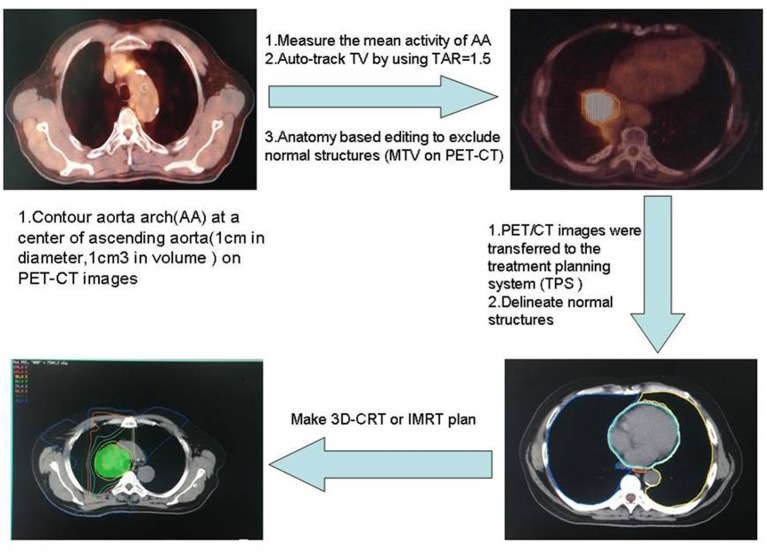
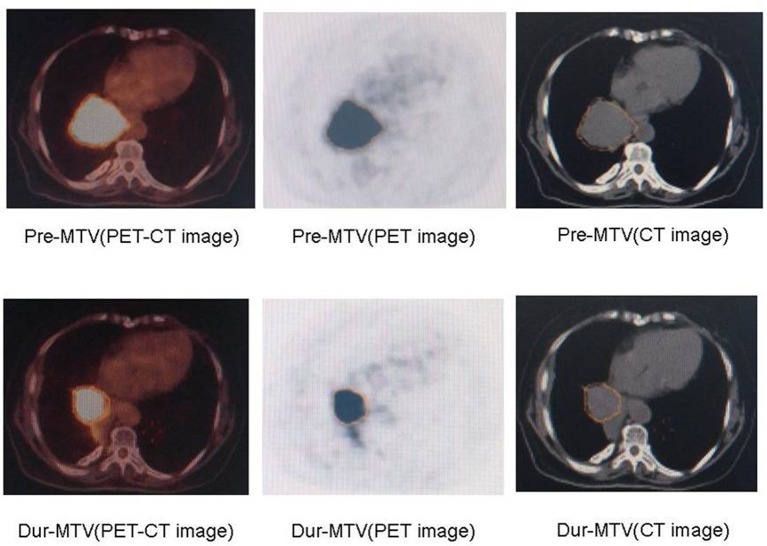
To reduce the high risk of radiation toxicity and enhance the quality of life of patients with non-small cell lung cancer (NSCLC), we quantified the metabolic tumor volumes (MTVs) from baseline to the late-course of radiotherapy (RT) by fluorodeoxyglucose positron emission tomography computerized tomography (FDG PET-CT) and discussed the potential benefit of late-course adaptive plans rather than original plans by dose volume histogram (DVH) comparisons. Seventeen patients with stage II-III NSCLC who were treated with definitive conventionally fractionated RT were eligible for this prospective study. FDG PET-CT scans were acquired within 1 week before RT (pre-RT) and at approximately two-thirds of the total dose during-RT (approximately 40 Gy). MTVs were taken as gross tumor volumes (GTVs) that included the primary tumor and any involved hilar or mediastinal lymph nodes. An original plan based on the baseline MTVs and adaptive plans based on observations during-RT MTVs were generated for each patient. The DVHs for lung, heart, esophagus and spinal cord were compared between the original plans and composite plans at 66 Gy. At the time of approximately 40 Gy during-RT, MTVs were significantly reduced in patients with NSCLC (pre-RT 136.2±82.3 ml vs. during-RT 64.7±68.0 ml, p = 0.001). The composite plan of the original plan at 40 Gy plus the adaptive plan at 26 Gy resulted in better DVHs for all the organs at risk that were evaluated compared to the original plan at 66 Gy (p<0.05), including V5, V10, V15, V20, V25, V30 and the mean dose of total lung, V10, V20, V30, V40, V50, V60 and the mean dose of heart, V35, V40, V50, V55, V60, the maximum dose and mean dose of the esophagus, and the maximum dose of the spinal-cord. PET-MTVs were reduced significantly at the time of approximately 40 Gy during-RT. Late course adaptive radiotherapy may be an effective way to reduce the dose volume to the organs at risk, thus reducing radiation toxicity in patients with NSCLC.
为降低非小细胞肺癌(NSCLC)患者发生放射性毒性的高风险并提高其生活质量,我们通过氟脱氧葡萄糖正电子发射断层扫描计算机断层扫描(FDG PET-CT)对从基线到放疗(RT)后期的代谢肿瘤体积(MTV)进行了量化,并通过剂量体积直方图(DVH)比较讨论了后期自适应计划而非原始计划的潜在益处。17例接受根治性常规分割放疗的II-III期NSCLC患者符合这项前瞻性研究的条件。在放疗前1周内(放疗前)以及放疗期间总剂量的大约三分之二时(约40 Gy)进行FDG PET-CT扫描。MTV被视为包括原发性肿瘤以及任何受累肺门或纵隔淋巴结的大体肿瘤体积(GTV)。为每位患者制定基于基线MTV的原始计划以及基于放疗期间MTV观察结果的自适应计划。比较了原始计划和66 Gy时的综合计划中肺、心脏、食管和脊髓的DVH。在放疗期间约40 Gy时,NSCLC患者的MTV显著减小(放疗前136.2±82.3 ml vs.放疗期间64.7±68.0 ml,p = 0.001)。40 Gy时的原始计划加26 Gy时的自适应计划组成的综合计划,与66 Gy时的原始计划相比,所有评估的危及器官的DVH更好(p<0.05),包括V5、V10、V15、V20、V25、V30以及全肺的平均剂量、V10、V20、V30、V40、V50、V60以及心脏的平均剂量、V35、V40、V50、V55、V60、食管的最大剂量和平均剂量以及脊髓的最大剂量。在放疗期间约40 Gy时,PET-MTV显著减小。后期自适应放疗可能是一种有效方法,可减少危及器官的剂量体积,从而降低NSCLC患者的放射性毒性。