Wang Nan, Qiao Yun, Song Yingqiu, Wang Zheng, Li Xia, Liu Chengsen, Wang Ye, Wu Yu, He Rong, Wang Chenyu, Ren Yangwu, Li Guang, Wang Tianlu
Department of Radiotherapy, Liaoning Cancer Hospital & Institute, Cancer Hospital of China Medical University, Shenyang, China.
Department of Surgery, Liaoning Cancer Hospital & Institute, Cancer Hospital of China Medical University, Shenyang, China.
Front Oncol. 2022 Jul 28;12:898233. doi: 10.3389/fonc.2022.898233. eCollection 2022.
Tumor related atelectasis(TRA) is an essential factor affecting survival that can cause chest pain, cough, hemoptysis, chest tightness, dyspnea, and even death. In the current study, we explored the possible impact of TRA on survival in cancer patients and the guiding significance of 18F-positron emission tomography/computed(PET/CT) in radiotherapy for patients with atelectasis tumors.
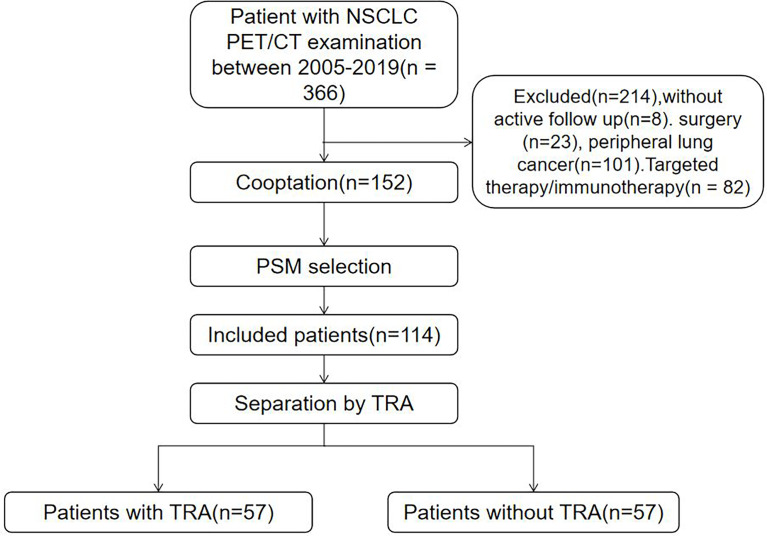
In this retrospective study, we analyzed the treatment model and survival of patients with centrally located non-small cell lung cancer(NSCLC) treated with radiotherapy at two medical centers between May 2005 and August 2019. We identified 152 eligible patients and used propensity score matching (1:1) to process the data to reduce confounding factors, data bias, and mal-distribution.
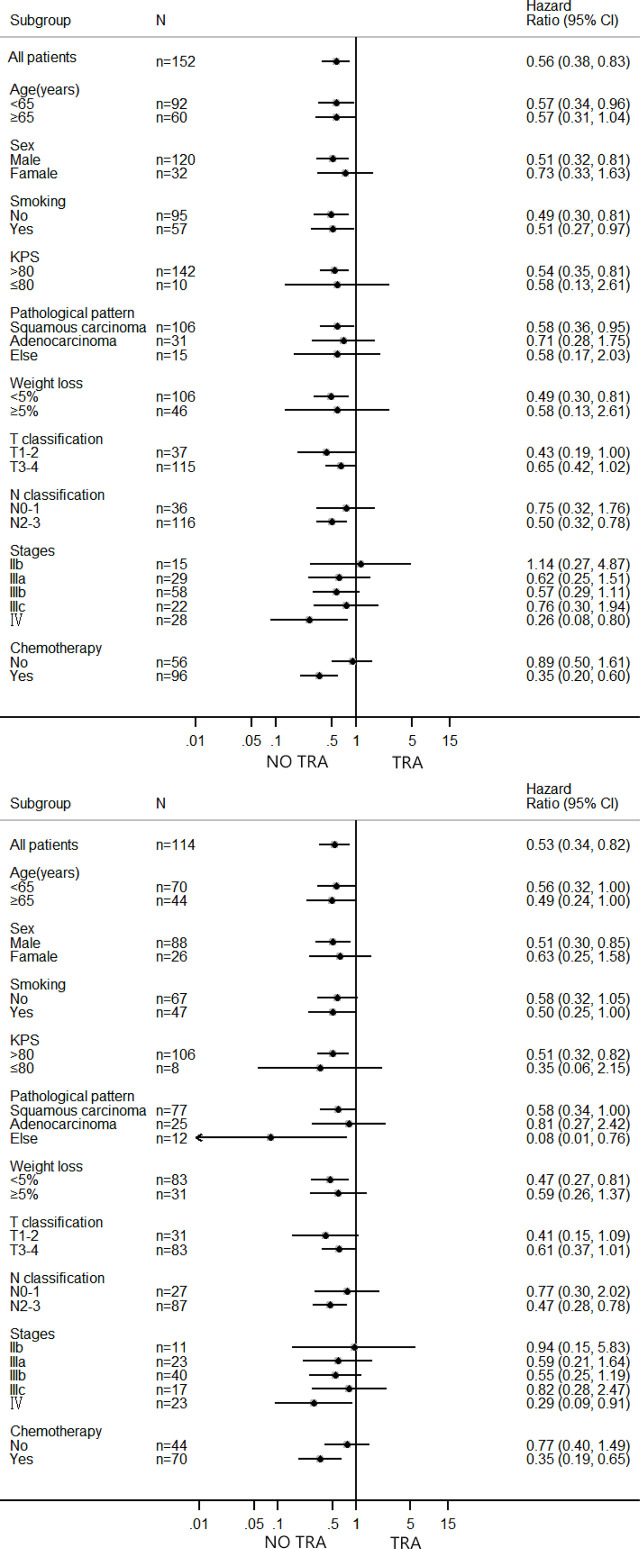
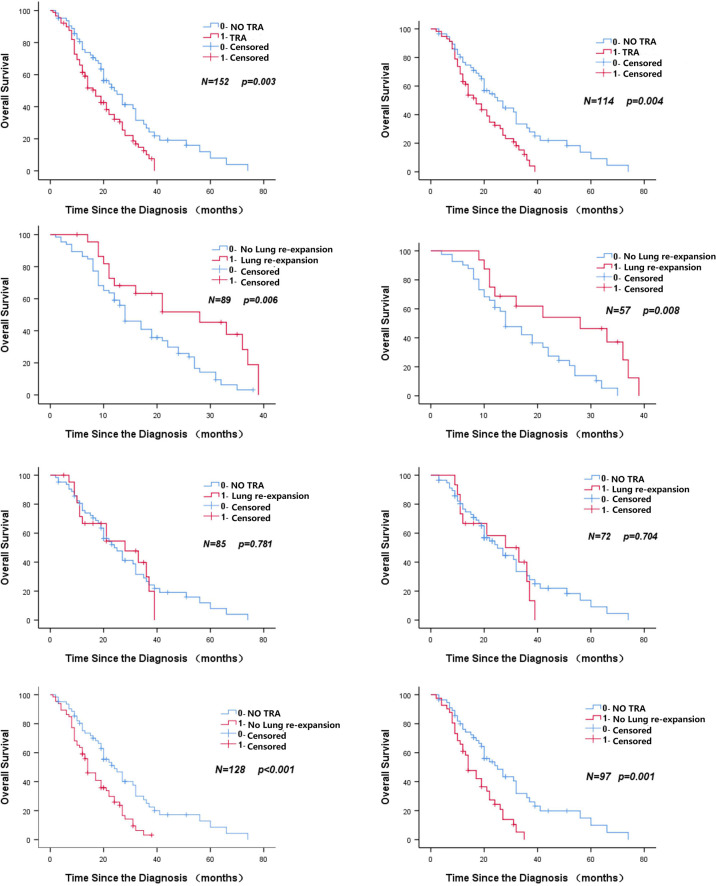
We used propensity scores created well-matched groups of 57 patients overall with or without TRA. The one-year survival rate of all patients was 71.9%, and the two-year survival rate was 33.3%. Compared to the atelectasis group, the overall survival (OS) of patients in the non-atelectasis group was significantly prolonged (25 months vs. 17 months, p = 0.004), as well as in the atelectasis recovery group (28 months vs. 14 months, p = 0.008). In multivariate analysis, non-atelectasis was closely correlated with favorable OS (HR, 1.804 (-2.840); 95% CI, 1.145-2.840; p = 0.011).
PET/CT can accurately stage NSCLC and better guide the treatment of NSCLC complicated with atelectasis. Tumor-associated atelectasis in patients with centrally located NSCLC can lead to is a poor prognostic marker.
肿瘤相关性肺不张(TRA)是影响生存的重要因素,可导致胸痛、咳嗽、咯血、胸闷、呼吸困难,甚至死亡。在本研究中,我们探讨了TRA对癌症患者生存的可能影响以及18F-正电子发射断层扫描/计算机断层扫描(PET/CT)在肺不张肿瘤患者放疗中的指导意义。
在这项回顾性研究中,我们分析了2005年5月至2019年8月期间在两个医疗中心接受放疗的中央型非小细胞肺癌(NSCLC)患者的治疗模式和生存情况。我们确定了152例符合条件的患者,并使用倾向得分匹配(1:1)来处理数据,以减少混杂因素、数据偏差和分布不均。
我们使用倾向得分创建了总体上57例有或无TRA的匹配良好的组。所有患者的一年生存率为71.9%,两年生存率为33.3%。与肺不张组相比,非肺不张组患者的总生存期(OS)显著延长(25个月对17个月,p = 0.004),肺不张恢复组也是如此(28个月对14个月,p = 0.008)。在多变量分析中,非肺不张与良好的OS密切相关(HR,1.804(-2.840);95%CI,1.145 - 2.840;p = 0.011)。
PET/CT可以准确地对NSCLC进行分期,并更好地指导合并肺不张的NSCLC的治疗。中央型NSCLC患者的肿瘤相关性肺不张可导致预后不良。