White Matthew J, Beaver Charlotte M, Goodier Martin R, Bottomley Christian, Nielsen Carolyn M, Wolf Asia-Sophia F M, Boldrin Luisa, Whitmore Charlotte, Morgan Jennifer, Pearce Daniel J, Riley Eleanor M
Department of Immunology and Infection, London School of Hygiene and Tropical Medicine , London , UK.
UCL Institute of Healthy Ageing, University College London , London , UK.
Front Immunol. 2017 Jan 12;7:667. doi: 10.3389/fimmu.2016.00667. eCollection 2016.
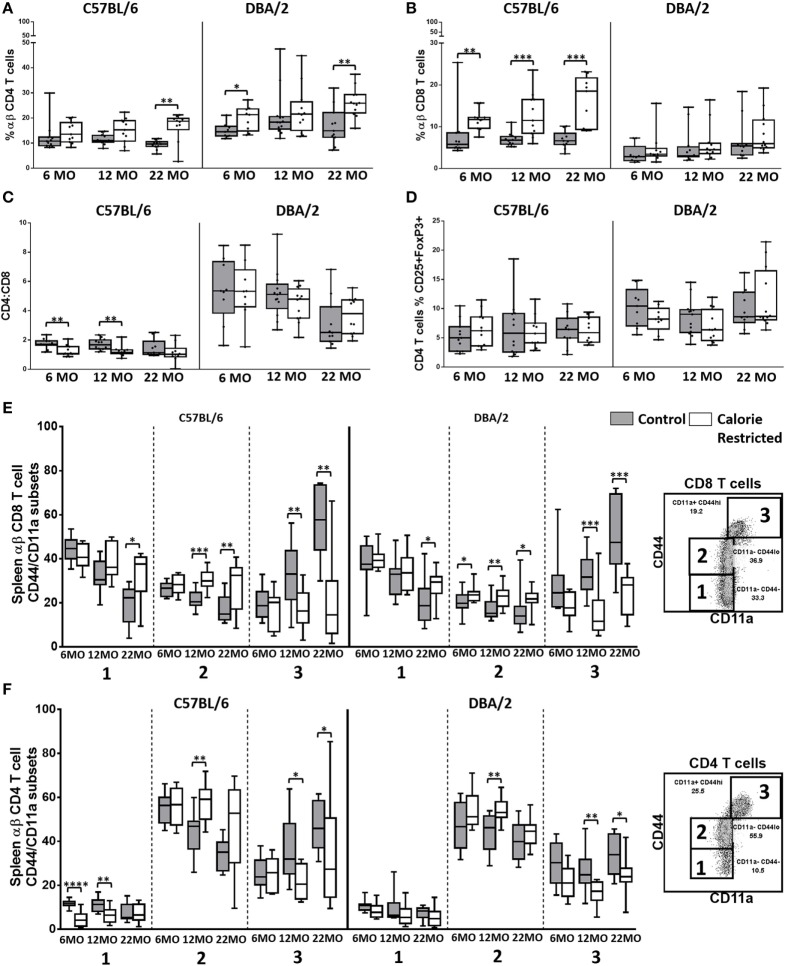
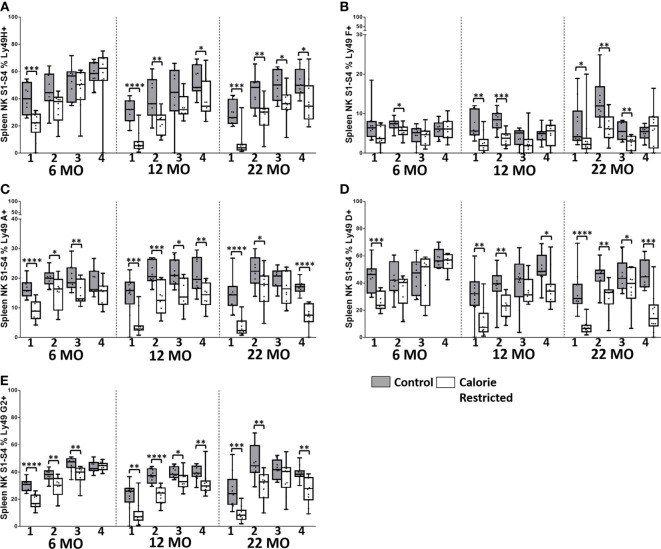
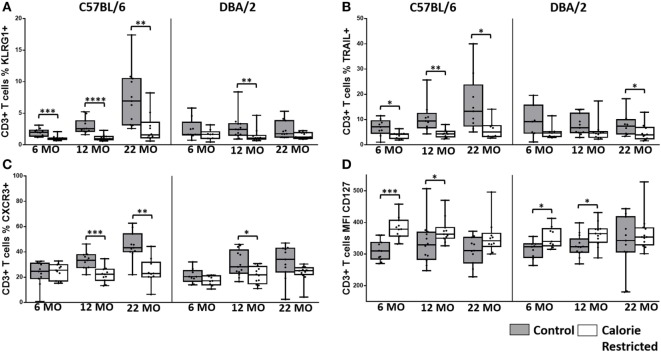
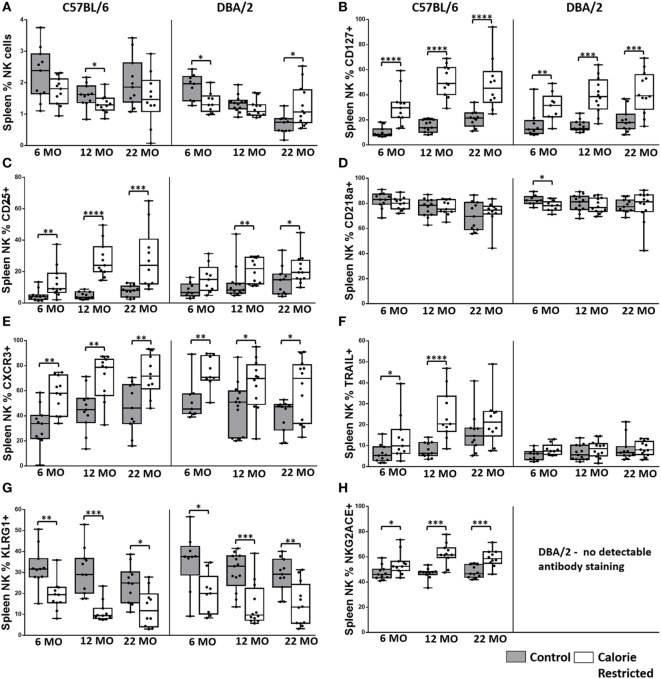
Immune senescence is a natural consequence of aging and may contribute to frailty and loss of homeostasis in later life. Calorie restriction increases healthy life-span in C57BL/6J (but not DBA/2J) mice, but whether this is related to preservation of immune function, and how it interacts with aging, is unclear. We compared phenotypic and functional characteristics of natural killer (NK) cells and T cells, across the lifespan, of calorie-restricted (CR) and control C57BL/6 and DBA/2 mice. Calorie restriction preserves a naïve T cell phenotype and an immature NK cell phenotype as mice age. The splenic T cell populations of CR mice had higher proportions of CD11aCD44 cells, lower expression of TRAIL, KLRG1, and CXCR3, and higher expression of CD127, compared to control mice. Similarly, splenic NK cells from CR mice had higher proportions of less differentiated CD11bCD27 cells and correspondingly lower proportions of highly differentiated CD11bCD27NK cells. Within each of these subsets, cells from CR mice had higher expression of CD127, CD25, TRAIL, NKG2A/C/E, and CXCR3 and lower expression of KLRG1 and Ly49 receptors compared to controls. The effects of calorie restriction on lymphoid cell populations in lung, liver, and lymph nodes were identical to those seen in the spleen, indicating that this is a system-wide effect. The impact of calorie restriction on NK cell and T cell maturation is much more profound than the effect of aging and, indeed, calorie restriction attenuates these age-associated changes. Importantly, the effects of calorie restriction on lymphocyte maturation were more marked in C57BL/6 than in DBA/2J mice indicating that delayed lymphocyte maturation correlates with extended lifespan. These findings have implications for understanding the interaction between nutritional status, immunity, and healthy lifespan in aging populations.
免疫衰老乃是衰老的自然结果,可能致使晚年出现身体虚弱及内环境稳态丧失的情况。热量限制可延长C57BL/6J(而非DBA/2J)小鼠的健康寿命,但这是否与免疫功能的维持相关,以及它如何与衰老相互作用,目前尚不清楚。我们比较了热量限制(CR)组和对照组的C57BL/6及DBA/2小鼠在整个生命周期中自然杀伤(NK)细胞和T细胞的表型及功能特征。随着小鼠年龄增长,热量限制可维持幼稚T细胞表型和未成熟NK细胞表型。与对照小鼠相比,CR小鼠的脾脏T细胞群体中CD11aCD44细胞比例更高,TRAIL、KLRG1和CXCR3的表达更低,而CD127的表达更高。同样,CR小鼠脾脏中的NK细胞中,分化程度较低的CD11bCD27细胞比例更高,而高度分化的CD11bCD27NK细胞比例相应更低。在这些亚群中的每一个亚群内,与对照组相比,CR小鼠的细胞CD127、CD25、TRAIL、NKG2A/C/E和CXCR3的表达更高,而KLRG1和Ly49受体的表达更低。热量限制对肺、肝和淋巴结中淋巴细胞群体的影响与在脾脏中观察到的相同,表明这是一种全身性效应。热量限制对NK细胞和T细胞成熟的影响比衰老的影响更为深远,实际上,热量限制减弱了这些与年龄相关的变化。重要的是,热量限制对淋巴细胞成熟的影响在C57BL/6小鼠中比在DBA/2J小鼠中更为显著,表明淋巴细胞成熟延迟与寿命延长相关。这些发现对于理解老年人群中营养状况、免疫和健康寿命之间的相互作用具有重要意义。