Booij Ronald, Dijkshoorn Marcel L, van Straten Marcel
Department of Radiology and Nuclear Medicine, Erasmus MC, P.O. Box 2240, 3000 CA, Rotterdam, The Netherlands.
Eur Radiol. 2017 Sep;27(9):3618-3624. doi: 10.1007/s00330-017-4745-8. Epub 2017 Jan 26.
The purpose of this study was to assess the efficacy of the renewed dynamic collimator in a third-generation dual source CT (DSCT) scanner and to determine the improvements over the second-generation scanner.
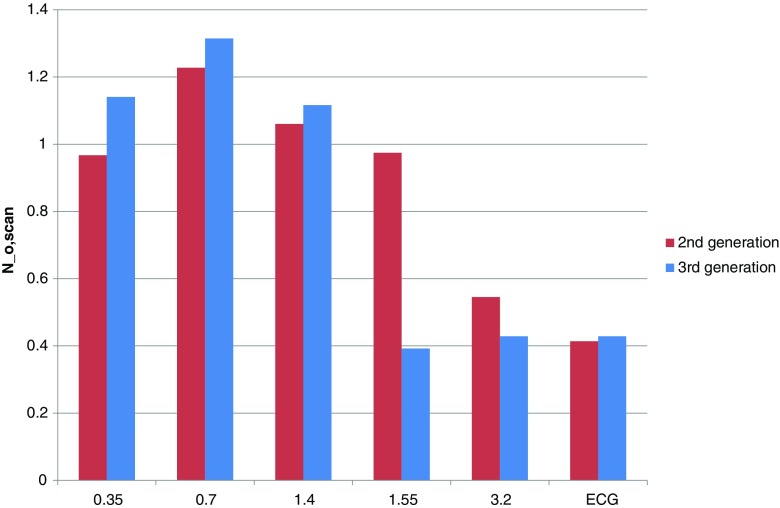
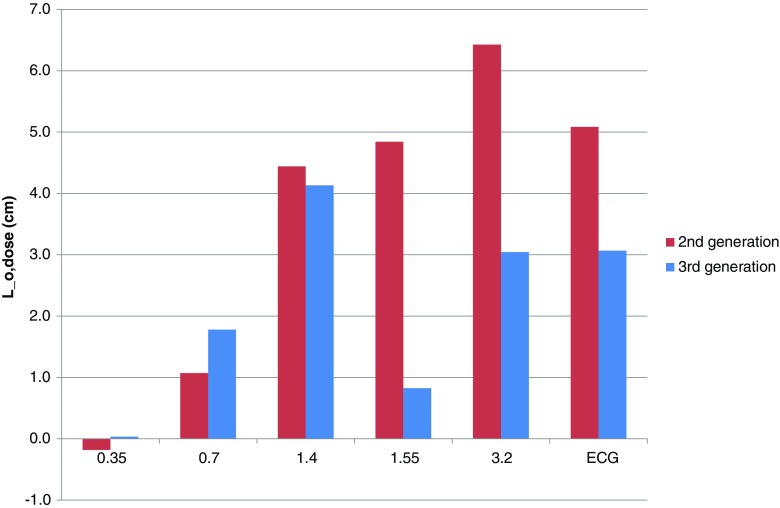
Collimator efficacy is defined as the percentage overranging dose in terms of dose-length product (DLP) that is blocked by the dynamic collimator relative to the total overranging dose in case of a static collimator. Efficacy was assessed at various pitch values and different scan lengths. The number of additional rotations due to overranging and effective scan length were calculated on the basis of reported scanning parameters. On the basis of these values, the efficacy of the collimator was calculated.
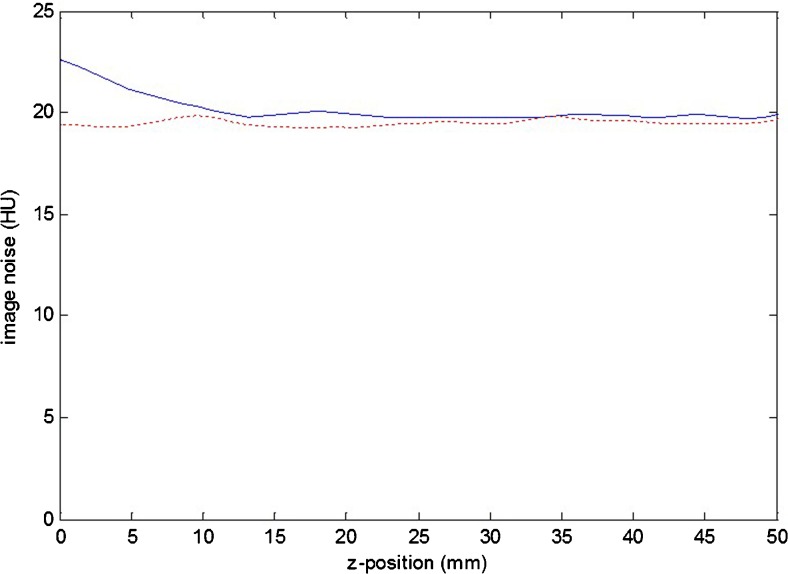
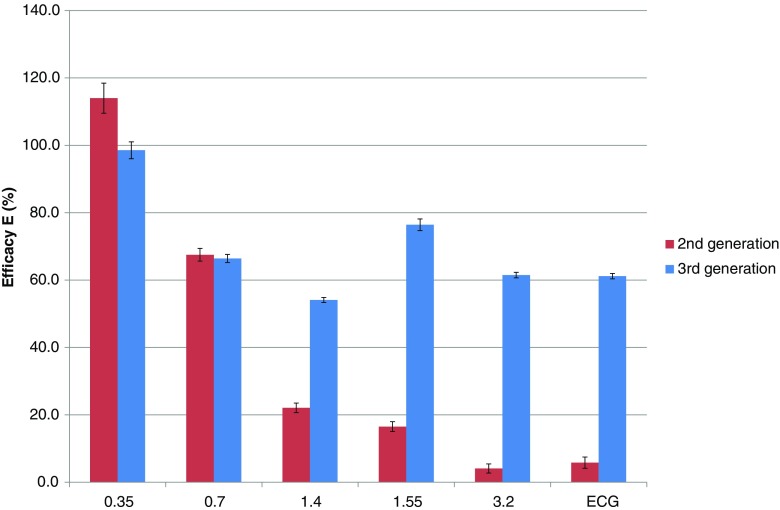
The second-generation scanner showed decreased performance of the dynamic collimator at increasing pitch. Efficacy dropped to 10% at the highest pitch. For the third-generation scanner the efficacy remained above 50% at higher pitch. Noise was for some pitch values slightly higher at the edge of the imaged volume, indicating a reduced scan range to reduce the overranging dose.
The improved dynamic collimator in the third-generation scanner blocks the overranging dose for more than 50% and is more capable of shielding radiation dose, especially in high pitch scan modes.
• Overranging dose is to a large extent blocked by the dynamic collimator • Efficacy is strongly improved within the third-generation DSCT scanner • Reducing the number of additional rotations can reduce overranging with increased noise.
本研究旨在评估第三代双源CT(DSCT)扫描仪中更新后的动态准直器的效能,并确定其相对于第二代扫描仪的改进之处。
准直器效能定义为动态准直器阻挡的超出范围剂量(以剂量长度乘积(DLP)计)相对于静态准直器情况下总超出范围剂量的百分比。在不同的螺距值和不同的扫描长度下评估效能。根据报告的扫描参数计算由于超出范围和有效扫描长度导致的额外旋转次数。基于这些值计算准直器的效能。
第二代扫描仪显示,随着螺距增加,动态准直器的性能下降。在最高螺距时,效能降至10%。对于第三代扫描仪,在较高螺距下效能仍保持在50%以上。在成像容积边缘,某些螺距值下的噪声略高,这表明扫描范围减小以降低超出范围剂量。
第三代扫描仪中改进后的动态准直器可阻挡超过50%的超出范围剂量,并且更有能力屏蔽辐射剂量,尤其是在高螺距扫描模式下。
• 超出范围剂量在很大程度上被动态准直器阻挡 • 第三代DSCT扫描仪内效能有显著提高 • 减少额外旋转次数可减少超出范围剂量,但会增加噪声。