Ruepp Marc-David, Wei Hao, Leuenberger Michele, Lochner Martin, Thompson Andrew J
Department of Chemistry and Biochemistry, University of Bern, Bern, Switzerland.
Department of Pharmacology, University of Cambridge, Cambridge, UK.
Neuropharmacology. 2017 Jun;119:48-61. doi: 10.1016/j.neuropharm.2017.01.023. Epub 2017 Jan 27.
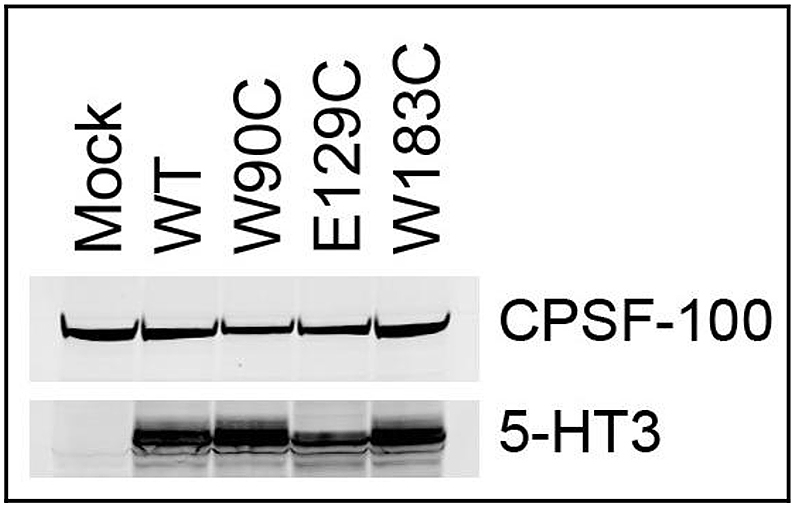
Crystal structures can identify ligand-receptor interactions and assist the development of novel therapeutics, but experimental challenges sometimes necessitate the use of homologous proteins. Tropisetron is an orthosteric ligand at both 5-HT and α7 nACh receptors and its binding orientation has been determined in the structural homologue AChBP (pdbid: 2WNC). Co-crystallisation with a structurally-related ligand, granisetron, reveals an almost identical orientation (pdbid; 2YME). However, there is a >1000-fold difference in the affinity of tropisetron at 5-HT versus α7 nACh receptors, and α7 nACh receptors do not bind granisetron. These striking pharmacological differences prompt questions about which receptor the crystal structures most closely represent and whether the ligand orientations are correct. Here we probe the binding orientation of tropisetron and granisetron at 5-HT receptors by in silico modelling and docking, radioligand binding on cysteine-substituted 5-HT receptor mutants transiently expressed in HEK 293 cells, and synthetic modification of the ligands. For 15 of the 23 cysteine substitutions, the effects on tropisetron and granisetron were different. Structure-activity relationships on synthesised derivatives of both ligands were also consistent with different orientations, revealing that contrary to the crystallographic evidence from AChBP, the two ligands adopt different orientations in the 5-HT receptor binding site. Our results show that even quite structurally similar molecules can adopt different orientations in the same binding site, and that caution may be needed when using homologous proteins to predict ligand binding.
晶体结构能够识别配体 - 受体相互作用,并有助于新型疗法的开发,但实验挑战有时需要使用同源蛋白。托烷司琼是5 - HT和α7烟碱型乙酰胆碱受体(nACh受体)的正构配体,其结合方向已在结构同源物乙酰胆碱结合蛋白(AChBP,蛋白质数据银行编号:2WNC)中确定。与结构相关的配体格拉司琼共结晶显示出几乎相同的方向(蛋白质数据银行编号;2YME)。然而,托烷司琼对5 - HT受体和α7 nACh受体的亲和力存在>1000倍的差异,并且α7 nACh受体不结合格拉司琼。这些显著的药理学差异引发了关于晶体结构最接近代表哪种受体以及配体方向是否正确的问题。在这里,我们通过计算机模拟和对接、在HEK 293细胞中瞬时表达的半胱氨酸取代的5 - HT受体突变体上的放射性配体结合以及配体的合成修饰,探究托烷司琼和格拉司琼在5 - HT受体上的结合方向。对于23个半胱氨酸取代中的15个,对托烷司琼和格拉司琼的影响是不同的。两种配体合成衍生物的构效关系也与不同方向一致,这表明与来自AChBP的晶体学证据相反,这两种配体在5 - HT受体结合位点采用不同的方向。我们的结果表明,即使是结构相当相似的分子也可以在同一结合位点采用不同的方向,并且在使用同源蛋白预测配体结合时可能需要谨慎。