Harrison Odile B, Cole Kevin, Peters Joanna, Cresswell Fiona, Dean Gillian, Eyre David W, Paul John, Maiden Martin Cj
Department of Zoology, University of Oxford, Oxford, UK.
Brighton and Sussex University Hospitals NHS Trust, Brighton, UK.
Sex Transm Infect. 2017 Sep;93(6):445-451. doi: 10.1136/sextrans-2016-052781. Epub 2017 Jan 30.
Invasive meningococcal disease (IMD) outbreaks in men who have sex with men (MSM) have been associated with meningococcal colonisation of the urethra and rectum, but little is known about this colonisation or co-colonisation with the closely related gonococcus. Whole genome sequencing (WGS) was employed to explore these phenomena.
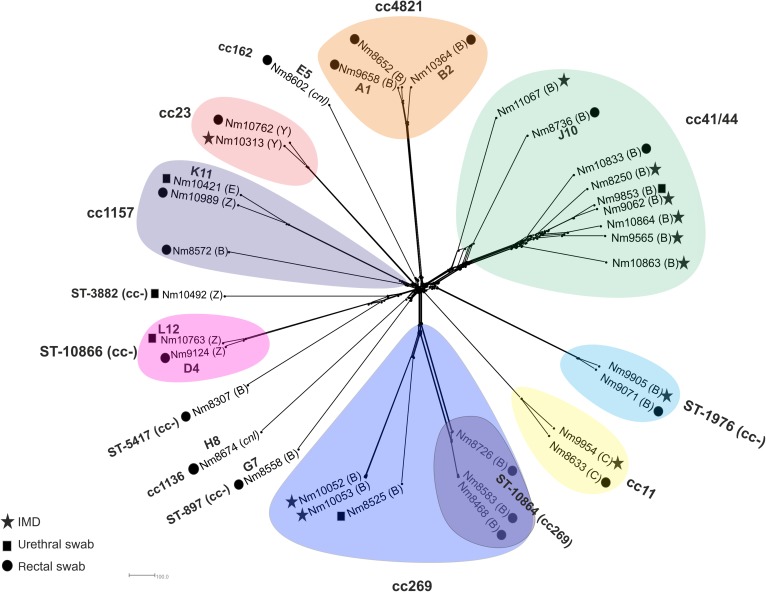
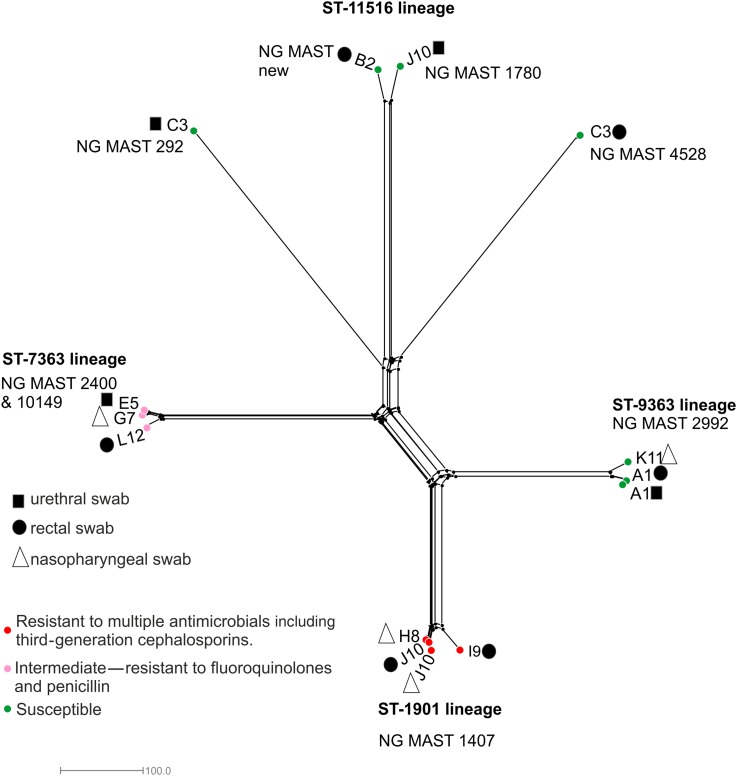
Meningococci isolated from the urogenital tract and rectum (n=23) and coincident gonococci (n=14) were analysed by WGS along with contemporary meningococci from IMD (n=11). All isolates were obtained from hospital admissions in Brighton, UK, 2011-2013. Assembled WGS were deposited in the PubMLST/neisseria database (http://pubmlst.org/neisseria) and compared at genomic loci common to gonococci or meningococci.
As expected, most meningococci from IMD were encapsulated and belonged to hyperinvasive lineages. So too were meningococci found in the urogenital tract and rectum, contrasting to those asymptomatically carried in the nasopharynx where such meningococci are rare. Five hyperinvasive meningococcal lineages and four distinct gonococcal genotypes were recovered, including multiresistant ST-1901 (NG MAST-1407) gonococci.
These data were consistent with a predisposition for potentially virulent encapsulated hyperinvasive meningococci to colonise the urethra and rectum, which suggests their involvement in MSM IMD outbreaks. The coincidence of multiresistant gonococci raises wider public health concerns.
男男性行为者(MSM)中侵袭性脑膜炎球菌病(IMD)暴发与尿道和直肠的脑膜炎球菌定植有关,但对于这种定植或与密切相关的淋球菌的共同定植知之甚少。采用全基因组测序(WGS)来探究这些现象。
对从泌尿生殖道和直肠分离出的脑膜炎球菌(n = 23)以及同时分离出的淋球菌(n = 14)进行WGS分析,并与来自IMD的当代脑膜炎球菌(n = 11)进行比较。所有分离株均取自2011 - 2013年英国布莱顿医院收治的患者。组装好的WGS序列存入PubMLST/奈瑟菌数据库(http://pubmlst.org/neisseria),并在淋球菌或脑膜炎球菌共有的基因组位点进行比较。
正如预期的那样,大多数来自IMD的脑膜炎球菌具有荚膜,属于高侵袭性谱系。在泌尿生殖道和直肠中发现的脑膜炎球菌也是如此,这与在鼻咽部无症状携带的脑膜炎球菌形成对比,后者此类脑膜炎球菌较为罕见。共发现了5个高侵袭性脑膜炎球菌谱系和4种不同的淋球菌基因型,包括多重耐药的ST - 1901(NG MAST - 1407)淋球菌。
这些数据表明,具有潜在毒性的荚膜高侵袭性脑膜炎球菌易于定植在尿道和直肠,这表明它们与MSM的IMD暴发有关。多重耐药淋球菌的同时存在引发了更广泛的公共卫生问题。