Dankbaar Mary E W, Richters Olivier, Kalkman Cor J, Prins Gerrie, Ten Cate Olle T J, van Merrienboer Jeroen J G, Schuit Stephanie C E
Institute of Medical Education Research, Erasmus University Medical Center, PO Box 2040, 3000, CA, Rotterdam, The Netherlands.
Faculty of Business Informatics, University of Utrecht, Utrecht, The Netherlands.
BMC Med Educ. 2017 Feb 2;17(1):30. doi: 10.1186/s12909-016-0836-5.
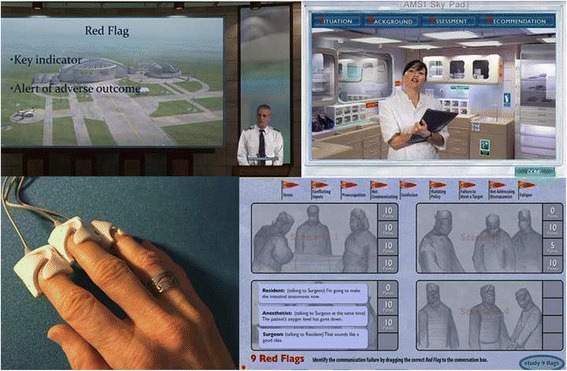
Serious games have the potential to teach complex cognitive skills in an engaging way, at relatively low costs. Their flexibility in use and scalability makes them an attractive learning tool, but more research is needed on the effectiveness of serious games compared to more traditional formats such e-modules. We investigated whether undergraduate medical students developed better knowledge and awareness and were more motivated after learning about patient-safety through a serious game than peers who studied the same topics using an e-module.
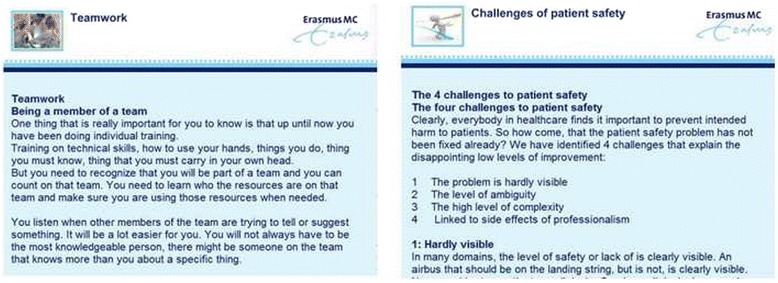
Fourth-year medical students were randomly assigned to either a serious game that included video-lectures, biofeedback exercises and patient missions (n = 32) or an e-module, that included text-based lectures on the same topics (n = 34). A third group acted as a historical control-group without extra education (n = 37). After the intervention, which took place during the clinical introduction course, before the start of the first rotation, all students completed a knowledge test, a self-efficacy test and a motivation questionnaire. During the following 10-week clinical rotation they filled out weekly questionnaires on patient-safety awareness and stress.
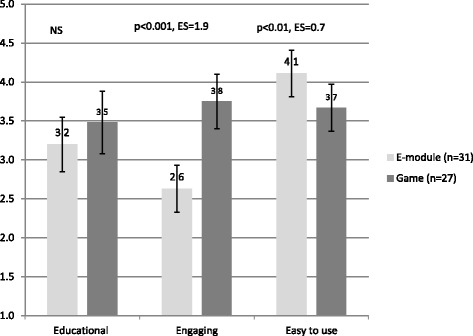
The results showed patient safety knowledge had equally improved in the game group and e-module group compared to controls, who received no extra education. Average learning-time was 3 h for the game and 1 h for the e-module-group. The serious game was evaluated as more engaging; the e-module as more easy to use. During rotations, students in the three groups reported low and similar levels of patient-safety awareness and stress. Students who had treated patients successfully during game missions experienced higher self-efficacy and less stress during their rotation than students who treated patients unsuccessfully.
Video-lectures (in a game) and text-based lectures (in an e-module) can be equally effective in developing knowledge on specific topics. Although serious games are strongly engaging for students and stimulate them to study longer, they do not necessarily result in better performance in patient safety issues.
严肃游戏有潜力以一种引人入胜的方式教授复杂的认知技能,且成本相对较低。它们在使用上的灵活性和可扩展性使其成为一种有吸引力的学习工具,但与电子模块等更传统的形式相比,严肃游戏的有效性还需要更多研究。我们调查了本科医学生通过一款严肃游戏学习患者安全知识后,与使用电子模块学习相同主题的同龄人相比,是否能获得更好的知识和意识,以及更有学习动力。
四年级医学生被随机分为两组,一组参与一款包含视频讲座、生物反馈练习和患者任务的严肃游戏(n = 32),另一组使用包含相同主题的文本讲座的电子模块(n = 34)。第三组作为历史对照组,不接受额外教育(n = 37)。在临床入门课程期间、第一次轮转开始前进行干预后,所有学生都完成了知识测试、自我效能测试和动机问卷。在接下来的10周临床轮转期间,他们每周填写关于患者安全意识和压力的问卷。
结果显示,与未接受额外教育的对照组相比,游戏组和电子模块组的患者安全知识均有同等程度的提高。游戏组的平均学习时间为3小时,电子模块组为1小时。严肃游戏被评价为更具吸引力;电子模块则被认为更易于使用。在轮转期间,三组学生报告的患者安全意识和压力水平较低且相似。在游戏任务中成功治疗患者的学生在轮转期间的自我效能感更高,压力更小,而治疗患者不成功的学生则相反。
(游戏中的)视频讲座和(电子模块中的)文本讲座在培养特定主题的知识方面可能同样有效。尽管严肃游戏对学生极具吸引力,并促使他们学习更长时间,但它们不一定能在患者安全问题上带来更好的表现。