Majdan Marek, Brazinova Alexandra, Rusnak Martin, Leitgeb Johannes
Department of Public Health, Faculty of Health Sciences and Social Work, Trnava University, Trnava, Slovakia; International Neurotrauma Research Organization, Trnava University, 1090 Vienna, Austria.
Department of Public Health, Faculty of Health Sciences and Social Work, Trnava University, Trnava, Slovakia.
J Neurosci Rural Pract. 2017 Jan-Mar;8(1):20-29. doi: 10.4103/0976-3147.193543.
Prognosis of outcome after traumatic brain injury (TBI) is important in the assessment of quality of care and can help improve treatment and outcome. The aim of this study was to compare the prognostic value of relatively simple injury severity scores between each other and against a gold standard model - the IMPACT-extended (IMP-E) multivariable prognostic model.
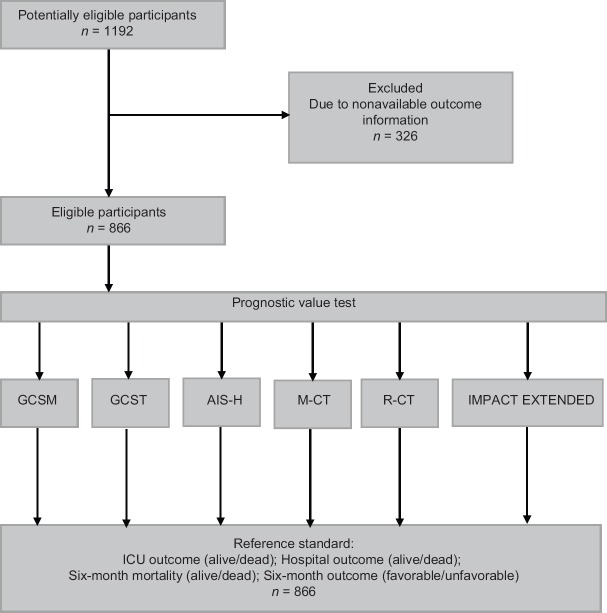
For this study, 866 patients with moderate/severe TBI from Austria were analyzed. The prognostic performances of the Glasgow coma scale (GCS), GCS motor (GCSM) score, abbreviated injury scale for the head region, Marshall computed tomographic (CT) classification, and Rotterdam CT score were compared side-by-side and against the IMP-E score. The area under the receiver operating characteristics curve (AUC) and Nagelkerke's were used to assess the prognostic performance. Outcomes at the Intensive Care Unit, at hospital discharge, and at 6 months (mortality and unfavorable outcome) were used as end-points.
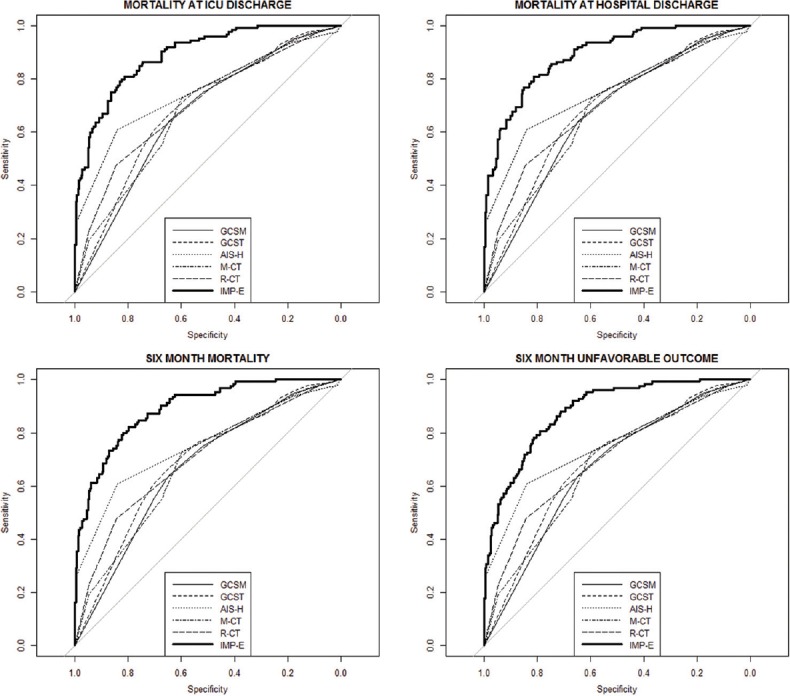
Comparing AUCs and s of the same model across four outcomes, only little variation was apparent. A similar pattern is observed when comparing the models between each other: Variation of AUCs <±0.09 and s by up to ±0.17 points suggest that all scores perform similarly in predicting outcomes at various points (AUCs: 0.65-0.77; s: 0.09-0.27). All scores performed significantly worse than the IMP-E model (with AUC > 0.83 and > 0.42 for all outcomes): AUCs were worse by 0.10-0.22 ( < 0.05) and s were worse by 0.22-0.39 points.
All tested simple scores can provide reasonably valid prognosis. However, it is confirmed that well-developed multivariable prognostic models outperform these scores significantly and should be used for prognosis in patients after TBI wherever possible.
创伤性脑损伤(TBI)后结局的预后在医疗质量评估中很重要,并且有助于改善治疗及结局。本研究的目的是比较相对简单的损伤严重程度评分之间以及与金标准模型——IMPACT扩展(IMP-E)多变量预后模型相比的预后价值。
在本研究中,分析了来自奥地利的866例中度/重度TBI患者。将格拉斯哥昏迷量表(GCS)、GCS运动(GCSM)评分、头部区域简明损伤量表、马歇尔计算机断层扫描(CT)分类以及鹿特丹CT评分的预后性能进行并列比较,并与IMP-E评分进行比较。采用受试者操作特征曲线(AUC)下面积和纳格尔克系数来评估预后性能。将重症监护病房、出院时以及6个月时的结局(死亡率和不良结局)用作终点。
比较同一模型在四种结局中的AUC和系数,仅发现微小差异。在相互比较模型时也观察到类似模式:AUC的差异<±0.09,系数差异高达±0.17分,这表明所有评分在预测不同时间点的结局时表现相似(AUC:0.65 - 0.770.77;系数:0.09 - 0.27)。所有评分的表现均显著差于IMP-E模型(所有结局的AUC>0.83,系数>0.42):AUC差0.10 - 0.二2(P<0.05),系数差0.22 - 0.39分。
所有测试的简单评分均可提供合理有效的预后。然而,已证实完善的多变量预后模型明显优于这些评分,并且应尽可能用于TBI患者的预后评估。