Department of Nephrology, The Second Affiliated Hospital of Anhui Medical University, Anhui Medical University, Hefei, People's Republic of China.
Institute of Kidney Disease, Inflammation and Immunity Mediated Diseases, The Second Affiliated Hospital of Anhui Medical University, Anhui Medical University, Hefei, People's Republic of China.
Sci Rep. 2023 Mar 30;13(1):5223. doi: 10.1038/s41598-023-32160-z.
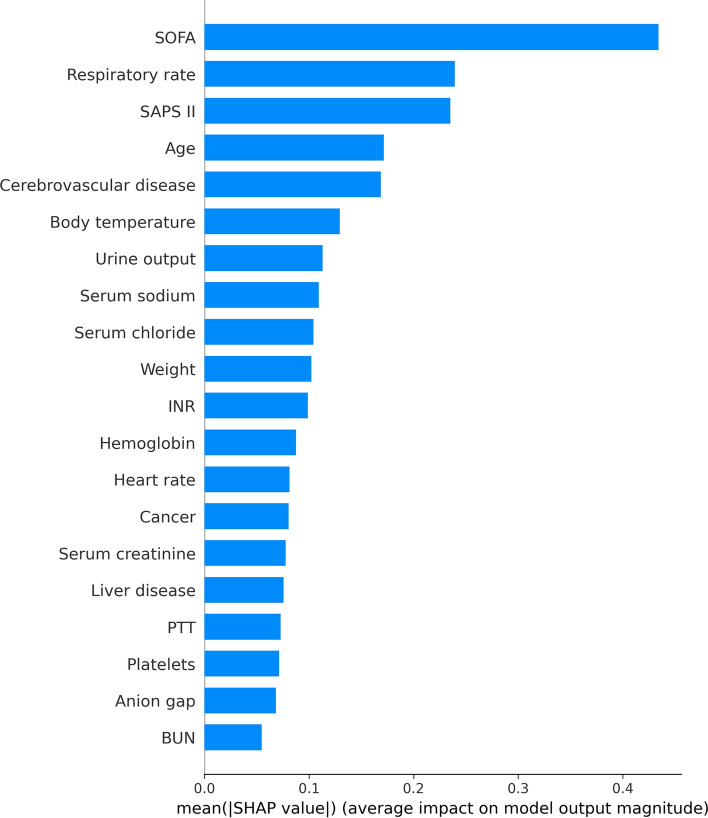
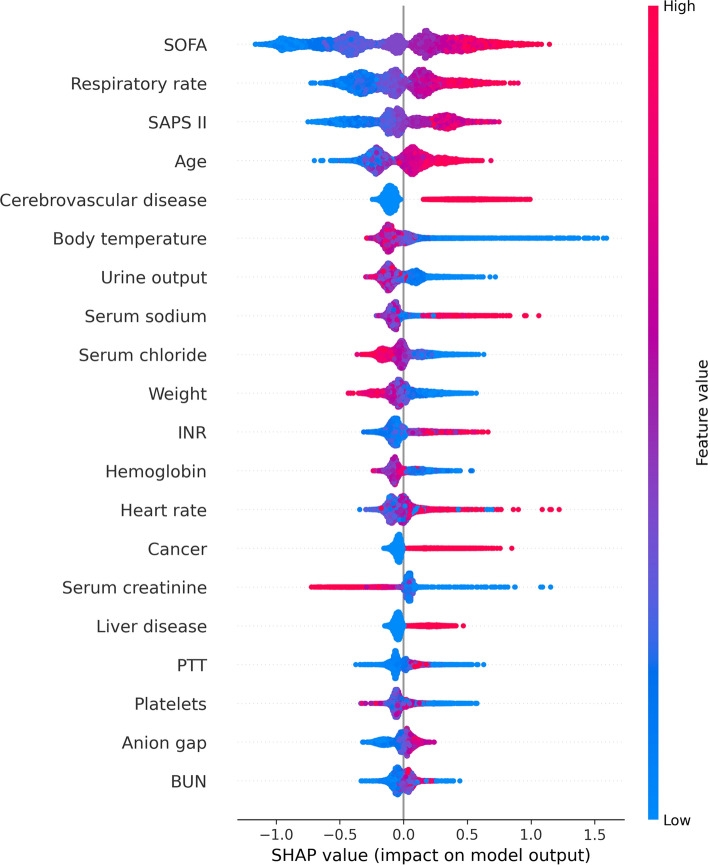
This study aimed to establish and validate a machine learning (ML) model for predicting in-hospital mortality in patients with sepsis-associated acute kidney injury (SA-AKI). This study collected data on SA-AKI patients from 2008 to 2019 using the Medical Information Mart for Intensive Care IV. After employing Lasso regression for feature selection, six ML approaches were used to build the model. The optimal model was chosen based on precision and area under curve (AUC). In addition, the best model was interpreted using SHapley Additive exPlanations (SHAP) values and Local Interpretable Model-Agnostic Explanations (LIME) algorithms. There were 8129 sepsis patients eligible for participation; the median age was 68.7 (interquartile range: 57.2-79.6) years, and 57.9% (4708/8129) were male. After selection, 24 of the 44 clinical characteristics gathered after intensive care unit admission remained linked with prognosis and were utilized developing ML models. Among the six models developed, the eXtreme Gradient Boosting (XGBoost) model had the highest AUC, at 0.794. According to the SHAP values, the sequential organ failure assessment score, respiration, simplified acute physiology score II, and age were the four most influential variables in the XGBoost model. Individualized forecasts were clarified using the LIME algorithm. We built and verified ML models that excel in early mortality risk prediction in SA-AKI and the XGBoost model performed best.
本研究旨在建立和验证用于预测脓毒症相关性急性肾损伤(SA-AKI)患者住院期间死亡率的机器学习(ML)模型。本研究使用医疗信息集市重症监护 IV 收集了 2008 年至 2019 年 SA-AKI 患者的数据。在使用 Lasso 回归进行特征选择后,使用六种 ML 方法构建模型。基于精度和曲线下面积(AUC)选择最优模型。此外,使用 SHapley Additive exPlanations (SHAP) 值和 Local Interpretable Model-Agnostic Explanations (LIME) 算法解释最佳模型。共有 8129 例脓毒症患者符合入选条件;中位年龄为 68.7(四分位距:57.2-79.6)岁,57.9%(4708/8129)为男性。入选后,从入住重症监护病房后收集的 44 项临床特征中选择了 24 项与预后相关的特征,并用于开发 ML 模型。在开发的六个模型中,极端梯度增强(XGBoost)模型的 AUC 最高,为 0.794。根据 SHAP 值,序贯器官衰竭评估评分、呼吸、简化急性生理学评分 II 和年龄是 XGBoost 模型中四个最具影响力的变量。使用 LIME 算法阐明了个体化预测。我们构建并验证了 ML 模型,在 SA-AKI 的早期死亡率预测方面表现出色,XGBoost 模型表现最佳。