Fort-Vanmeerhaeghe Azahara, Gual Gabriel, Romero-Rodriguez Daniel, Unnitha Viswanath
School of Health and Sport Sciences (EUSES), Universitat de Girona, Salt, Spain; Blanquerna Faculty of Psychology, Education Sciences and Sport (FPCEE), Universitat Ramon Llull, Barcelona, Spain.
Department of Physical Therapy, Universitat de les Illes Balears, Mallorca, Spain.
J Hum Kinet. 2016 Apr 13;50:135-143. doi: 10.1515/hukin-2015-0150. eCollection 2016 Apr 1.
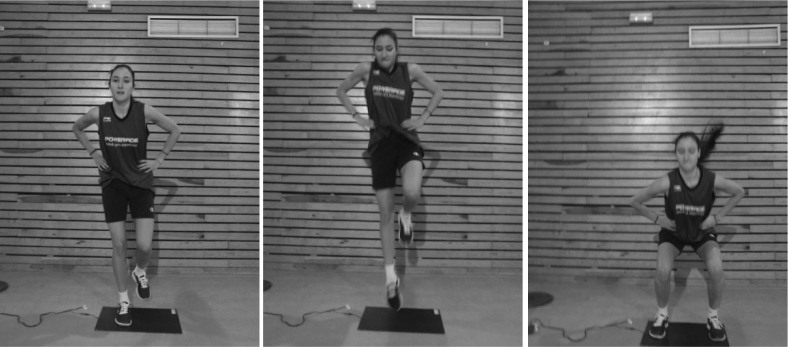
The primary objective of the present study was to evaluate the agreement between the dominant leg (DL) (determined subjectively) and the stronger leg (SL) (determined via a functional test) in a group of basketball and volleyball players. The secondary objective was to calculate lower limb neuromuscular asymmetry when comparing the DL vs the non-dominant leg (NDL) and the SL vs the weaker (WL) leg in the whole group and when differentiating by sex. Seventy-nine male and female volleyball and basketball players (age: 23.7 ± 4.5 years) performed three single-leg vertical countermovement jumps (SLVCJ) on a contact mat. Vertical jump height and an inter-limb asymmetry index (ASI) were determined. Only 32 (40%) of the subjects had a concordance between the perception of their dominant leg and the limb reaching the highest jump height. Using the DL as the discriminating variable, significant (p<0.05) inter-limb differences were found in the total group of players. When comparing between sexes, significant differences (p<0.05) arose in the female group only. With regard to the WL vs. the SL, significant (p<0.05) differences were noted in the whole group and when stratified into males and females. The mean ASI ranged from 9.31% (males) to 12.84% (females) and from 10.49% (males) to 14.26% (females), when comparing the DL vs. the NDL and the SL vs. the WL, respectively. Subjective expression of leg dominance cannot be used as a predictor of limb jump performance. Vertical jump asymmetry of 10-15% exists and this can be considered as a reference value for male and female basketball and volleyball players.
本研究的主要目的是评估一组篮球和排球运动员中,主观确定的优势腿(DL)与通过功能测试确定的较强腿(SL)之间的一致性。次要目的是在比较全组中DL与非优势腿(NDL)以及SL与较弱腿(WL)时,以及按性别区分时,计算下肢神经肌肉不对称性。79名男女排球和篮球运动员(年龄:23.7±4.5岁)在接触垫上进行了三次单腿垂直反向跳(SLVCJ)。测定了垂直跳高度和肢体间不对称指数(ASI)。只有32名(40%)受试者的优势腿感知与达到最高跳高度的肢体之间存在一致性。以DL作为区分变量,在全体运动员中发现了显著(p<0.05)的肢体间差异。在比较性别时,仅在女性组中出现了显著差异(p<0.05)。关于WL与SL,在全组以及按男女分层时均发现了显著(p<0.05)差异。当分别比较DL与NDL以及SL与WL时,平均ASI范围分别为9.31%(男性)至12.84%(女性)以及10.49%(男性)至14.26%(女性)。腿部优势的主观表达不能用作肢体跳跃表现的预测指标。存在10%-15%的垂直跳不对称性,这可被视为男女篮球和排球运动员的参考值。