MacDonell Robert, Hamrick Mark W, Isales Carlos M
Institute for Regenerative and Reparative Medicine, Medical College of Georgia, Augusta University , Augusta, GA, USA.
Institute for Regenerative and Reparative Medicine, Medical College of Georgia, Augusta University, Augusta, GA, USA; Departments of Cellular Biology and Anatomy, Medical College of Georgia, Augusta University, Augusta, GA, USA; Departments of Orthopaedic Surgery, Medical College of Georgia, Augusta University, Augusta, GA, USA.
Bonekey Rep. 2016 Aug 10;5:827. doi: 10.1038/bonekey.2016.58. eCollection 2016.
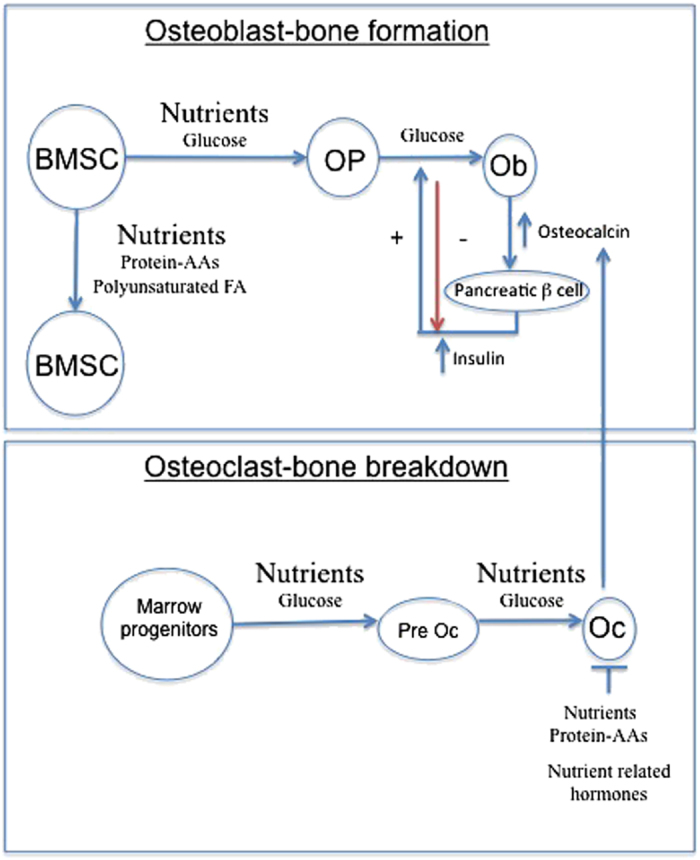
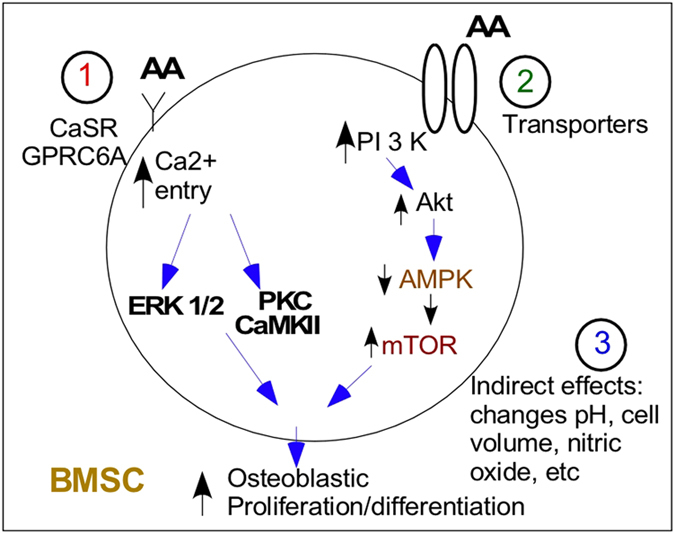
Nutrients (protein, carbohydrates and fats) have traditionally been thought of as fuels simply providing the energy for cellular metabolic activity. According to the classic view, if nutrients are available, then anabolic pathways are activated, and if nutrients are not available, catabolic pathways are activated. However, it is becoming increasingly clear that nutrient effects on bone cells (stem cells, osteoblasts and osteoclasts) are complex, some nutrients promote bone formation, whereas others interfere with bone formation or actually promote bone break down. At an organ level, nutrient intake can suppress bone breakdown and modulate the activity of the calcium/vitamin D/parathyroid hormone axis. At a cellular level, nutrient intake can impact cellular energetics either through a direct mechanism (binding or uptake of the nutrient into the cell) or indirect (by elevating nutrient-related hormones such as insulin, insulin-like growth factor 1 or incretin hormones). It is also becoming clear that within a nutrient class (for example, protein), individual components (that is, amino acids) can have markedly different effects on cell function and impact bone formation. The focus of this review will be on one nutrient class in particular, dietary protein. As the prevalence of inadequate dietary protein intake increases with age, these findings may have translational implications as to the optimal dietary protein content in the setting of age-associated bone loss.
传统上,营养素(蛋白质、碳水化合物和脂肪)被视为仅仅为细胞代谢活动提供能量的燃料。根据经典观点,如果有营养素可用,那么合成代谢途径就会被激活;如果没有营养素可用,分解代谢途径就会被激活。然而,越来越清楚的是,营养素对骨细胞(干细胞、成骨细胞和破骨细胞)的影响是复杂的,一些营养素促进骨形成,而另一些则干扰骨形成或实际上促进骨分解。在器官水平上,营养摄入可以抑制骨分解并调节钙/维生素D/甲状旁腺激素轴的活性。在细胞水平上,营养摄入可以通过直接机制(营养素与细胞结合或被细胞摄取)或间接机制(通过升高与营养相关的激素,如胰岛素、胰岛素样生长因子1或肠促胰岛素激素)影响细胞能量代谢。同样越来越清楚的是,在一类营养素(例如蛋白质)中,各个成分(即氨基酸)对细胞功能和骨形成的影响可能有显著差异。本综述的重点将特别关注一类营养素,即膳食蛋白质。随着膳食蛋白质摄入量不足的发生率随年龄增长而增加,这些发现可能对与年龄相关的骨质流失情况下的最佳膳食蛋白质含量具有转化意义。