Tientcheu Leopold D, Koch Anastasia, Ndengane Mthawelenga, Andoseh Genevieve, Kampmann Beate, Wilkinson Robert J
Vaccines and Immunity Theme, Medical Research Council Unit, The Gambia, Banjul, The Gambia.
Department of Biochemistry, Faculty of Science, University of Yaoundé 1, Yaoundé, Cameroon.
Eur J Immunol. 2017 Mar;47(3):432-445. doi: 10.1002/eji.201646562. Epub 2017 Feb 24.
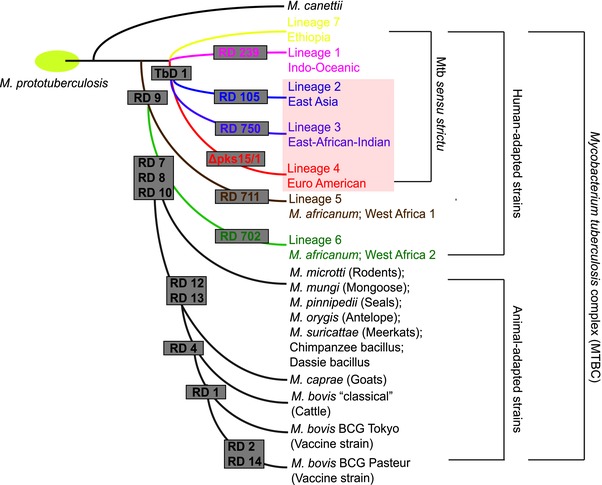
In 2015, there were an estimated 10.4 million new cases of tuberculosis (TB) globally, making it one of the leading causes of death due to an infectious disease. TB is caused by members of the Mycobacterium tuberculosis complex (MTBC), with human disease resulting from infection by M. tuberculosis sensu stricto and M. africanum. Recent progress in genotyping techniques, in particular the increasing availability of whole genome sequence data, has revealed previously under appreciated levels of genetic diversity within the MTBC. Several studies have shown that this genetic diversity may translate into differences in TB transmission, clinical manifestations of disease, and host immune responses. This suggests the existence of MTBC genotype-dependent host-pathogen interactions which may influence the outcome of infection and progression of disease. In this review, we highlight the studies demonstrating differences in innate and adaptive immunological outcomes consequent on MTBC genetic diversity, and discuss how these differences in immune response might influence the development of TB vaccines, diagnostics and new therapies.
2015年,全球估计有1040万例新发结核病病例,使其成为因传染病导致死亡的主要原因之一。结核病由结核分枝杆菌复合群(MTBC)成员引起,人类疾病由结核分枝杆菌狭义种和非洲分枝杆菌感染所致。基因分型技术的最新进展,特别是全基因组序列数据的日益可得,揭示了MTBC内此前未被充分认识的遗传多样性水平。多项研究表明,这种遗传多样性可能转化为结核病传播、疾病临床表现和宿主免疫反应的差异。这表明存在MTBC基因型依赖的宿主-病原体相互作用,可能影响感染结果和疾病进展。在本综述中,我们重点介绍了证明MTBC遗传多样性导致先天性和适应性免疫结果存在差异的研究,并讨论了这些免疫反应差异如何可能影响结核病疫苗、诊断方法和新疗法的开发。