Gunn Laura H, Valegård Karin, Andersson Inger
From the Department of Cell and Molecular Biology, Uppsala University, S-751 24 Uppsala, Sweden
From the Department of Cell and Molecular Biology, Uppsala University, S-751 24 Uppsala, Sweden.
J Biol Chem. 2017 Apr 21;292(16):6838-6850. doi: 10.1074/jbc.M116.767145. Epub 2017 Jan 30.
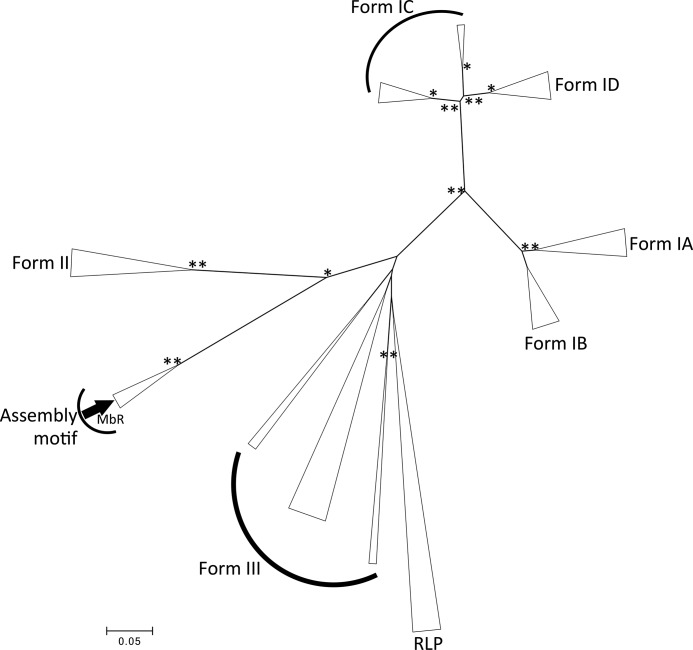
The catalytic inefficiencies of the CO-fixing enzyme ribulose-1,5-bisphosphate carboxylase/oxygenase (Rubisco) often limit plant productivity. Strategies to engineer more efficient plant Rubiscos have been hampered by evolutionary constraints, prompting interest in Rubisco isoforms from non-photosynthetic organisms. The methanogenic archaeon contains a Rubisco isoform that functions to scavenge the ribulose-1,5-bisphosphate (RuBP) by-product of purine/pyrimidine metabolism. The crystal structure of Rubisco (MbR) presented here at 2.6 Å resolution is composed of catalytic large subunits (LSu) assembled into pentamers of dimers, (L), and differs from Rubiscos from higher plants where LSus are glued together by small subunits (SSu) into hexadecameric LS enzymes. MbR contains a unique 29-amino acid insertion near the C terminus, which folds as a separate domain in the structure. This domain, which is visualized for the first time in this study, is located in a similar position to SSus in LS enzymes between LSus of adjacent L dimers, where negatively charged residues coordinate around a Mg ion in a fashion that suggests this domain may be important for the assembly process. The Rubisco assembly domain is thus an inbuilt SSu mimic that concentrates L dimers. MbR assembly is ligand-stimulated, and we show that only 6-carbon molecules with a particular stereochemistry at the C carbon can induce oligomerization. Based on MbR structure, subunit arrangement, sequence, phylogenetic distribution, and function, MbR and a subset of Rubiscos from the Methanosarcinales order are proposed to belong to a new Rubisco subgroup, named form IIIB.
固定二氧化碳的酶核酮糖-1,5-二磷酸羧化酶/加氧酶(Rubisco)的催化低效性常常限制植物的生产力。设计更高效植物Rubisco的策略受到进化限制的阻碍,这激发了人们对非光合生物中Rubisco同工型的兴趣。产甲烷古菌含有一种Rubisco同工型,其功能是清除嘌呤/嘧啶代谢的副产物核酮糖-1,5-二磷酸(RuBP)。此处展示的分辨率为2.6 Å的产甲烷古菌Rubisco(MbR)晶体结构由组装成二聚体五聚体(L)的催化大亚基(LSu)组成,与高等植物的Rubisco不同,高等植物的LSu通过小亚基(SSu)粘在一起形成十六聚体LS酶。MbR在C末端附近含有一个独特的29个氨基酸的插入序列,在结构中折叠成一个单独的结构域。该结构域在本研究中首次可视化,位于相邻L二聚体的LSu之间的LS酶中与SSu相似的位置,其中带负电荷的残基以一种表明该结构域可能对组装过程很重要的方式围绕Mg离子配位。因此,Rubisco组装结构域是一个内置的模拟SSu,可使L二聚体聚集。MbR的组装受配体刺激,我们表明只有在C碳上具有特定立体化学的6碳分子才能诱导寡聚化。基于MbR的结构、亚基排列、序列、系统发育分布和功能,MbR和甲烷八叠球菌目Rubisco的一个子集被提议属于一个新的Rubisco亚组,命名为IIIB型。