Negrini Simone, Fenoglio Daniela, Parodi Alessia, Kalli Francesca, Battaglia Florinda, Nasi Giorgia, Curto Monica, Tardito Samuele, Ferrera Francesca, Filaci Gilberto
Center of Excellence for Biomedical Research, University of Genoa, Genoa, Italy; Department of Internal Medicine, Clinical Immunology Unit, University of Genoa, Genoa, Italy.
Center of Excellence for Biomedical Research, University of Genoa , Genoa , Italy.
Front Immunol. 2017 Jan 19;8:18. doi: 10.3389/fimmu.2017.00018. eCollection 2017.
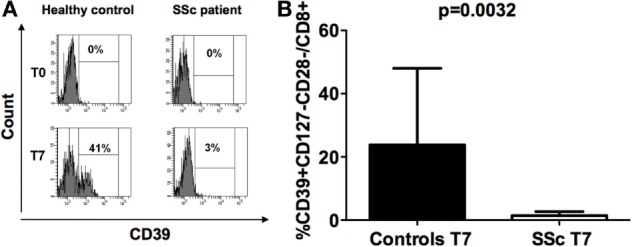
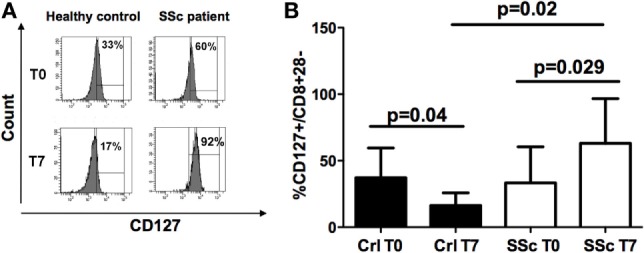
Systemic sclerosis (SSc) is a connective tissue disease characterized by tissue fibrosis, vasculopathy, and autoimmunity. Although the exact pathogenetic mechanisms behind SSc remain to be fully elucidated, a great deal of evidence suggests the existence of an unbalanced ratio between the effector and regulatory arms of the immune system. With regard to the T regulatory (Treg) compartment, we observed that CD8+ Treg subsets display functional defects in SSc-affected patients. Since CD127 down-modulation and CD39 upregulation have been observed on Treg subsets, the phenotypic expression of these molecules was analyzed on the CD8+CD28- Treg precursors and on CD8+ Treg cells generated through interleukin-10 commitment. Immunophenotypic data from SSc patients were compared to those obtained from healthy subjects. The analyses performed on -isolated CD8+CD28- Treg precursors did not show any significant differences in CD39 or CD127 expression as compared to values obtained from healthy donors. On the contrary, -generated CD8+ Tregs obtained from SSc patients displayed reduced expression of the CD39 molecule as compared to controls. Moreover, the percentage of CD127+ cells was significantly higher in -generated CD8+ Tregs from SSc patients compared to CD8+ Tregs obtained from healthy donors. Taken together, these findings may indicate an impairment of maturation processes affecting CD8+ Treg cells in SSc patients. This impairment of maturation involves phenotypic alterations that are mainly characterized by a deficient CD39 upregulation and a lack of down-modulation of the CD127 molecule.
系统性硬化症(SSc)是一种以组织纤维化、血管病变和自身免疫为特征的结缔组织疾病。尽管SSc背后的确切发病机制仍有待充分阐明,但大量证据表明免疫系统的效应臂和调节臂之间存在失衡比例。关于调节性T细胞(Treg)亚群,我们观察到CD8 + Treg亚群在受SSc影响的患者中存在功能缺陷。由于在Treg亚群上观察到CD127下调和CD39上调,因此在CD8 + CD28 - Treg前体以及通过白细胞介素-10定向产生的CD8 + Treg细胞上分析了这些分子的表型表达。将SSc患者的免疫表型数据与健康受试者的数据进行比较。对分离出的CD8 + CD28 - Treg前体进行的分析显示,与健康供体的值相比,CD39或CD127表达没有任何显著差异。相反,与对照组相比,从SSc患者获得的诱导产生的CD8 + Tregs显示CD39分子的表达降低。此外,与从健康供体获得的CD8 + Tregs相比,SSc患者诱导产生的CD8 + Tregs中CD127 +细胞的百分比显著更高。综上所述,这些发现可能表明SSc患者中影响CD8 + Treg细胞的成熟过程受损。这种成熟受损涉及表型改变,其主要特征是CD39上调不足和CD127分子下调缺失。