Oualim Sara, Elharda Charafeddine Ait, Benzeroual Dounia, Hattaoui Mustapha El
Department of Cardiology, Ibn Tofail Hospital, University Hospital Center Mohammed VI, Marrakech, Morocco.
Pan Afr Med J. 2016 Aug 11;24:308. doi: 10.11604/pamj.2016.24.308.8828. eCollection 2016.
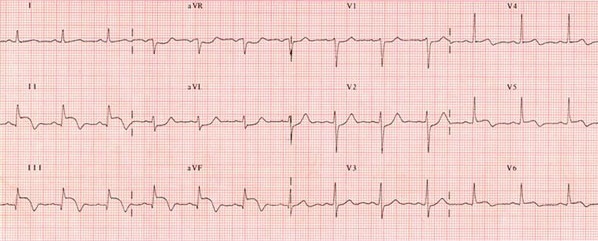
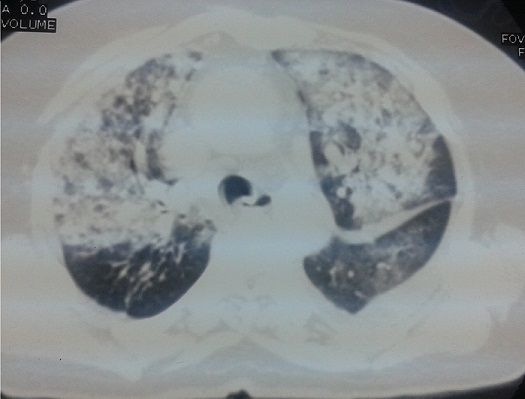
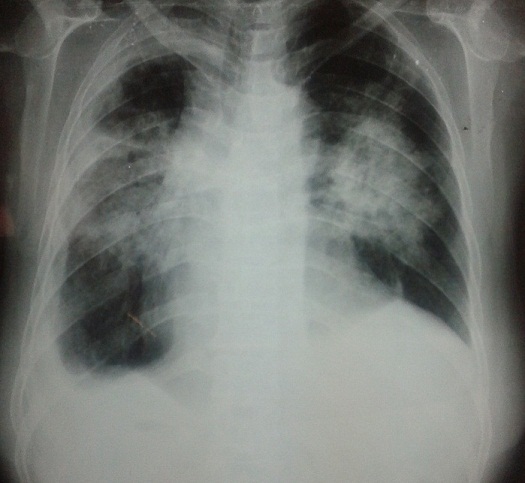
Diffuse alveolar hemorrhage after percutaneous coronary intervention (PCI) is a rare complication. The diagnosis is difficult and can mimic by clinical and radiological features other diagnosis as pneumopathy. We herein report the case of a 63-year-old female admitted to the hospital for ST elevation myocardial infarction. The patient underwent PCI and received dual antiplatelet therapy. Four days later, she developed dyspnea, hemoptysis and fever. Clinical, radiological and biological findings oriented to a pneumopathy and the patient received the treatment for it. Later and because of the non improvement, a thoracic computed tomography was performed and revealed patchy areas of ground-glass opacity consistent with a diffuse pulmonary hemorrhage. The combination therapy with aspirin and clopidogrel was therefore the most likely cause. Although the dual antiplatelet combination reduces systemic ischemic events after PCI, it is associated with increased risk of nonfatal and sometimes fatal bleeding. Hence the necessity of close and careful observation to watch for possible fatal complications.
经皮冠状动脉介入治疗(PCI)后发生弥漫性肺泡出血是一种罕见的并发症。诊断困难,其临床和影像学特征可能与其他疾病如肺病相混淆。我们在此报告一例63岁女性因ST段抬高型心肌梗死入院的病例。该患者接受了PCI并接受双联抗血小板治疗。四天后,她出现呼吸困难、咯血和发热。临床、影像学和生物学检查结果提示为肺病,患者因此接受了相应治疗。后来由于病情未改善,进行了胸部计算机断层扫描,结果显示有斑片状磨玻璃影,符合弥漫性肺出血表现。因此,阿司匹林和氯吡格雷的联合治疗最有可能是病因。尽管双联抗血小板联合治疗可降低PCI后全身性缺血事件的发生,但它会增加非致命性甚至有时是致命性出血的风险。因此,有必要密切仔细观察,以警惕可能出现的致命并发症。