Zhang Tiantian, Gao Bin, Zhou Zhixiang, Chang Yu
School of Life Science and Bioengineering, Beijing University of Technology, Beijing, 100124, People's Republic of China.
Biomed Eng Online. 2016 Dec 28;15(Suppl 2):138. doi: 10.1186/s12938-016-0281-z.
PM2.5 is an important factor to affect the patients with respiratory and cardiovascular diseases. Clinical studies have found that the morbidity and mortality of patients with heart failure (HF) have a close relationship with the movement and deposition state of PM2.5. One reason is that the breathing pattern of patients with HF has obvious difference with healthy people, however the effect caused by these differences on the distribution regularity of PM2.5 in the respiratory tract is still unclear. Hence, a computational fluid dynamics simulation was conducted to clarify the aerodynamic effect of breathing pattern of patients with HF on respiratory system.
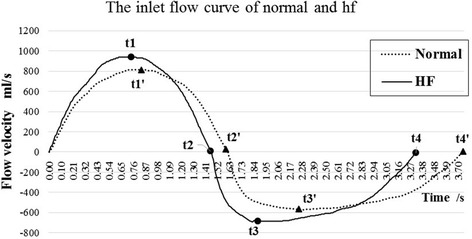
Ideal upper respiratory tract geometric model was established based on standardized aerosol research laboratory of Alberta and Weibel A dimension. The discrete phase method is used to calculate the movement of the airflow and particles. The flow rate were chosen as the inlet boundary conditions, and the outlets are set at a constant pressure. The rate of particle deposition, distribution location, wall pressure, flow velocity and wall shear stress are obtained, and compared to the normal control.
The results demonstrated that the rate of escaped particles in every bronchial outlet of the patients with HF was more than the normal controls, meanwhile the trapped was less (1024 < 1160). There was higher by 12.9% possibility that the PM2.5 entered the lungs than the normal control.
The aerodynamic performances of HF patients are different from normal control. Compared to the normal control, under similar environment, there is higher possibility of PM2.5 moving into lungs, and these particles could affect the function of the respiratory system, resulting in the deterioration of the state of cardiovascular system. In short, it's necessary to pay more attention to the living environment of HF patients, to reduce the content of PM2.5 particles in the air, and reduce the damage of PM2.5 particles caused by breathing patterns.
细颗粒物(PM2.5)是影响呼吸系统和心血管系统疾病患者的重要因素。临床研究发现,心力衰竭(HF)患者的发病率和死亡率与PM2.5的运动和沉积状态密切相关。原因之一是HF患者的呼吸模式与健康人有明显差异,然而这些差异对呼吸道中PM2.5分布规律的影响仍不清楚。因此,进行了计算流体动力学模拟,以阐明HF患者呼吸模式对呼吸系统的空气动力学效应。
基于阿尔伯塔省标准化气溶胶研究实验室和韦贝尔A模型建立理想的上呼吸道几何模型。采用离散相方法计算气流和颗粒的运动。将流速作为入口边界条件,出口设置为恒定压力。获得颗粒沉积率、分布位置、壁面压力、流速和壁面剪应力,并与正常对照组进行比较。
结果表明,HF患者每个支气管出口的逃逸颗粒率高于正常对照组,同时捕获的颗粒较少(1024 < 1160)。PM2.5进入肺部的可能性比正常对照组高12.9%。
HF患者的空气动力学性能与正常对照组不同。与正常对照组相比,在相似环境下,PM2.5进入肺部的可能性更高,这些颗粒可能影响呼吸系统功能,导致心血管系统状态恶化。总之,有必要更加关注HF患者的生活环境,降低空气中PM2.5颗粒的含量,减少呼吸模式导致的PM2.5颗粒的损害。