Department of Optics and Optical Engineering, Institute of Photonics, University of Science and Technology of China, Number 96 Jinzhai Road, Hefei, Anhui 230026, China.
CAS Key Laboratory of Soft Matter Chemistry, Department of Polymer Science and Engineering, iChEM, University of Science and Technology of China, Hefei, Anhui 230026, China.
Nat Commun. 2017 Feb 3;8:14330. doi: 10.1038/ncomms14330.
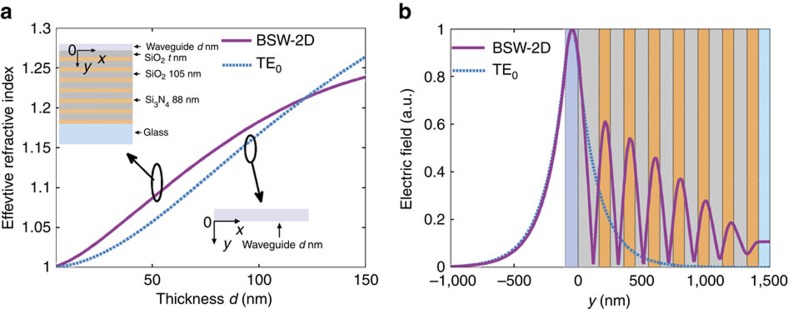
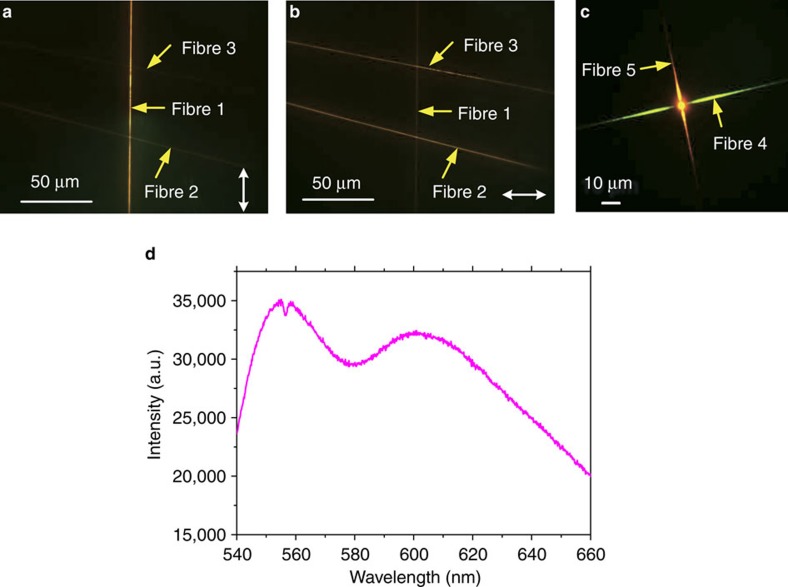
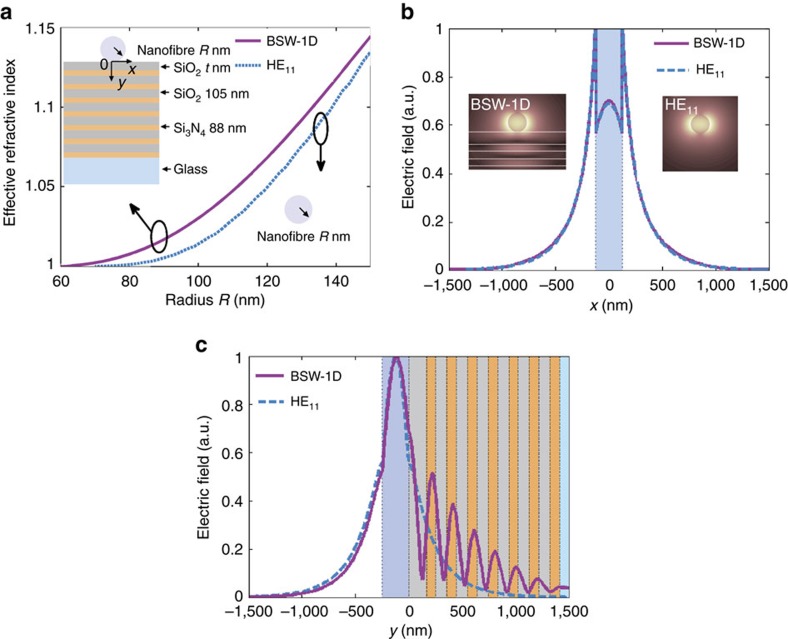
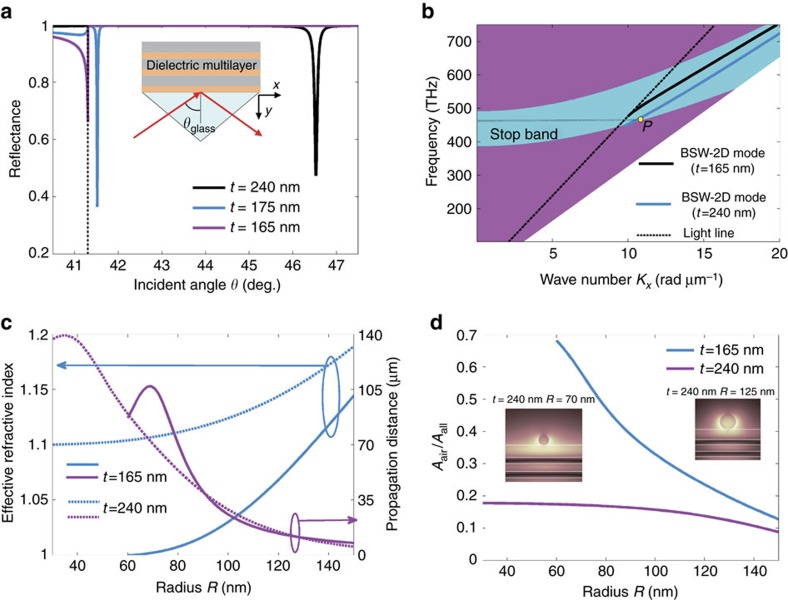
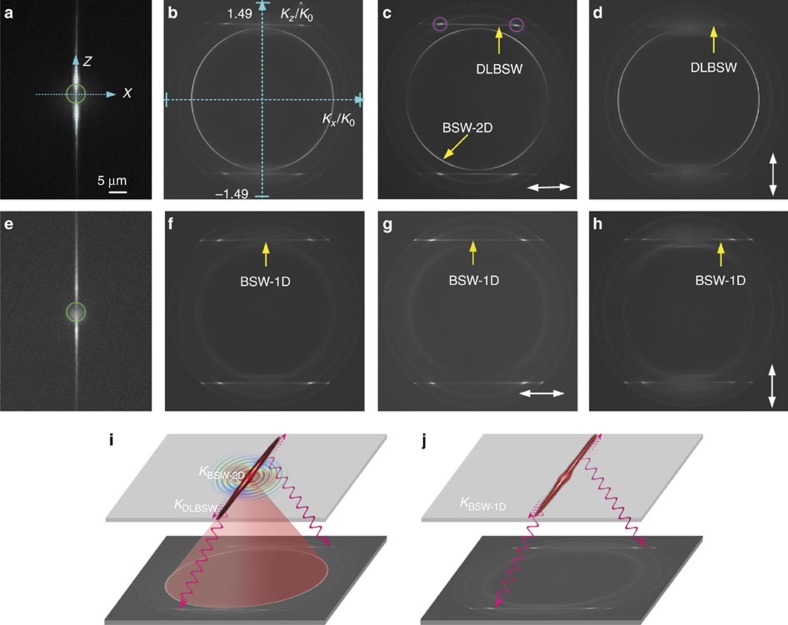
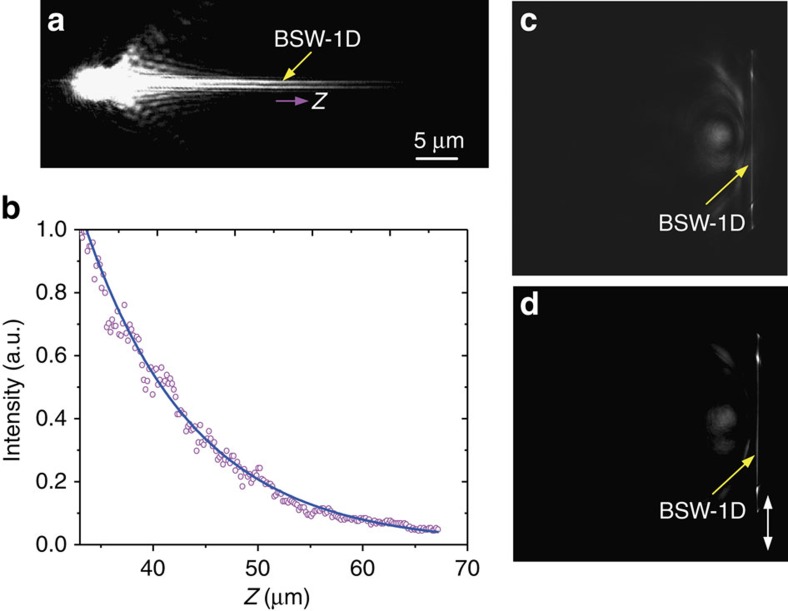
Polymeric fibres with small radii (such as ≤125 nm) are delicate to handle and should be laid down on a solid substrate to obtain practical devices. However, placing these nanofibres on commonly used glass substrates prevents them from guiding light. In this study, we numerically and experimentally demonstrate that when the nanofibre is placed on a suitable dielectric multilayer, it supports a guided mode, a Bloch surface wave (BSW) confined in one dimension. The physical origin of this new mode is discussed in comparison with the typical two-dimensional BSW mode. Polymeric nanofibres are easily fabricated to contain fluorophores, which make the dielectric nanofibre and multilayer configuration suitable for developing a large range of new nanometric scale devices, such as processor-memory interconnections, devices with sensitivity to target analytes, incident polarization and multi-colour BSW modes.
具有小半径(如 ≤125nm)的聚合纤维难以处理,应铺设在固体基板上以获得实用的器件。然而,将这些纳米纤维放置在常用的玻璃基板上会阻止它们导光。在这项研究中,我们通过数值和实验证明,当纳米纤维放置在合适的介电多层上时,它会支持一种导模,即限制在一维的 Bloch 表面波(BSW)。与典型的二维 BSW 模式相比,讨论了这种新模式的物理起源。聚合物纳米纤维易于制造以包含荧光团,这使得介电纳米纤维和多层结构适合开发各种新型纳米尺度器件,例如处理器-存储器互连、对目标分析物敏感的器件、入射偏振和多色 BSW 模式。