Liu Jenny X, Goryakin Yevgeniy, Maeda Akiko, Bruckner Tim, Scheffler Richard
Institute for Health and Aging, Department of Social and Behavioral Sciences, University of California, San Francisco, 3333 California Street, Suite 340, San Francisco, CA, 94118, United States of America.
Health Division, Labour and Social Affairs, Organization for Economic Co-operation and Development, 2 rue Andre Pascal, 75775, Paris, Cedex 16, France.
Hum Resour Health. 2017 Feb 3;15(1):11. doi: 10.1186/s12960-017-0187-2.
In low- and middle-income countries, scaling essential health interventions to achieve health development targets is constrained by the lack of skilled health professionals to deliver services.
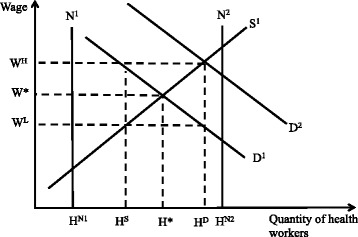
We take a labor market approach to project future health workforce demand based on an economic model based on projected economic growth, demographics, and health coverage, and using health workforce data (1990-2013) for 165 countries from the WHO Global Health Observatory. The demand projections are compared with the projected growth in health worker supply and the health worker "needs" as estimated by WHO to achieve essential health coverage.
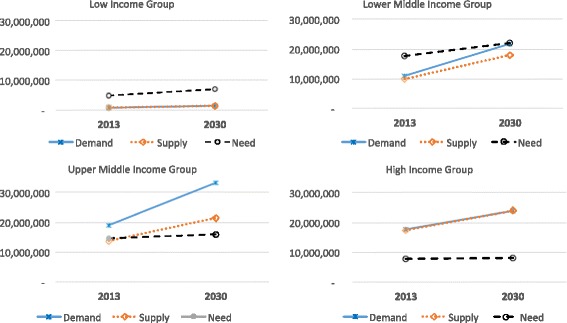
The model predicts that, by 2030, global demand for health workers will rise to 80 million workers, double the current (2013) stock of health workers, while the supply of health workers is expected to reach 65 million over the same period, resulting in a worldwide net shortage of 15 million health workers. Growth in the demand for health workers will be highest among upper middle-income countries, driven by economic and population growth and aging. This results in the largest predicted shortages which may fuel global competition for skilled health workers. Middle-income countries will face workforce shortages because their demand will exceed supply. By contrast, low-income countries will face low growth in both demand and supply, which are estimated to be far below what will be needed to achieve adequate coverage of essential health services.
In many low-income countries, demand may stay below projected supply, leading to the paradoxical phenomenon of unemployed ("surplus") health workers in those countries facing acute "needs-based" shortages. Opportunities exist to bend the trajectory of the number and types of health workers that are available to meet public health goals and the growing demand for health workers.
在低收入和中等收入国家,扩大基本卫生干预措施以实现卫生发展目标受到缺乏提供服务的熟练卫生专业人员的制约。
我们采用劳动力市场方法,基于经济增长、人口统计学和卫生覆盖范围的预测经济模型,并利用世界卫生组织全球卫生观察站提供的165个国家的卫生人力数据(1990 - 2013年),预测未来卫生人力需求。将需求预测与卫生工作者供应的预计增长以及世界卫生组织为实现基本卫生覆盖估计的卫生工作者“需求”进行比较。
该模型预测,到2030年,全球对卫生工作者的需求将增至8000万人,是当前(2013年)卫生工作者存量的两倍,而同期卫生工作者的供应量预计将达到6500万人,导致全球卫生工作者净短缺1500万人。中高收入国家卫生工作者需求增长将最高,这是由经济和人口增长及老龄化推动的。这导致预测的短缺最为严重,可能加剧全球对熟练卫生工作者的竞争。中等收入国家将面临劳动力短缺,因为其需求将超过供应。相比之下,低收入国家需求和供应增长都将较低,估计远低于实现基本卫生服务充分覆盖所需水平。
在许多低收入国家,需求可能低于预计供应,导致这些面临严重“基于需求”短缺的国家出现卫生工作者失业(“过剩”)的矛盾现象。存在机会改变可用于实现公共卫生目标和满足对卫生工作者不断增长需求的卫生工作者数量和类型的轨迹。