Ding Yew Y, Kuha Jouni, Murphy Michael
Department of Methodology, London School of Economics, Columbia House, Houghton Street, London, WC2A 2AE, UK.
Department of Geriatric Medicine & Institute of Geriatrics and Active Ageing, Tan Tock Seng Hospital, 11 Jalan Tan Tock Seng, Singapore, 308433, Singapore.
Biogerontology. 2017 Apr;18(2):237-252. doi: 10.1007/s10522-017-9677-9. Epub 2017 Feb 3.
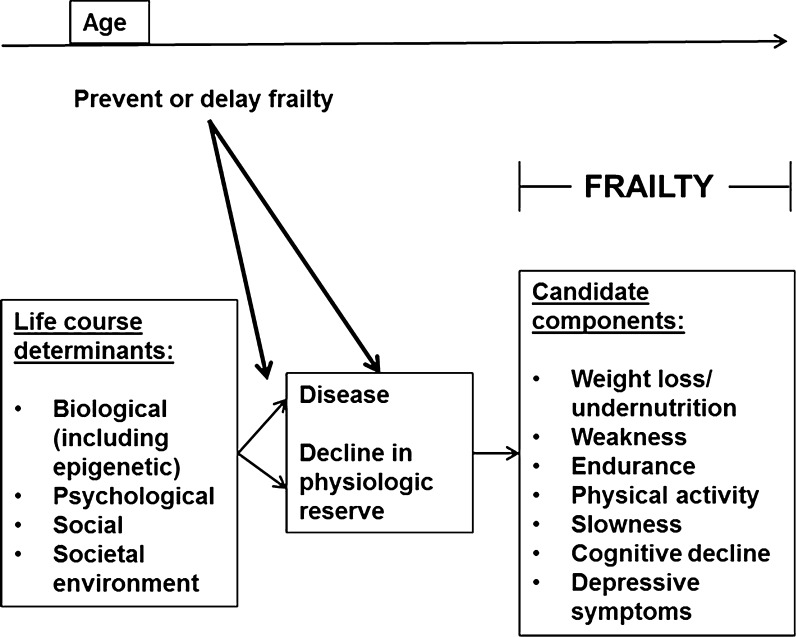
Physical frailty in older people is an escalating health and social challenge. We investigate its physical, psychological, and social predictors, including how and for whom these conditions exert their effects. For 4638 respondents aged 65-89 years from wave 2 of the English Longitudinal Study of Ageing, we examine prediction of future physical frailty by physical, psychological, and social conditions using latent growth curve analysis with multiple indicators. In addition, we explore their indirect effects through disease and physiologic decline, and repeat these analyses after stratification by gender, age group, and selected conditions which are possible moderators. We find that chronic disease, allostatic load, low physical activity, depressive symptoms, cognitive impairment, and poor social support all predict future physical frailty. Furthermore, chronic disease and allostatic load mediate the effects of low physical activity, depressive symptoms, and cognitive impairment on future physical frailty. Finally, although poor social integration is not a predictor of future physical frailty, this condition moderates the indirect effect of poor social support through chronic disease by rendering it stronger. By virtue of their roles as predictor, mediator, or moderator on pathways to physical frailty, chronic disease, allostatic load, low physical activity, cognitive impairment, depressive symptoms, poor social support, and poor social integration are potentially modifiable target conditions for population-level health and social interventions to reduce future physical frailty in older people.
老年人身体虚弱是一个日益严峻的健康和社会挑战。我们研究其身体、心理和社会方面的预测因素,包括这些状况如何以及对哪些人产生影响。对于来自英国老龄化纵向研究第二轮的4638名65 - 89岁的受访者,我们使用多指标潜在增长曲线分析,研究身体、心理和社会状况对未来身体虚弱的预测作用。此外,我们探讨它们通过疾病和生理衰退产生的间接影响,并在按性别、年龄组以及可能作为调节因素的选定状况进行分层后重复这些分析。我们发现,慢性病、应激负荷、低体力活动、抑郁症状、认知障碍和社会支持不足均能预测未来的身体虚弱。此外,慢性病和应激负荷介导了低体力活动、抑郁症状和认知障碍对未来身体虚弱的影响。最后,尽管社会融合度低并非未来身体虚弱的预测因素,但这种状况通过使慢性病导致的社会支持不足的间接影响更强,从而起到调节作用。鉴于慢性病、应激负荷、低体力活动、认知障碍、抑郁症状、社会支持不足和社会融合度低在身体虚弱发展路径中作为预测因素、中介因素或调节因素的作用,它们有可能成为可改变的目标状况,用于开展人群层面的健康和社会干预,以减少老年人未来的身体虚弱。