Lv Feng, Huang Yingzi, Lv Wentao, Yang Longbiao, Li Feng, Fan Jingli, Sun Jianmin
Department of Spine Surgery, Shandong Provincial Hospital Affiliated to Shandong University, Jinan, Shandong, China (mainland).
Department of Orthopedics, Shandong Energy Zibo Mining Group Co. Ltd. Central Hospital, Zibo, Shandong, China (mainland).
Med Sci Monit. 2017 Feb 5;23:659-664. doi: 10.12659/msm.898660.
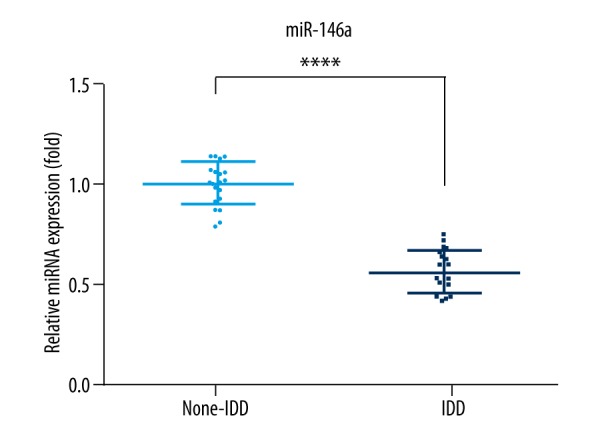
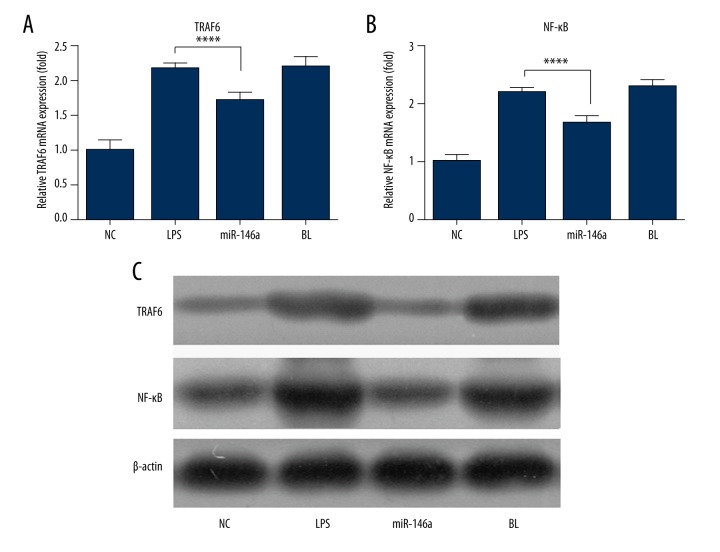
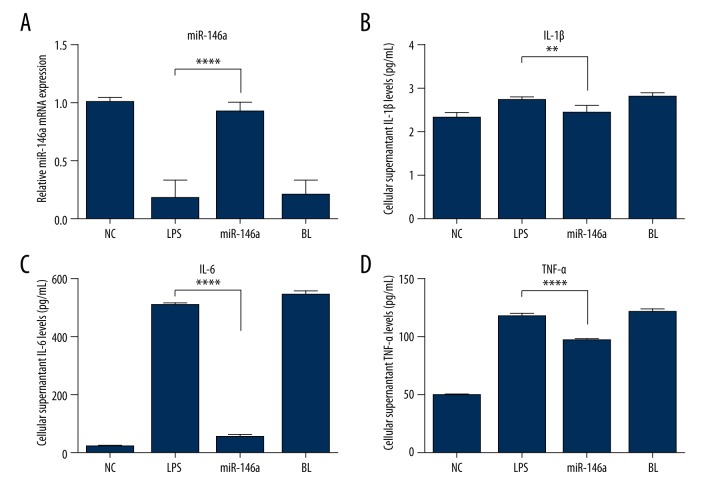
BACKGROUND Intervertebral disc degeneration (IDD) has been widely recognized as a major contributor to low back pain. Accumulating evidence suggests that IDD is linked to various pro-inflammatory cytokines and metabolites. Recently, numerous studies have demonstrated that microRNAs (miRNAs) play a pivotal role in the development of most disorders, including degenerative disc diseases. Previous reports have revealed that miRNA-146a (miR-146a) could attenuate neuropathic pain in the spinal cord. The aim of this study was to investigate the role of miR-146a in the inflammatory response of IDD. MATERIAL AND METHODS Quantitative real-time (RT)-PCR was performed to investigate the levels of miR-146a in the PBMCs (peripheral blood mononuclear cells) of patients with IDD. Human nucleus pulposus (NP) cells were transiently transfected with miR-146a mimic; control NP cell transfections lacked miR-146a. Then all NP cells were treated with LPS (10 μM) to induce inflammation. The mRNA levels of miR-146a in NP cells were determined by RT-PCR. In addition, the mRNA and protein expression levels of tumor necrosis factor (TNF), receptor-associated factor 6 (TRAF6), and nuclear factor (NF)-κB in NP cells were evaluated by quantitative RT-PCR and Western blot analysis, respectively. RESULTS We found that miR-146a was significantly downregulated in the PBMCs of patients. Moreover, overexpression of miR-146a significantly decreased the levels of pro-inflammatory cytokines in LPS-stimulated NP cells. The mRNA and protein levels of TRAF6 and NF-κB were downregulated by miR-146a overexpression. CONCLUSIONS These results suggest that overexpression of miR-146a could promote IDD through the TRAF/NF-κB pathway. Our findings also highlight miR-146a as a novel possible therapeutic target for IDD.
椎间盘退变(IDD)已被广泛认为是下腰痛的主要原因。越来越多的证据表明,IDD与多种促炎细胞因子和代谢产物有关。最近,大量研究表明,微小RNA(miRNA)在包括退行性椎间盘疾病在内的大多数疾病的发展中起关键作用。先前的报道显示,miRNA-146a(miR-146a)可减轻脊髓神经性疼痛。本研究旨在探讨miR-146a在IDD炎症反应中的作用。
采用定量实时(RT)-PCR检测IDD患者外周血单个核细胞(PBMCs)中miR-146a的水平。将人髓核(NP)细胞用miR-146a模拟物进行瞬时转染;对照NP细胞转染中不含miR-146a。然后所有NP细胞用脂多糖(LPS,10 μM)处理以诱导炎症。通过RT-PCR测定NP细胞中miR-146a的mRNA水平。此外,分别通过定量RT-PCR和蛋白质印迹分析评估NP细胞中肿瘤坏死因子(TNF)、受体相关因子6(TRAF6)和核因子(NF)-κB的mRNA和蛋白质表达水平。
我们发现患者PBMCs中miR-146a显著下调。此外,miR-146a的过表达显著降低了LPS刺激的NP细胞中促炎细胞因子的水平。TRAF6和NF-κB的mRNA和蛋白质水平因miR-146a过表达而下调。
这些结果表明,miR-146a的过表达可能通过TRAF/NF-κB途径促进IDD。我们的研究结果还突出了miR-146a作为IDD一种新的潜在治疗靶点。