Clinic of Orthodontics and Pediatric Dentistry, Center of Dental Medicine, University of Zurich, Plattenstrasse 11, 8032, Zurich, Switzerland.
Department of Oral Technology, School of Dentistry, University of Bonn, Welschnonnenstr. 17, 53111, Bonn, Germany.
Prog Orthod. 2017 Dec;18(1):6. doi: 10.1186/s40510-017-0161-5. Epub 2017 Feb 27.
Torque of the maxillary incisors is crucial to occlusal relationship and esthetics and can be influenced by many factors. The aim of this study was to assess the relative influence of the material of the orthodontic appliance (adhesive, bracket, ligature, and wire) on tooth displacements and developed stresses/strains after torque application.
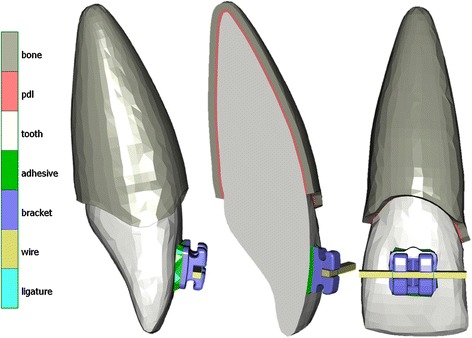
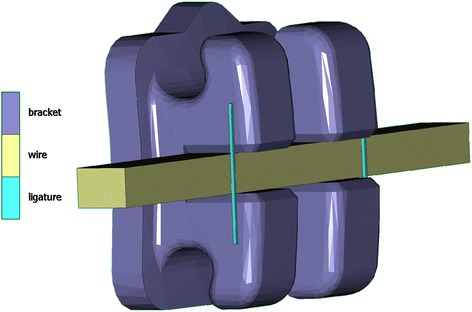
A three-dimensional upper right central incisor with its periodontal ligament (PDL) and alveolus was modeled. A 0.018-in. slot discovery® (Dentaurum, Ispringen, Germany) bracket with a rectangular 0.018 x 0.025-in. wire was generated. The orthodontic appliance varied in the material of its components: adhesive (composite resin or resin-modified glass ionomer cement), bracket (titanium, steel, or ceramic), wire (beta-titanium or steel), and ligature (elastomeric or steel). A total of 24 models were generated, and a palatal root torque of 5° was applied. Afterwards, crown and apex displacement, strains in the PDL, and stresses in the bracket were calculated and analyzed.
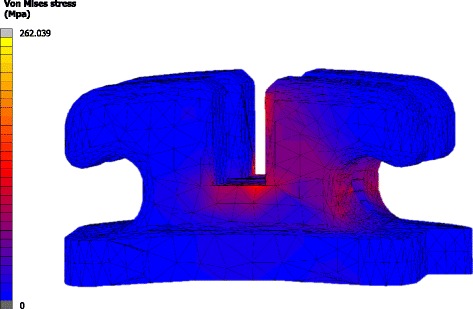
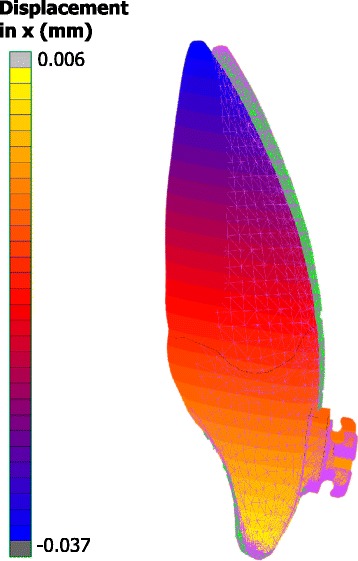
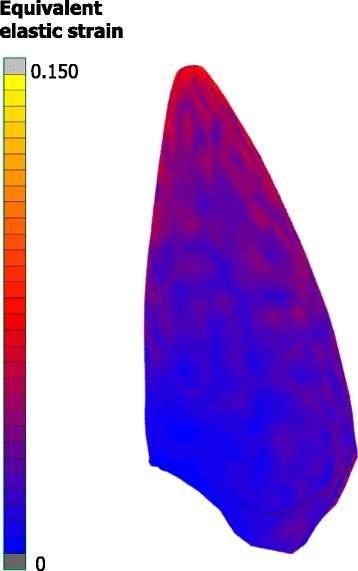
The labial crown displacement and the palatal root displacement of the tooth were mainly influenced by the material of the wire (up to 150% variation), followed by the material of the bracket (up to 19% variation). The magnitude of strains developed in the PDL was primarily influenced by the material of the wire (up to 127% variation), followed by the material of the bracket (up to 30% variation) and the ligature (up to 13% variation). Finally, stresses developed at the bracket were mainly influenced by the material of the wire (up to 118% variation) and the bracket (up to 59% variation).
The material properties of the orthodontic appliance and all its components should be considered during torque application. However, these in silico results need to be validated in vivo before they can be clinically extrapolated.
上颌切牙的转矩对于咬合关系和美观至关重要,并且会受到许多因素的影响。本研究的目的是评估正畸矫治器的材料(粘结剂、托槽、结扎丝和弓丝)对转矩应用后牙齿位移和产生的应力/应变的相对影响。
建立了一个带有牙周膜(PDL)和牙槽骨的右上侧切牙的三维模型。生成了一个带有 0.018×0.025 英寸矩形弓丝的 0.018 英寸槽发现®(登士柏,伊森堡,德国)托槽。正畸矫治器的组件材料不同:粘结剂(复合树脂或树脂改性玻璃离子水门汀)、托槽(钛、钢或陶瓷)、弓丝(β钛或钢)和结扎丝(弹性体或钢)。共生成 24 个模型,并施加了 5°的腭向根转矩。之后,计算并分析了牙冠和根尖的位移、牙周膜的应变和托槽的应力。
牙的唇侧冠位移和腭向根位移主要受弓丝材料的影响(变化达 150%),其次是托槽材料(变化达 19%)。PDL 中产生的应变大小主要受弓丝材料的影响(变化达 127%),其次是托槽材料(变化达 30%)和结扎丝(变化达 13%)。最后,托槽上产生的应力主要受弓丝材料的影响(变化达 118%)和托槽材料的影响(变化达 59%)。
在应用转矩时,应考虑正畸矫治器及其所有组件的材料特性。然而,这些计算机模拟结果需要在体内验证后才能在临床上外推。