Kuniishi Hiroshi, Ichisaka Satoshi, Matsuda Sae, Futora Eri, Harada Riho, Hata Yoshio
Division of Integrative Bioscience, Institute of Regenerative Medicine and Biofunction, Tottori University Graduate School of Medical Sciences Yonago, Japan.
Division of Neurobiology, School of Life Sciences, Faculty of Medicine, Tottori University Yonago, Japan.
Front Behav Neurosci. 2017 Jan 23;10:250. doi: 10.3389/fnbeh.2016.00250. eCollection 2016.
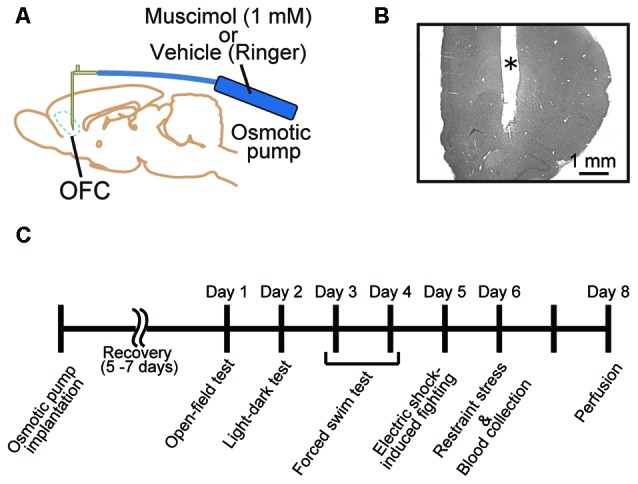
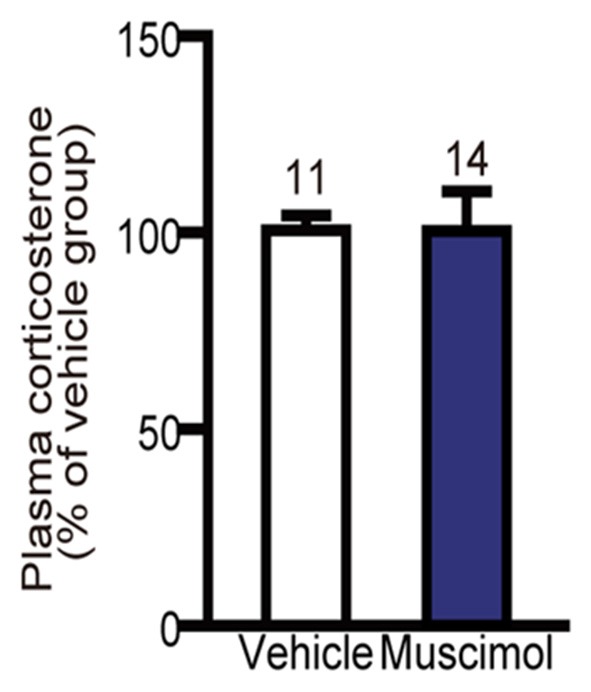
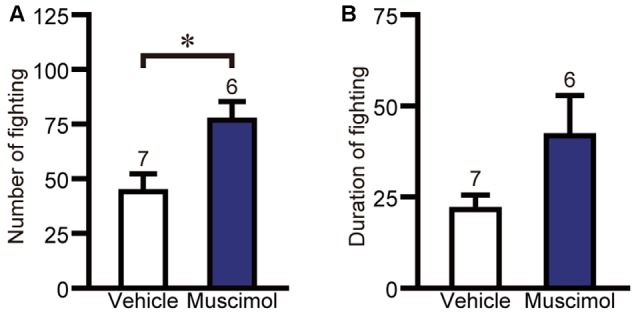
The orbitofrontal cortex (OFC) is involved in emotional processing, and orbitofrontal abnormalities have often been observed in various affective disorders. Thus, chronic dysfunction of the OFC may cause symptoms of affective disorders, such as anxiety, depression and impulsivity. Previous studies have investigated the effect of orbitofrontal dysfunction on anxiety-like behavior and impulsive aggression in rodents, but the results are inconsistent possibly reflecting different methods of OFC inactivation. These studies used either a lesion of the OFC, which may affect other brain regions, or a transient inactivation of the OFC, whose effect may be restored in time and not reflect effects of chronic OFC dysfunction. In addition, there has been no study on the effect of orbitofrontal inactivation on depression-like behavior in rodents. Therefore, the present study examined whether chronic inactivation of the OFC by continuous infusion of a GABA receptor agonist, muscimol, causes behavioral abnormalities in rats. Muscimol infusion inactivated the ventral and lateral part of the OFC. Following a week of OFC inactivation, the animals showed an increase in anxiety-like behavior in the open field test and light-dark test. Impulsive aggression was also augmented in the chronically OFC-inactivated animals because they showed increased frequency of fighting behavior induced by electric foot shock. On the other hand, chronic OFC inactivation reduced depression-like behavior as evaluated by the forced swim test. Additionally, it did not cause a significant change in corticosterone secretion in response to restraint stress. These data suggest that orbitofrontal neural activity is involved in the regulation of anxiety- and depression-like behaviors and impulsive aggression in rodents.
眶额皮质(OFC)参与情绪处理,并且在各种情感障碍中经常观察到眶额皮质异常。因此,OFC的慢性功能障碍可能导致情感障碍的症状,如焦虑、抑郁和冲动。先前的研究调查了眶额皮质功能障碍对啮齿动物焦虑样行为和冲动攻击性的影响,但结果不一致,这可能反映了OFC失活的不同方法。这些研究要么使用OFC损伤,这可能会影响其他脑区,要么使用OFC的短暂失活,其效果可能会及时恢复,无法反映慢性OFC功能障碍的影响。此外,尚未有关于眶额皮质失活对啮齿动物抑郁样行为影响的研究。因此,本研究检查了通过持续注入GABA受体激动剂蝇蕈醇来慢性失活OFC是否会导致大鼠行为异常。注入蝇蕈醇使OFC的腹侧和外侧部分失活。在OFC失活一周后,动物在旷场试验和明暗试验中表现出焦虑样行为增加。在慢性OFC失活的动物中,冲动攻击性也增强了,因为它们在电足电击诱导的打斗行为频率增加。另一方面,通过强迫游泳试验评估,慢性OFC失活减少了抑郁样行为。此外,它在应对束缚应激时并未引起皮质酮分泌的显著变化。这些数据表明,眶额皮质神经活动参与调节啮齿动物的焦虑样和抑郁样行为以及冲动攻击性。