Stem Cell and Regenerative Medicine Consortium, School of Biomedical Sciences, Li Ka Shing Faculty of Medicine, University of Hong Kong, Hong Kong, Special Administrative Region, People's Republic of China.
Department of Biochemistry, Medical College of Wisconsin, Milwaukee, Wisconsin, USA.
Stem Cells Transl Med. 2017 Jan;6(1):131-138. doi: 10.5966/sctm.2016-0109. Epub 2016 Jul 28.
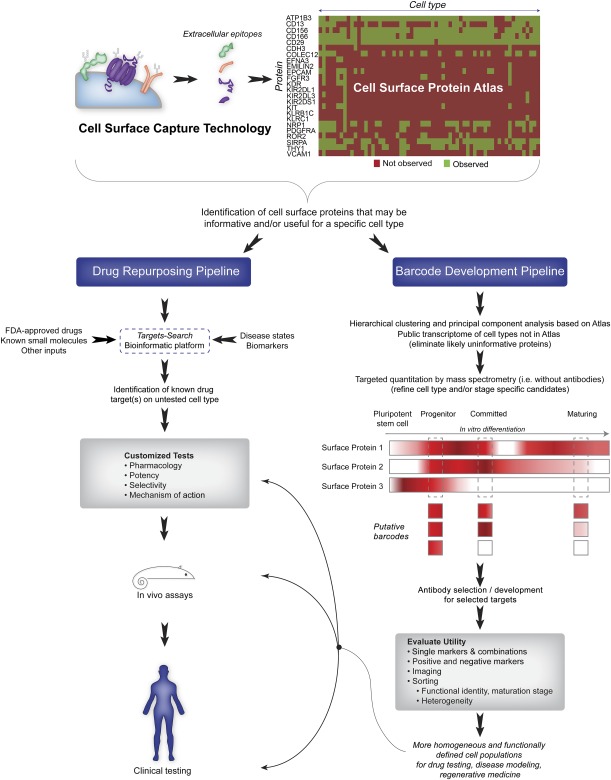
Stem cells and their derivatives hold great promise to advance regenerative medicine. Critical to the progression of this field is the identification and utilization of antibody-accessible cell-surface proteins for immunophenotyping and cell sorting-techniques essential for assessment and isolation of defined cell populations with known functional and therapeutic properties. Beyond their utility for cell identification and selection, cell-surface proteins are also major targets for pharmacological intervention. Although comprehensive cell-surface protein maps are highly valuable, they have been difficult to define until recently. In this review, we discuss the application of a contemporary targeted chemoproteomic-based technique for defining the cell-surface proteomes of stem and progenitor cells. In applying this approach to pluripotent stem cells (PSCs), these studies have improved the biological understanding of these cells, led to the enhanced use and development of antibodies suitable for immunophenotyping and sorting, and contributed to the repurposing of existing drugs without the need for high-throughput screening. The utility of this latter approach was first demonstrated with human PSCs (hPSCs) through the identification of small molecules that are selectively toxic to hPSCs and have the potential for eliminating confounding and tumorigenic cells in hPSC-derived progeny destined for research and transplantation. Overall, the cutting-edge technologies reviewed here will accelerate the development of novel cell-surface protein targets for immunophenotyping, new reagents to improve the isolation of therapeutically qualified cells, and pharmacological studies to advance the treatment of intractable diseases amenable to cell-replacement therapies. Stem Cells Translational Medicine 2017;6:131-138.
干细胞及其衍生物在推进再生医学方面具有巨大的潜力。该领域的关键进展是鉴定和利用可被抗体识别的细胞表面蛋白,进行免疫表型分析和细胞分选——这是评估和分离具有已知功能和治疗特性的特定细胞群体所必需的技术。除了用于细胞鉴定和选择之外,细胞表面蛋白也是药物干预的主要靶点。尽管全面的细胞表面蛋白图谱具有很高的价值,但直到最近才得以定义。在这篇综述中,我们讨论了一种当代靶向化学蛋白质组学技术在定义干细胞和祖细胞的细胞表面蛋白质组学中的应用。在将这种方法应用于多能干细胞(PSCs)时,这些研究提高了对这些细胞的生物学认识,导致了适合免疫表型分析和分选的抗体的增强使用和开发,并有助于重新利用现有的药物,而无需进行高通量筛选。这种方法的实用性首先在人多能干细胞(hPSCs)中得到了证明,通过鉴定出对 hPSCs 具有选择性毒性的小分子,这些小分子有可能消除 hPSC 衍生后代中的混杂细胞和致瘤细胞,这些细胞是用于研究和移植的。总的来说,本文综述的前沿技术将加速新型细胞表面蛋白免疫表型靶点的开发,改善用于分离治疗合格细胞的新型试剂,并推进适用于细胞替代疗法的难治性疾病的药理学研究。《干细胞转化医学》2017 年;6:131-138。