Coulombe Geneviève, Rivard Nathalie
Department of Anatomy and Cell Biology, Cancer Research Pavilion, Faculty of Medicine and Health Sciences, Université de Sherbrooke, Sherbrooke, Quebec, Canada.
Cell Mol Gastroenterol Hepatol. 2015 Nov 14;2(1):11-21. doi: 10.1016/j.jcmgh.2015.11.001. eCollection 2016 Jan.
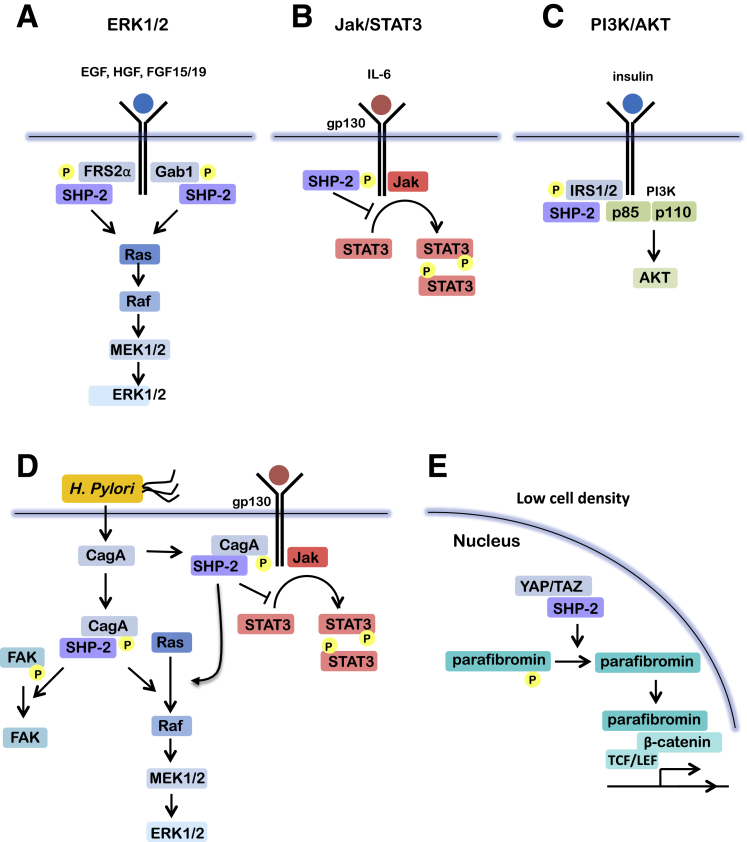
SHP-2 is a tyrosine phosphatase expressed in most embryonic and adult tissues. SHP-2 regulates many cellular functions including growth, differentiation, migration, and survival. Genetic and biochemical evidence show that SHP-2 is required for rat sarcoma viral oncogene/extracellular signal-regulated kinases mitogen-activated protein kinase pathway activation by most tyrosine kinase receptors, as well as by G-protein-coupled and cytokine receptors. In addition, SHP-2 can regulate the Janus kinase/signal transducers and activators of transcription, nuclear factor-κB, phosphatidyl-inositol 3-kinase/Akt, RhoA, Hippo, and Wnt/β-catenin signaling pathways. Emerging evidence has shown that SHP-2 dysfunction represents a key factor in the pathogenesis of gastrointestinal diseases, in particular in chronic inflammation and cancer. Variations within the gene locus encoding SHP-2 have been associated with increased susceptibility to develop ulcerative colitis and gastric atrophy. Furthermore, mice with conditional deletion of SHP-2 in intestinal epithelial cells rapidly develop severe colitis. Similarly, hepatocyte-specific deletion of SHP-2 induces hepatic inflammation, resulting in regenerative hyperplasia and development of tumors in aged mice. However, the SHP-2 gene initially was suggested to be a proto-oncogene because activating mutations of this gene were found in pediatric leukemias and certain forms of liver and colon cancers. Moreover, SHP-2 expression is up-regulated in gastric and hepatocellular cancers. Notably, SHP-2 functions downstream of cytotoxin-associated antigen A (CagA), the major virulence factor of , and is associated with increased risks of gastric cancer. Further compounding this complexity, most recent findings suggest that SHP-2 also coordinates carbohydrate, lipid, and bile acid synthesis in the liver and pancreas. This review aims to summarize current knowledge and recent data regarding the biological functions of SHP-2 in the gastrointestinal tract.
SHP-2是一种在大多数胚胎组织和成年组织中表达的酪氨酸磷酸酶。SHP-2调节多种细胞功能,包括生长、分化、迁移和存活。遗传学和生物化学证据表明,大多数酪氨酸激酶受体以及G蛋白偶联受体和细胞因子受体激活大鼠肉瘤病毒癌基因/细胞外信号调节激酶丝裂原活化蛋白激酶途径需要SHP-2。此外,SHP-2可以调节Janus激酶/信号转导子和转录激活子、核因子-κB、磷脂酰肌醇3激酶/Akt、RhoA、Hippo和Wnt/β-连环蛋白信号通路。新出现的证据表明,SHP-2功能障碍是胃肠道疾病发病机制中的一个关键因素,尤其是在慢性炎症和癌症中。编码SHP-2的基因座内的变异与患溃疡性结肠炎和胃萎缩的易感性增加有关。此外,肠道上皮细胞中条件性缺失SHP-2的小鼠会迅速发展为严重的结肠炎。同样,肝细胞特异性缺失SHP-2会诱发肝脏炎症,导致老年小鼠出现再生性增生和肿瘤。然而,SHP-2基因最初被认为是一种原癌基因,因为在儿童白血病以及某些形式的肝癌和结肠癌中发现了该基因的激活突变。此外,SHP-2在胃癌和肝细胞癌中表达上调。值得注意的是,SHP-2在细胞毒素相关抗原A(CagA)下游发挥作用,CagA是幽门螺杆菌的主要毒力因子,并且与胃癌风险增加有关。更复杂的是,最新研究结果表明,SHP-2还在肝脏和胰腺中协调碳水化合物、脂质和胆汁酸的合成。这篇综述旨在总结关于SHP-2在胃肠道中的生物学功能的现有知识和最新数据。