Hassard Francis, Sharp Jasmine H, Taft Helen, LeVay Lewis, Harris John P, McDonald James E, Tuson Karen, Wilson James, Jones David L, Malham Shelagh K
Centre for Applied Marine Sciences, School of Ocean Sciences, Bangor University, Menai Bridge, Anglesey, LL59 5AB, UK.
Natural Resources Wales, Ty Cambria, Cardiff, CF24 0TP, UK.
Food Environ Virol. 2017 Jun;9(2):123-141. doi: 10.1007/s12560-017-9279-3. Epub 2017 Feb 7.
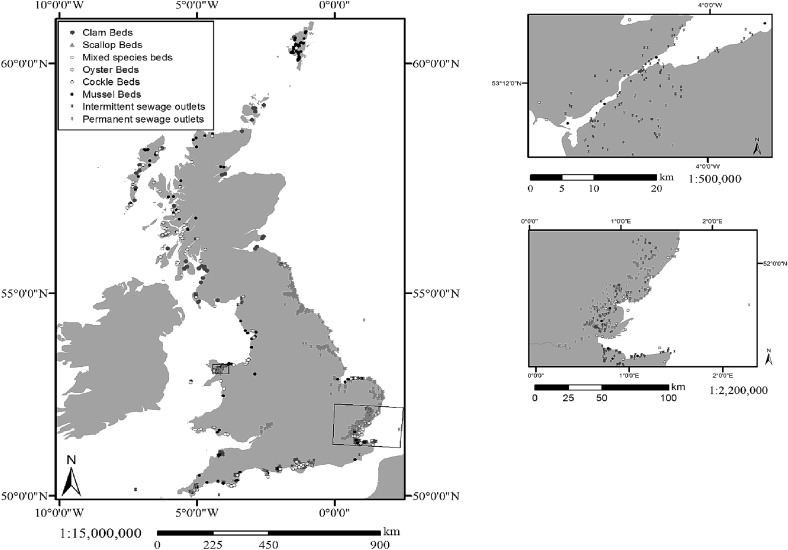
We review the risk of norovirus (NoV) infection to the human population from consumption of contaminated shellfish. From a UK perspective, risk is apportioned for different vectors of NoV infection within the population. NoV spreads mainly by person-to-person contact or via unsanitary food handling. NoV also enters the coastal zone via wastewater discharges resulting in contamination of shellfish waters. Typically, NoV persists in the marine environment for several days, with its presence strongly linked to human population density, wastewater discharge rate, and efficacy of wastewater treatment. Shellfish bioaccumulate NoV and current post-harvest depuration is inefficient in its removal. While NoV can be inactivated by cooking (e.g. mussels), consumption of contaminated raw shellfish (e.g. oysters) represents a risk to human health. Consumption of contaminated food accounts for 3-11% of NoV cases in the UK (~74,000 cases/year), of which 16% are attributable to oyster consumption (11,800 cases/year). However, environmental and human factors influencing NoV infectivity remain poorly understood. Lack of standard methods for accurate quantification of infective and non-infective (damaged) NoV particles represent a major barrier, hampering identification of an appropriate lower NoV contamination limit for shellfish. Future management strategies may include shellfish quality assessment (at point of harvest or at point of supply) or harvesting controls. However, poor understanding of NoV inactivation in shellfish and the environment currently limits accurate apportionment and risk assessment for NoV and hence the identification of appropriate shellfish or environmental quality standards.
我们综述了食用受污染贝类给人类带来的诺如病毒(NoV)感染风险。从英国的角度来看,对人群中NoV感染的不同传播媒介进行了风险分配。NoV主要通过人与人之间的接触或不卫生的食品处理方式传播。NoV还通过废水排放进入沿海区域,导致贝类养殖水域受到污染。通常,NoV在海洋环境中会持续存在数天,其存在与人口密度、废水排放率以及废水处理效率密切相关。贝类会生物累积NoV,目前收获后的净化处理在去除NoV方面效率低下。虽然NoV可通过烹饪(如贻贝)灭活,但食用受污染的生贝类(如牡蛎)会对人类健康构成风险。在英国,食用受污染食品占NoV病例的3 - 11%(约每年74,000例),其中16%可归因于食用牡蛎(每年11,800例)。然而,影响NoV传染性的环境和人为因素仍知之甚少。缺乏准确量化感染性和非感染性(受损)NoV颗粒的标准方法是一个主要障碍,阻碍了确定贝类合适的较低NoV污染限值。未来的管理策略可能包括贝类质量评估(收获时或供应时)或收获控制。然而,目前对贝类和环境中NoV灭活的了解不足,限制了对NoV的准确风险分配和风险评估,从而也限制了确定合适的贝类或环境质量标准。