Yuasa Shouhei, Sato Kazuyoshi, Furuki Takamoto, Minamizawa Kosuke, Sakai Hiroyuki, Numata Yuichi, Chin Keiichi, Kojima Jisho, Miyakawa Masaaki, Matsuba Ikuro
Hypertension and Renal Disease Committee Study Group, Kanagawa Physicians Association, Kanagawa, Japan.
Diabetes Committee Study Group, Kanagawa Physicians Association, Kanagawa, Japan.
J Clin Med Res. 2017 Mar;9(3):188-192. doi: 10.14740/jocmr2820w. Epub 2017 Jan 25.
The influence of long-term sitagliptin therapy on office blood pressure (BP) and home BP has been unclear.
In a retrospective cohort study of 454 patients with type 2 diabetes, the following variables were analyzed before and at 3, 6, 9, and 12 months after initiation of sitagliptin therapy: office systolic blood pressure (SBP), office diastolic blood pressure (DBP), office pulse rate, morning home SBP, morning home DBP, morning home pulse rate, evening home SBP, evening home DBP, evening home pulse rate, hemoglobin A1c (HbA1c), plasma glucose, lipid profile, and renal function parameters.
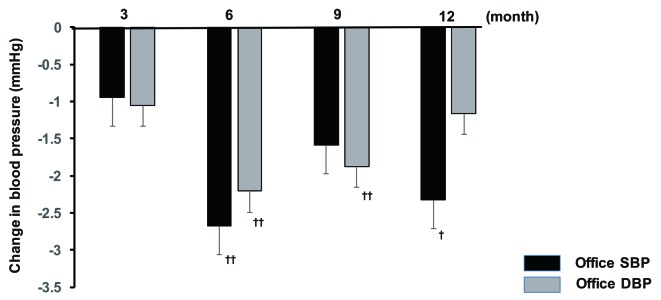
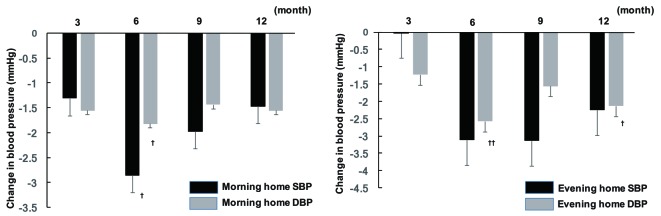
The office SBP showed a significant decrease after 6 and 12 months of sitagliptin therapy (P < 0.01 and P < 0.01, respectively), while office DBP was decreased significantly at all time points of evaluation (3, 6, 9, and 12 months: P < 0.05, P < 0.001, P < 0.001, and P < 0.05, respectively). Analysis of covariance revealed a significant decrease in office SBP after 6 and 12 months, as well as significant reduction of office DBP after 6 and 9 months. Morning home SBP and DBP were significantly reduced after 6 months, as was evening home DBP after 6 and 12 months, but there was no significant decrease in evening home SBP. HbA1c and plasma glucose levels were significantly reduced at all time points of evaluation. Examination of the lipid profile revealed that total cholesterol, low-density lipoprotein cholesterol, and triglycerides were also decreased at all time points of evaluation, while high-density lipoprotein cholesterol was significantly reduced after 3, 9, and 12 months. Significant reduction of the estimated glomerular filtration rate was observed after 6, 9, and 12 months, and the urinary albumin/creatinine ratio was significantly lower at 9 and 12 months. Serum creatinine was increased significantly at all time points of evaluation.
BP was slightly but significantly reduced from 6 months after initiation of sitagliptin therapy, indicating that this antidiabetic drug has pleiotropic effects, including an antihypertensive effect.
长期使用西他列汀治疗对诊室血压(BP)和家庭血压的影响尚不清楚。
在一项对454例2型糖尿病患者的回顾性队列研究中,分析了西他列汀治疗开始前以及治疗后3、6、9和12个月时的以下变量:诊室收缩压(SBP)、诊室舒张压(DBP)、诊室脉搏率、早晨家庭SBP、早晨家庭DBP、早晨家庭脉搏率、晚上家庭SBP、晚上家庭DBP、晚上家庭脉搏率、糖化血红蛋白(HbA1c)、血糖、血脂谱和肾功能参数。
西他列汀治疗6个月和12个月后,诊室SBP显著降低(分别为P < 0.01和P < 0.01),而诊室DBP在所有评估时间点均显著降低(3、6、9和12个月时分别为:P < 0.05、P < 0.001、P < 0.001和P < 0.05)。协方差分析显示,6个月和12个月后诊室SBP显著降低,6个月和9个月后诊室DBP显著降低。6个月后早晨家庭SBP和DBP显著降低,6个月和12个月后晚上家庭DBP显著降低,但晚上家庭SBP无显著降低。在所有评估时间点,HbA1c和血糖水平均显著降低。血脂谱检查显示,在所有评估时间点,总胆固醇、低密度脂蛋白胆固醇和甘油三酯也均降低,而高密度脂蛋白胆固醇在3、9和12个月后显著降低。6、9和12个月后观察到估算肾小球滤过率显著降低,9和12个月时尿白蛋白/肌酐比值显著降低。在所有评估时间点,血清肌酐均显著升高。
西他列汀治疗开始6个月后血压略有但显著降低,表明这种抗糖尿病药物具有多种作用,包括降压作用。