Kang Seokmin, Tversky Barbara
Wisconsin Center for Education Research, University of Wisconsin-Madison, Educational Sciences Building, 1025 West Johnson Street, Madison, WI 53706 USA.
Department of Psychology, Stanford University, Stanford, CA, USA ; Department of Human Development, Teachers College, Columbia University, New York, NY, USA.
Cogn Res Princ Implic. 2016;1(1):4. doi: 10.1186/s41235-016-0004-9. Epub 2016 Sep 22.
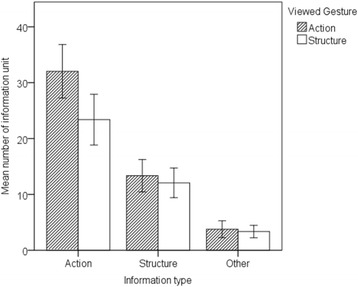
Gestures serve many roles in communication, learning and understanding both for those who view them and those who create them. Gestures are especially effective when they bear resemblance to the thought they represent, an advantage they have over words. Here, we examine the role of conceptually congruent gestures in deepening understanding of dynamic systems. Understanding the structure of dynamic systems is relatively easy, but understanding the actions of dynamic systems can be challenging. We found that seeing gestures representing actions enhanced understanding of the dynamics of a complex system as revealed in invented language, gestures and visual explanations. Gestures can map many meanings more directly than language, representing many concepts congruently. Designing and using gestures congruent with meaning can augment comprehension and learning.
手势在交流、学习以及理解方面对观看者和做出手势的人都发挥着多种作用。当手势与它们所代表的思想相似时,手势尤其有效,这是它们相对于语言的一个优势。在此,我们研究概念上一致的手势在加深对动态系统理解方面的作用。理解动态系统的结构相对容易,但理解动态系统的行为可能具有挑战性。我们发现,看到代表动作的手势能增强对复杂系统动态的理解,这在发明的语言、手势和视觉解释中有所体现。手势比语言能更直接地映射多种含义,能一致地代表许多概念。设计和使用与意义相符的手势可以增强理解和学习。