Department of Anatomy &Cell Biology, Indiana University School of Medicine, Indianapolis, IN, USA.
Bindley Bioscience Center, Department of Agricultural &Biological Engineering, Purdue University, West Lafayette, IN, USA.
Sci Rep. 2017 Feb 9;7:42047. doi: 10.1038/srep42047.
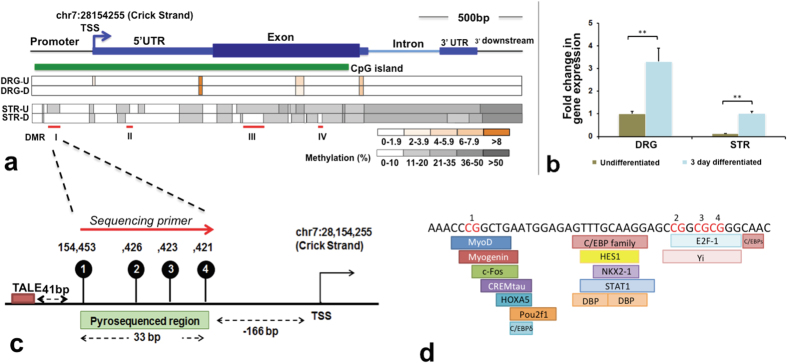
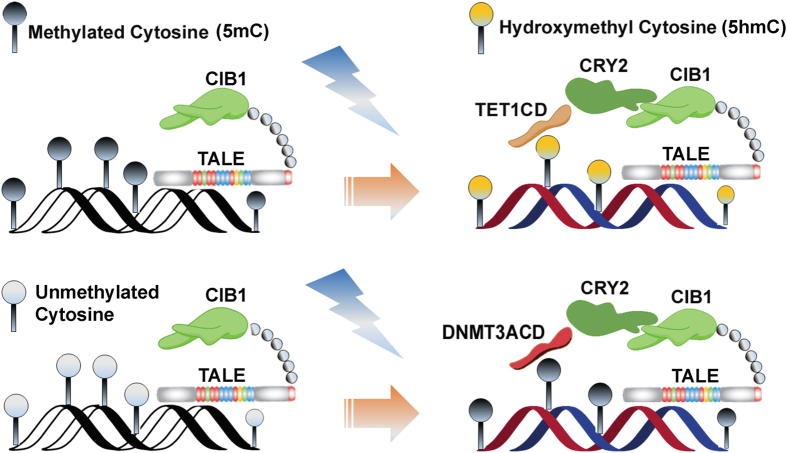
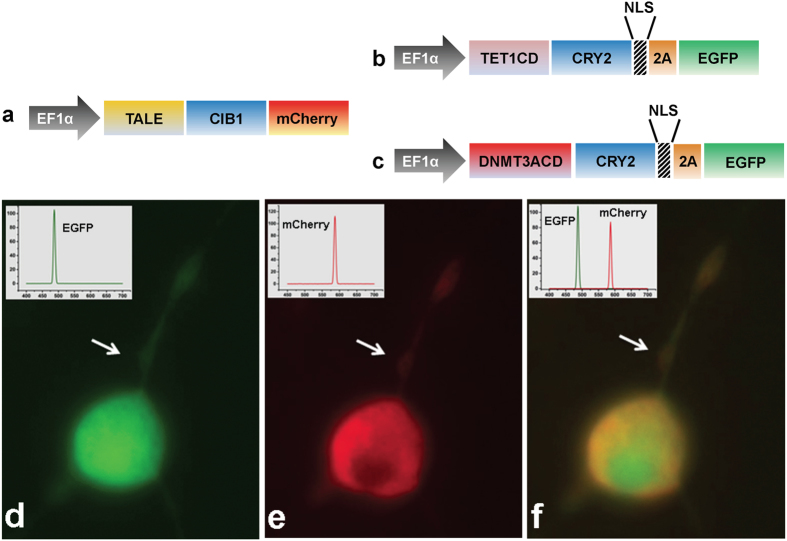
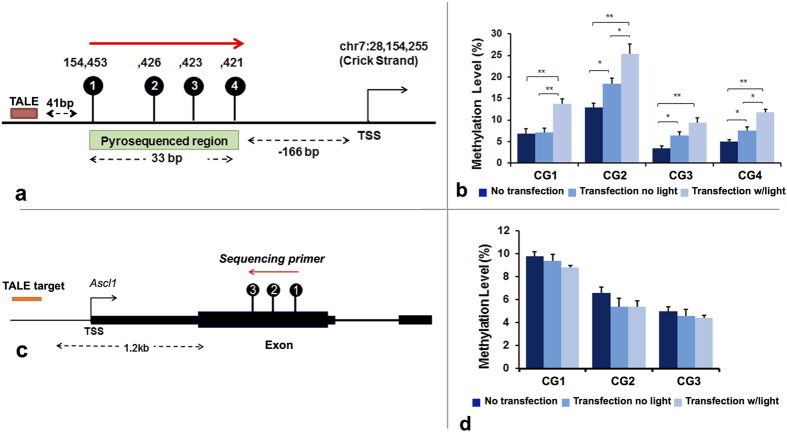
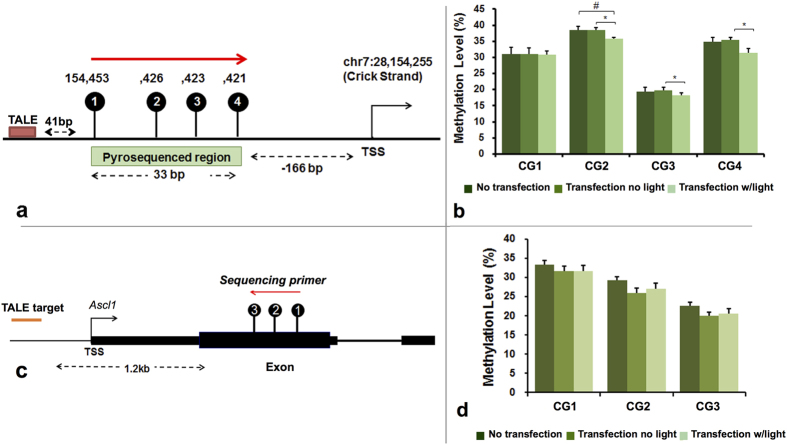
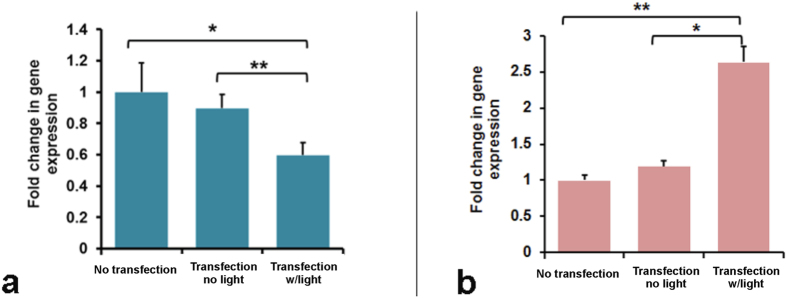
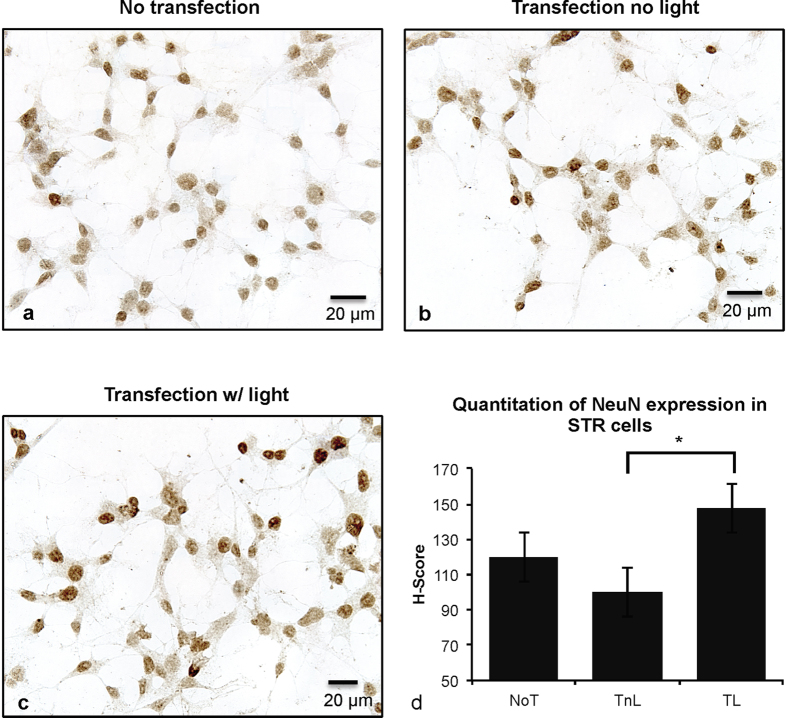
Enzymes involved in epigenetic processes such as methyltransferases or demethylases are becoming highly utilized for their persistent DNA or histone modifying efficacy. Herein, we have developed an optogenetic toolbox fused to the catalytic domain (CD) of DNA-methyltransferase3A (DNMT3A-CD) or Ten-Eleven Dioxygenase-1 (TET1-CD) for loci-specific alteration of the methylation state at the promoter of Ascl1 (Mash1), a candidate proneuron gene. Optogenetical protein pairs, CRY2 linked to DNMT3A-CD or TET1-CD and CIB1 fused to a Transcription Activator-Like Element (TALE) locating an Ascl1 promoter region, were designed for site specific epigenetic editing. A differentially methylated region at the Ascl1 promoter, isolated from murine dorsal root ganglion (hypermethylated) and striated cells (hypomethylated), was targeted with these optogenetic-epigenetic constructs. Optimized blue-light illumination triggered the co-localization of TALE constructs with DNMT3A-CD or TET1-CD fusion proteins at the targeted site of the Ascl1 promoter. We found that this spatiotemporal association of the fusion proteins selectively alters the methylation state and also regulates gene activity. This proof of concept developed herein holds immense promise for the ability to regulate gene activity via epigenetic modulation with spatiotemporal precision.
涉及表观遗传过程的酶,如甲基转移酶或去甲基酶,由于其持续的 DNA 或组蛋白修饰效果而被广泛应用。在此,我们开发了一个光遗传学工具箱,融合了 DNA-甲基转移酶 3A(DNMT3A-CD)或 Ten-Eleven 双加氧酶-1(TET1-CD)的催化结构域(CD),用于在候选前体细胞基因 Ascl1(Mash1)的启动子处进行特定位置的甲基化状态改变。光遗传学蛋白对,CRY2 与 DNMT3A-CD 或 TET1-CD 相连,CIB1 与转录激活样元件(TALE)融合,位于 Ascl1 启动子区域,用于特定位置的表观遗传编辑。从鼠背根神经节(高甲基化)和横纹肌细胞(低甲基化)中分离出的 Ascl1 启动子上的差异甲基化区域,被这些光遗传学-表观遗传学构建体靶向。优化的蓝光照射触发 TALE 构建体与靶向 Ascl1 启动子的 DNMT3A-CD 或 TET1-CD 融合蛋白的共定位。我们发现,这种融合蛋白的时空关联选择性地改变了甲基化状态,并调节了基因活性。本文开发的这一概念验证为通过时空精确的表观遗传调节来调节基因活性提供了巨大的潜力。