Broad Institute of MIT and Harvard, 7 Cambridge Center, Cambridge, MA 02142, USA.
McGovern Institute for Brain Research, Department of Brain and Cognitive Sciences, Department of Biological Engineering, Massachusetts Institute of Technology, Cambridge, MA 02139, USA.
Nature. 2013 Aug 22;500(7463):472-476. doi: 10.1038/nature12466. Epub 2013 Aug 23.
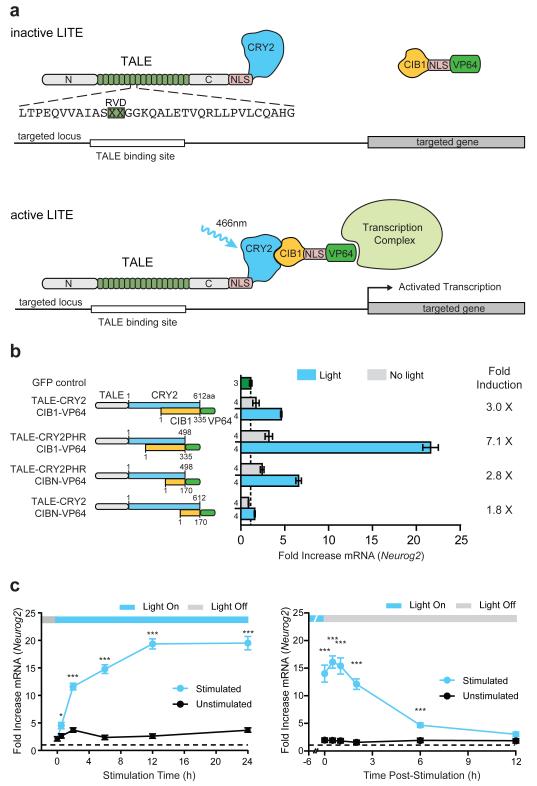
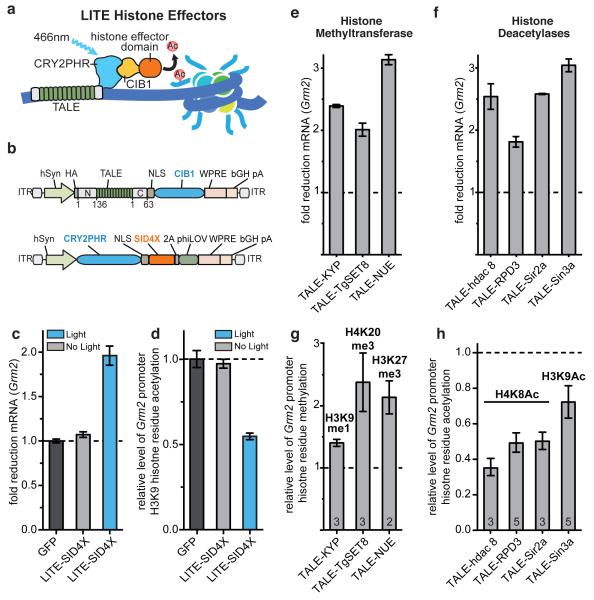
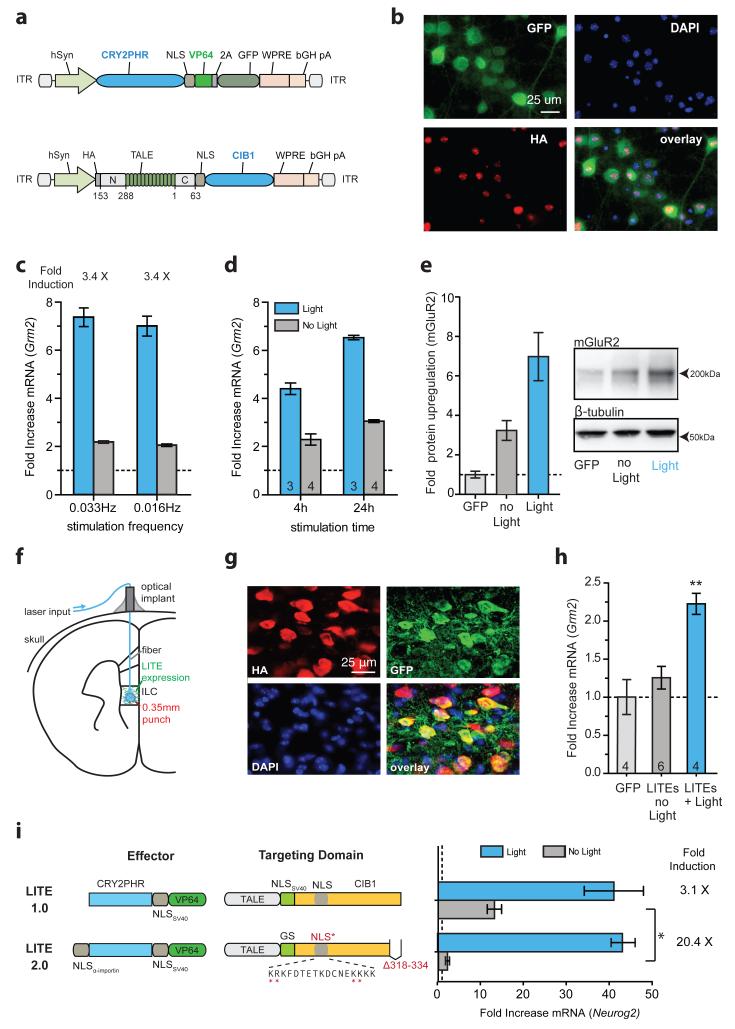
The dynamic nature of gene expression enables cellular programming, homeostasis and environmental adaptation in living systems. Dissection of causal gene functions in cellular and organismal processes therefore necessitates approaches that enable spatially and temporally precise modulation of gene expression. Recently, a variety of microbial and plant-derived light-sensitive proteins have been engineered as optogenetic actuators, enabling high-precision spatiotemporal control of many cellular functions. However, versatile and robust technologies that enable optical modulation of transcription in the mammalian endogenous genome remain elusive. Here we describe the development of light-inducible transcriptional effectors (LITEs), an optogenetic two-hybrid system integrating the customizable TALE DNA-binding domain with the light-sensitive cryptochrome 2 protein and its interacting partner CIB1 from Arabidopsis thaliana. LITEs do not require additional exogenous chemical cofactors, are easily customized to target many endogenous genomic loci, and can be activated within minutes with reversibility. LITEs can be packaged into viral vectors and genetically targeted to probe specific cell populations. We have applied this system in primary mouse neurons, as well as in the brain of freely behaving mice in vivo to mediate reversible modulation of mammalian endogenous gene expression as well as targeted epigenetic chromatin modifications. The LITE system establishes a novel mode of optogenetic control of endogenous cellular processes and enables direct testing of the causal roles of genetic and epigenetic regulation in normal biological processes and disease states.
基因表达的动态特性使生物系统能够进行细胞编程、维持内稳态和适应环境。因此,要剖析细胞和机体过程中因果基因的功能,就需要采用能够精确调控基因表达时空的方法。最近,人们已经对各种微生物和植物来源的光敏感蛋白进行了工程改造,将其作为光遗传学驱动器,从而实现了对许多细胞功能的高精度时空控制。然而,能够在哺乳动物内源性基因组中进行光学转录调控的多功能、稳健的技术仍然难以实现。本文中,我们描述了光诱导转录效应器(LITE)的开发,这是一种光遗传学双杂交系统,它将可定制的 TALE DNA 结合域与来自拟南芥的光敏感隐花色素 2 蛋白及其相互作用蛋白 CIB1 整合在一起。LITE 不需要额外的外源化学辅因子,很容易被定制以靶向许多内源性基因组位点,并且可以在数分钟内激活,具有可逆性。LITE 可以被包装到病毒载体中,并通过遗传靶向用于探测特定的细胞群体。我们已经在原代小鼠神经元以及自由活动的小鼠大脑中应用了该系统,以介导哺乳动物内源性基因表达的可逆调节以及靶向的表观遗传染色质修饰。LITE 系统建立了一种新的内源性细胞过程的光遗传学控制模式,并能够直接测试遗传和表观遗传调控在正常生物学过程和疾病状态中的因果作用。