Gathright Emily C, Goldstein Carly M, Josephson Richard A, Hughes Joel W
Department of Psychological Sciences, Kent State University, Kent, OH 44240, USA; Alpert Medical School, Brown University, Providence, RI 02903, USA.
Alpert Medical School, Brown University, Providence, RI 02903, USA.
J Psychosom Res. 2017 Mar;94:82-89. doi: 10.1016/j.jpsychores.2017.01.010. Epub 2017 Jan 24.
Depression is a risk factor for mortality in cardiovascular diseases. Prior studies confirm that depression predicts adverse outcomes in patients with heart failure (HF). However, data were inconclusive regarding the effect of depression on mortality. This meta-analysis examines the relationship between depression and mortality in HF.
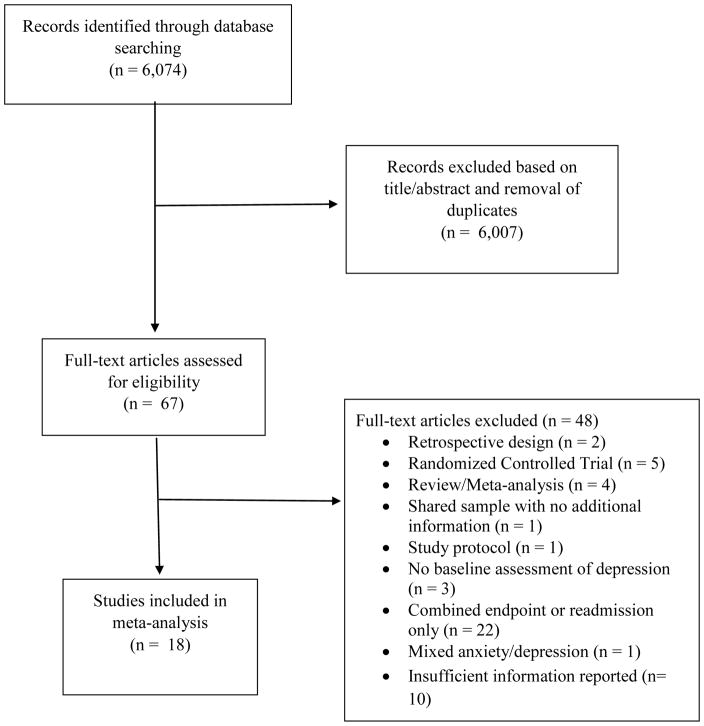
Prospective studies of depression and mortality in HF published between 1999 and April 2016 were located using PubMed, PsychINFO, and MEDLINE. Comprehensive Meta-Analysis software was used to compute an aggregated effect size estimates of hazard ratios and to conduct subgroup analyses.
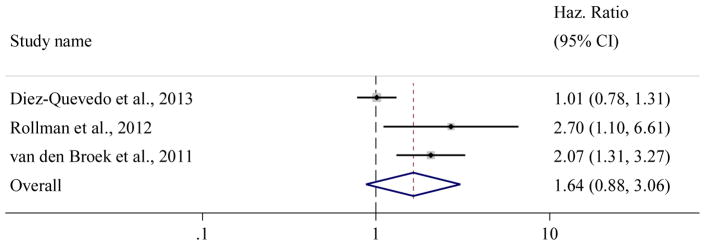
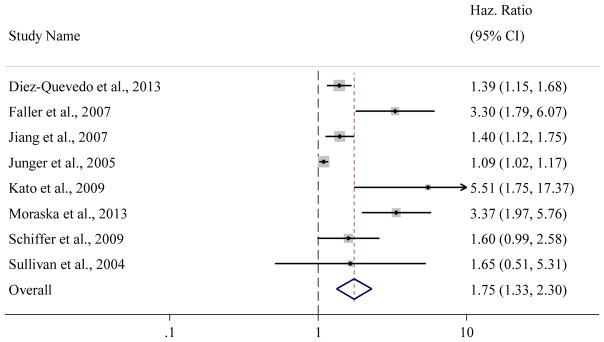
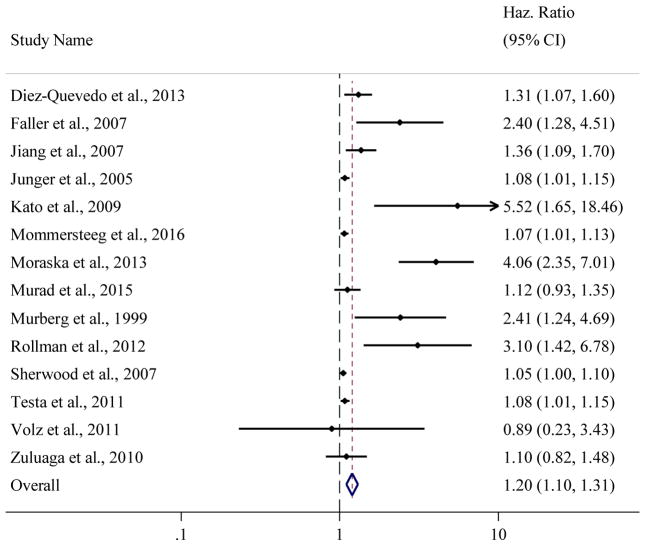
Eighteen studies met inclusion criteria. For 8 aggregated univariate and 14 multivariate estimates, depressive symptoms were related to all-cause mortality. A pooled HR of 3 multivariate analyses indicated that depressive symptoms were not linked to cardiovascular mortality. In subgroup analyses, depression predicted all-cause mortality in samples with a mean age >65. The impact of depression on all-cause mortality also differed by follow-up duration, with samples with shorter follow-up durations demonstrating a larger effect.
In HF, depression is related to increased all-cause mortality risk, with stronger effects in samples with shorter follow-up and in older adults. In older adults, depression may serve as a marker of more severe HF. However, this possibility is difficult to examine given inconsistent adjustment for HF severity. Additional studies may assist in determining the relationship between depression and cardiovascular mortality, as the low number of studies examining cardiovascular mortality may have precluded detection of an effect.
抑郁症是心血管疾病死亡的一个风险因素。先前的研究证实,抑郁症可预测心力衰竭(HF)患者的不良结局。然而,关于抑郁症对死亡率的影响,数据尚无定论。这项荟萃分析探讨了抑郁症与HF死亡率之间的关系。
利用PubMed、PsychINFO和MEDLINE检索1999年至2016年4月发表的关于HF患者抑郁症与死亡率的前瞻性研究。使用综合荟萃分析软件计算风险比的综合效应量估计值并进行亚组分析。
18项研究符合纳入标准。对于8个汇总的单变量估计值和14个多变量估计值,抑郁症状与全因死亡率相关。3项多变量分析的合并风险比表明,抑郁症状与心血管死亡率无关。在亚组分析中,抑郁症可预测平均年龄>65岁样本中的全因死亡率。抑郁症对全因死亡率的影响也因随访时间而异,随访时间较短的样本显示出更大的效应。
在HF中,抑郁症与全因死亡风险增加相关,在随访时间较短的样本和老年人中效应更强。在老年人中,抑郁症可能是更严重HF的一个标志。然而,鉴于对HF严重程度的调整不一致,这种可能性难以检验。由于研究心血管死亡率的研究数量较少,可能无法检测到效应,因此更多的研究可能有助于确定抑郁症与心血管死亡率之间的关系。