Patterson Stuart, Drewe Julian A, Pfeiffer Dirk U, Clutton-Brock Tim H
Veterinary Epidemiology, Economics and Public Health Group, Royal Veterinary College, University of London, Hawkshead Lane, Hatfield AL9 7TA, UK.
School of Veterinary Medicine, City University of Hong Kong, Tat Chee Avenue, Kowloon, Hong Kong SAR.
J Anim Ecol. 2017 May;86(3):442-450. doi: 10.1111/1365-2656.12649. Epub 2017 Apr 3.
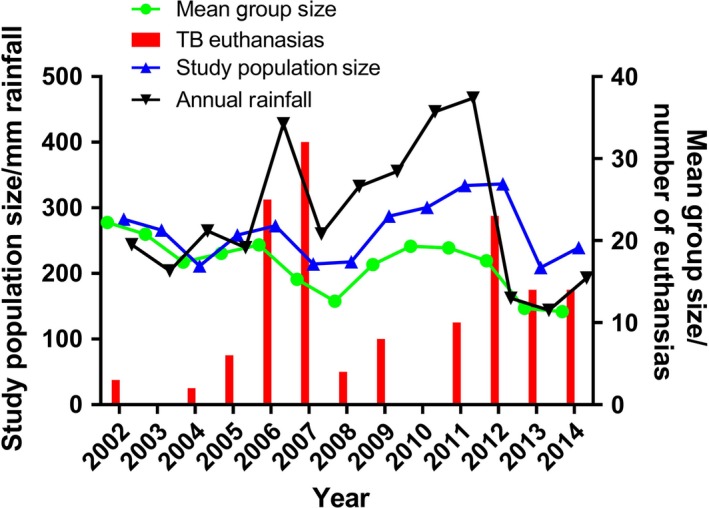
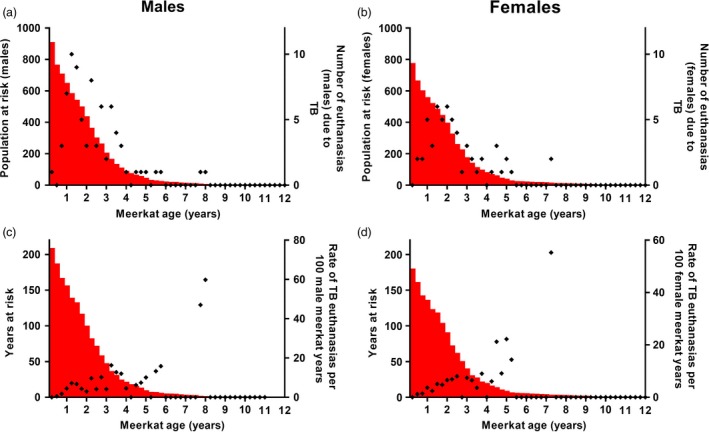
Tuberculosis (TB) is an important and widespread disease of wildlife, livestock and humans world-wide, but long-term empirical datasets describing this condition are rare. A population of meerkats (Suricata suricatta) in South Africa's Kalahari Desert have been diagnosed with Mycobacterium suricattae, a novel strain of TB, causing fatal disease in this group-living species. This study aimed to find characteristics associated with clinical TB in meerkats. These characteristics could subsequently be used to identify 'at-risk' animals within a population, and target these individuals for control measures. We conducted a retrospective study based on a unique, long-term life-history dataset of over 2000 individually identified animals covering a 14-year period after the first confirmatory diagnosis of TB in this population in 2001. Individual- and group-level risk factors were analysed using time-dependent Cox regression to examine their potential influence on the time to development of end-stage TB. Cases of disease involved 144 individuals in 27 of 73 social groups, across 12 of 14 years (an incidence rate of 3·78 cases/100 study years). At the individual level, increasing age had the greatest effect on risk of disease with a hazard ratio of 4·70 (95% CI: 1·92-11·53, P < 0·01) for meerkats aged 24-48 months, and a hazard ratio of 9·36 (3·34-26·25, P < 0·001) for animals aged over 48 months (both age categories compared with animals aged below 24 months). Previous group history of TB increased the hazard by a factor of 4·29 (2·00-9·17, P < 0·01), and an interaction was found between this variable and age. At a group level, immigrations of new group members in the previous year increased hazard by a factor of 3·00 (1·23-7·34, P = 0·016). There was weaker evidence of an environmental effect with a hazard ratio for a low rainfall (<200 mm) year of 2·28 (0·91-5·72, P = 0·079). Our findings identify potential individual characteristics on which to base targeted control measures such as vaccination. Additional data on the dynamics of the infection status of individuals and how this changes over time would complement these findings by enhancing understanding of disease progression and transmission, and thus the implications of potential management measures.
结核病(TB)是一种在全球范围内影响野生动物、家畜和人类的重要且广泛传播的疾病,但描述这种疾病状况的长期实证数据集却很罕见。南非喀拉哈里沙漠的一群狐獴(狐獴属)被诊断感染了一种新型结核分枝杆菌——苏氏分枝杆菌,这种病菌在这种群居物种中引发了致命疾病。本研究旨在找出与狐獴临床结核病相关的特征。这些特征随后可用于识别种群中“高危”动物,并针对这些个体采取控制措施。我们基于一个独特的长期生活史数据集进行了一项回顾性研究,该数据集涵盖了2000多只个体识别动物,时间跨度为自2001年该种群首次确诊结核病后的14年。使用时间依赖性Cox回归分析个体和群体层面的风险因素,以检验它们对终末期结核病发病时间的潜在影响。疾病病例涉及73个社会群体中的27个群体的144只个体,时间跨度为14年中的12年(发病率为3.78例/100研究年)。在个体层面,年龄增长对患病风险影响最大,24至48个月大的狐獴患病风险比为4.70(95%置信区间:1.92 - 11.53,P < 0.01),48个月以上的动物患病风险比为9.36(3.34 - 26.25,P < 0.001)(这两个年龄组均与24个月以下的动物相比)。之前群体的结核病病史使患病风险增加了4.29倍(2.00 - 9.17,P < 0.01),并且发现该变量与年龄之间存在相互作用。在群体层面,前一年新群体成员的迁入使患病风险增加了3.00倍(1.23 - 7.34,P = 0.016)。有较弱的证据表明存在环境影响,降雨量低(<200毫米)年份的患病风险比为2.28(0.91 - 5.72,P = 0.079)。我们的研究结果确定了可作为针对性控制措施(如疫苗接种)依据的潜在个体特征。关于个体感染状态动态以及其随时间如何变化的更多数据,将通过加强对疾病进展和传播的理解,从而补充这些发现,并进而了解潜在管理措施的影响。