Brandt Linn, Vandvik Per Olav, Alonso-Coello Pablo, Akl Elie A, Thornton Judith, Rigau David, Adams Katie, O'Connor Paul, Guyatt Gordon, Kristiansen Annette
Department of Internal Medicine, Sykehuset Innlandet Hospital Trust, Gjøvik, Norway.
Faculty of Medicine, Institute of Health and Society, University of Oslo, Oslo, Norway.
BMJ Open. 2017 Feb 10;7(2):e011569. doi: 10.1136/bmjopen-2016-011569.
To investigate practicing physicians' preferences, perceived usefulness and understanding of a new multilayered guideline presentation format-compared to a standard format-as well as conceptual understanding of trustworthy guideline concepts.
Participants attended a standardised lecture in which they were presented with a clinical scenario and randomised to view a guideline recommendation in a multilayered format or standard format after which they answered multiple-choice questions using clickers. Both groups were also presented and asked about guideline concepts.
Mandatory educational lectures in 7 non-academic and academic hospitals, and 2 settings involving primary care in Lebanon, Norway, Spain and the UK.
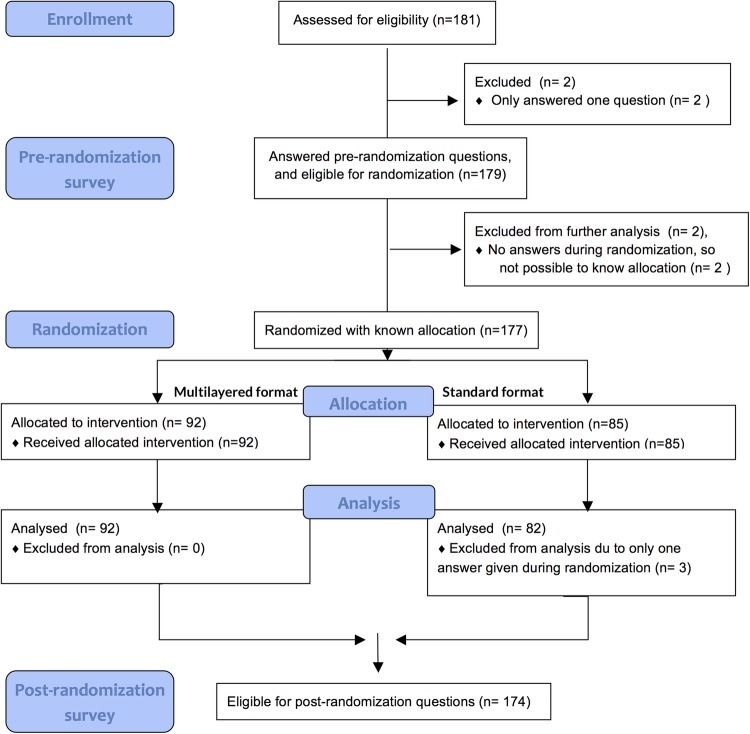
181 practicing physicians in internal medicine (156) and general practice (25).
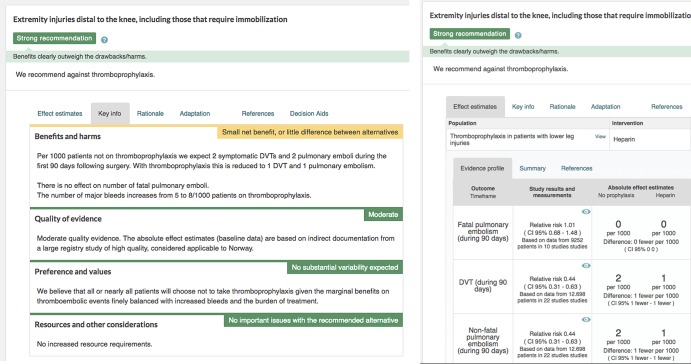
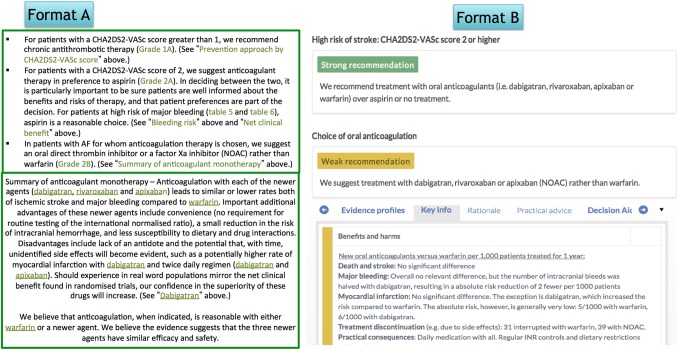
A new digitally structured, multilayered guideline presentation format and a standard narrative presentation format currently in widespread use.
Our primary outcome was preference for presentation format. Understanding, perceived usefulness and perception of absolute effects were secondary outcomes.
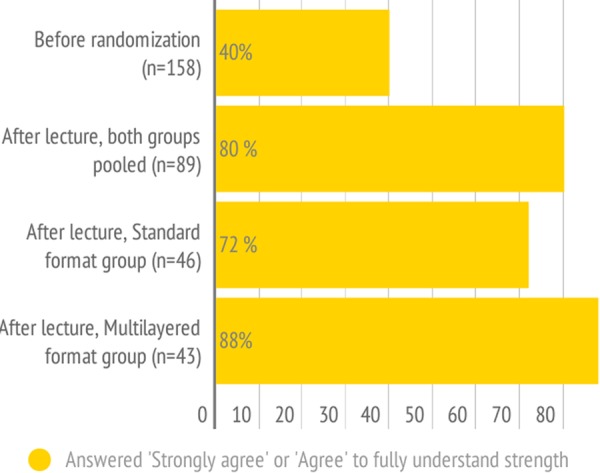
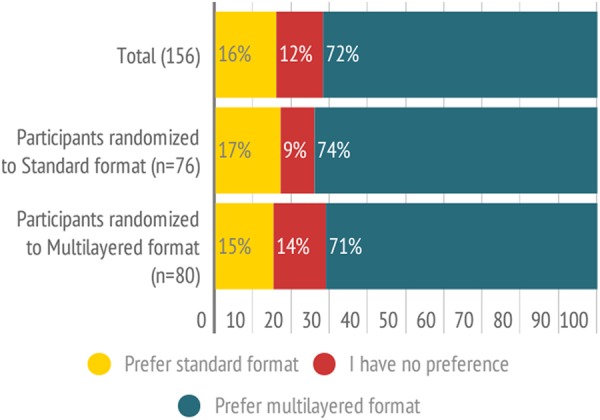
72% (95% CI 65 to 79) of participants preferred the multilayered format and 16% (95% CI 10 to 22) preferred the standard format. A majority agreed that recommendations (multilayered 86% vs standard 91%, p value=0.31) and evidence summaries (79% vs 77%, p value=0.76) were useful in the context of the clinical scenario. 72% of participants randomised to the multilayered format vs 58% for standard formats reported correct understanding of the recommendations (p value=0.06). Most participants elected an appropriate clinical action after viewing the recommendations (98% vs 92%, p value=0.10). 82% of the participants considered absolute effect estimates in evidence summaries helpful or crucial.
Clinicians clearly preferred a novel multilayered presentation format to the standard format. Whether the preferred format improves decision-making and has an impact on patient important outcomes merits further investigation.
与标准格式相比,调查执业医师对一种新的多层指南呈现格式的偏好、感知有用性和理解,以及对可信指南概念的概念理解。
参与者参加了一场标准化讲座,在讲座中向他们展示了一个临床病例,并随机分为观看多层格式或标准格式的指南推荐,之后他们使用答题器回答多项选择题。两组还都展示并询问了指南概念。
在黎巴嫩、挪威、西班牙和英国的7家非学术和学术医院举办的强制性教育讲座,以及2个涉及初级保健的场所。
181名内科(156名)和全科(25名)执业医师。
一种新的数字结构化多层指南呈现格式和一种目前广泛使用的标准叙述性呈现格式。
我们的主要结局是对呈现格式的偏好。理解、感知有用性和对绝对效应的感知是次要结局。
72%(95%置信区间65%至79%)的参与者更喜欢多层格式,16%(95%置信区间10%至22%)更喜欢标准格式。大多数人同意推荐(多层格式86%对标准格式91%,p值=0.31)和证据总结(79%对77%,p值=0.76)在临床病例背景下是有用的。随机分配到多层格式的参与者中有72%对推荐的理解正确,而标准格式组为58%(p值=0.06)。大多数参与者在查看推荐后选择了适当的临床行动(98%对92%,p值=0.10)。82%的参与者认为证据总结中的绝对效应估计有帮助或至关重要。
临床医生明显更喜欢新颖的多层呈现格式而非标准格式。这种首选格式是否能改善决策并对患者的重要结局产生影响值得进一步研究。