de Heer E C, Hulshoff J B, Klerk D, Burgerhof J G M, de Groot D J A, Plukker J Th M, Hospers G A P
Department of Surgical Oncology, University of Groningen, University Medical Center Groningen, Groningen, The Netherlands.
Department of Medical Oncology, University Medical Center Groningen, Groningen, The Netherlands.
Ann Surg Oncol. 2017 Jul;24(7):1811-1820. doi: 10.1245/s10434-017-5797-3. Epub 2017 Feb 10.
Patients with curable esophageal cancer (EC) who proceed beyond the original Chemoradiotherapy for Oesophageal Cancer Followed by Surgery Study (CROSS) eligibility criteria are also treated with neoadjuvant chemoradiotherapy (nCRT). This study assessed the effect that extending the CROSS eligibility criteria for nCRT has on treatment-related toxicity and overall survival (OS) in EC.
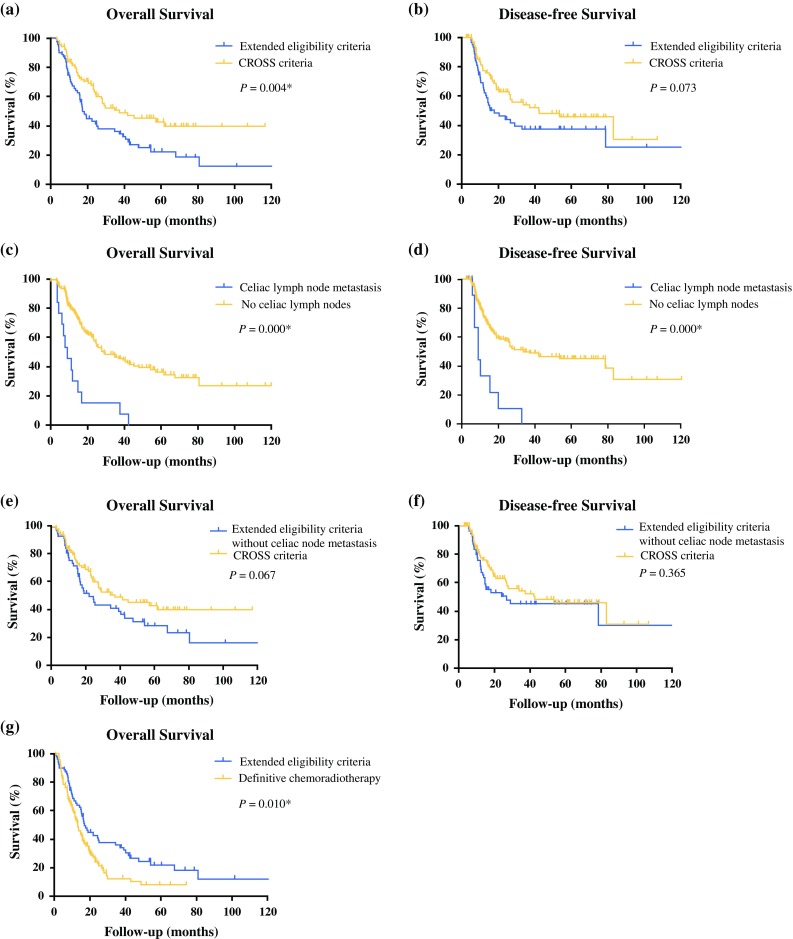
The study enrolled 161 patients with locally advanced EC (T1N1-3/T2-4aN0-3/M0) treated with the CROSS schedule followed by esophagectomy. Group 1 consisted of 89 patients who met the CROSS criteria, and group 2 consisted of 72 patients who met the extended eligibility criteria, i.e. a tumor length greater than 8 cm (n = 24), more than 10% weight loss (n = 35), more than 2-4 cm extension in the stomach (n = 21), celiac lymph node metastasis (n = 13), and/or age over 75 years (n = 2). The study assessed the differences in nCRT-associated toxicity [National Cancer Institute's Common Terminology Criteria for Adverse Events (CTCAE) grade ≥ 3] and 90-day postoperative mortality. Moreover, the prognostic value for OS was assessed with multivariate Cox regression analysis.
No difference was found in nCRT-associated toxicity (P = 0.117), postoperative complications (P = 0.783), and 90-day mortality (P = 0.492). The OS differed significantly (P = 0.004), with a median of 37.3 months [95% confidence interval (CI), 10.4-64.2 months] for group 1 and 17.2 months (95% CI 13.8-20.7 months) for group 2. Pathologic N stage (P = 0.023), pathologic T stage (P = 0.043), and group 2 (P = 0.008) were independent prognostic factors for OS.
Extension of the CROSS study eligibility criteria for nCRT did not affect nCRT-associated toxicity, postoperative complications, and postoperative mortality, but was prognostic for OS.
对于可治愈的食管癌(EC)患者,若超出了最初的食管癌放化疗后手术研究(CROSS)纳入标准,也会接受新辅助放化疗(nCRT)。本研究评估了扩大nCRT的CROSS纳入标准对EC患者治疗相关毒性和总生存期(OS)的影响。
本研究纳入了161例局部晚期EC患者(T1N1 - 3/T2 - 4aN0 - 3/M0),接受CROSS方案治疗后行食管切除术。第1组由89例符合CROSS标准的患者组成,第2组由72例符合扩大纳入标准的患者组成,即肿瘤长度大于8 cm(n = 24)、体重减轻超过10%(n = 35)、胃受累超过2 - 4 cm(n = 21)、腹腔淋巴结转移(n = 13)和/或年龄超过75岁(n = 2)。本研究评估了nCRT相关毒性(美国国立癌症研究所不良事件通用术语标准(CTCAE)≥3级)和术后90天死亡率的差异。此外,通过多因素Cox回归分析评估OS的预后价值。
nCRT相关毒性(P = 0.117)、术后并发症(P = 0.783)和90天死亡率(P = 0.492)方面未发现差异。OS有显著差异(P = 0.004),第1组的中位OS为37.3个月[95%置信区间(CI),10.4 - 64.2个月],第2组为17.2个月(95% CI 13.8 - 20.7个月)。病理N分期(P = 0.023)、病理T分期(P = 0.043)和第2组(P = 0.008)是OS的独立预后因素。
扩大nCRT的CROSS研究纳入标准不影响nCRT相关毒性、术后并发症和术后死亡率,但对OS有预后意义。