Blauvelt A, Papp K A, Sofen H, Augustin M, Yosipovitch G, Katoh N, Mrowietz U, Ohtsuki M, Poulin Y, Shrom D, Burge R, See K, Mallbris L, Gordon K B
Oregon Medical Research Center, Portland, OR, USA.
Probity Medical Research and K. Papp Clinical Research, Waterloo, ON, Canada.
J Eur Acad Dermatol Venereol. 2017 Jun;31(6):1004-1013. doi: 10.1111/jdv.14163. Epub 2017 Mar 31.
Continuous treatment is recommended for patients with moderate-to-severe psoriasis; however, treatment may need to be interrupted in routine clinical practice.
To assess outcomes in patients continuously treated with ixekizumab versus those who interrupted therapy and were subsequently retreated with ixekizumab (IXE).
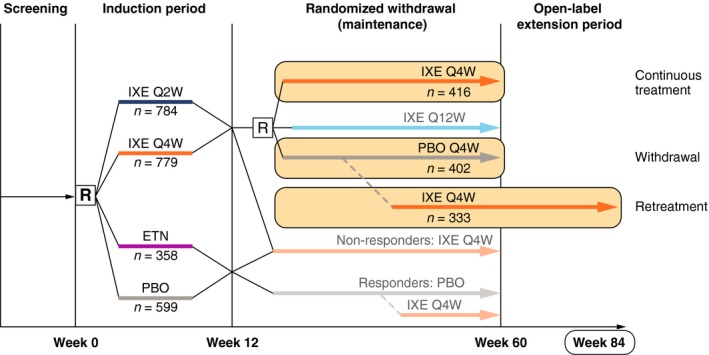
This analysis used data pooled from two phase 3 trials, UNCOVER-1 and UNCOVER-2. Patients were randomized to placebo (PBO), IXE every 4 (Q4W) or IXE every 2 weeks (Q2W) for 12 weeks. Patients with a static Physician's Global Assessment (sPGA) 0, 1 at Week 12 were rerandomized to IXEQ4W, IXE every 12 weeks (not presented) or PBO. We examined outcomes in patients who were continuously treated (IXEQ2W/IXEQ4W; IXEQ4W/IXEQ4W) or withdrawn (IXEQ2W/PBO; IXEQ4W/PBO), and in patients who were withdrawn and retreated with IXEQ4W for 24 weeks after disease relapse (sPGA ≥3).
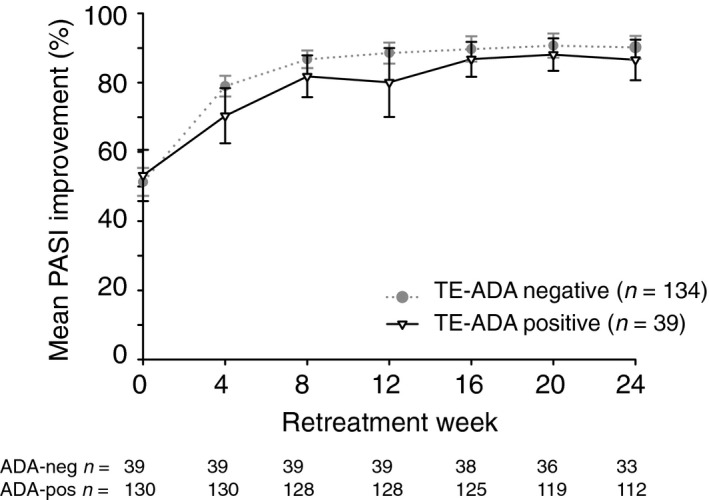
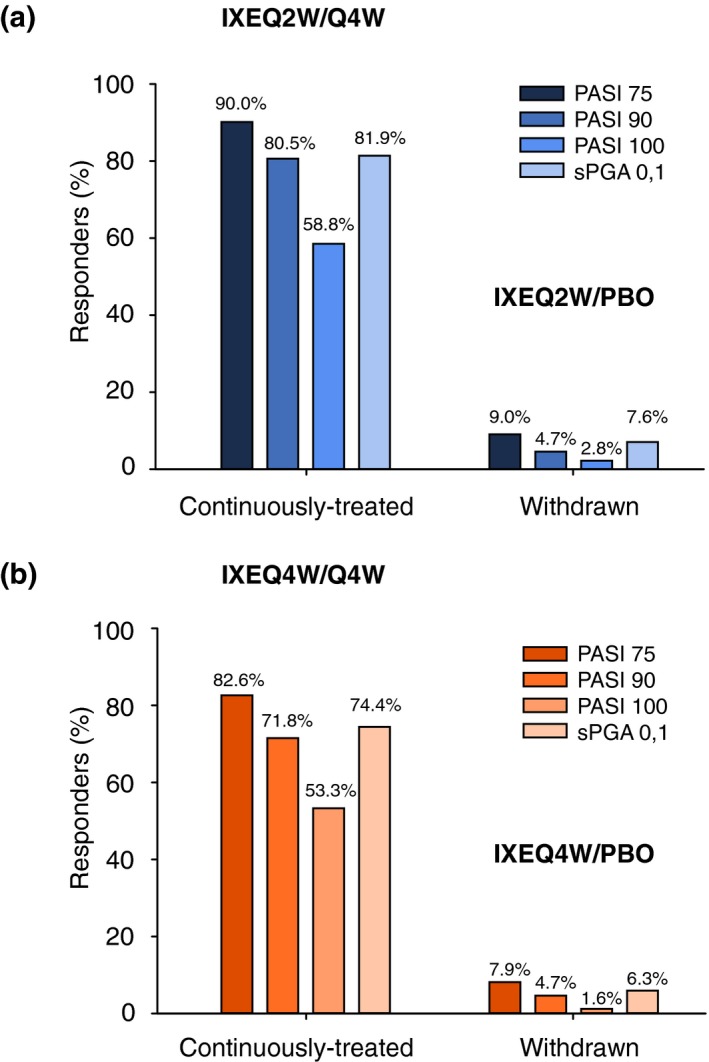
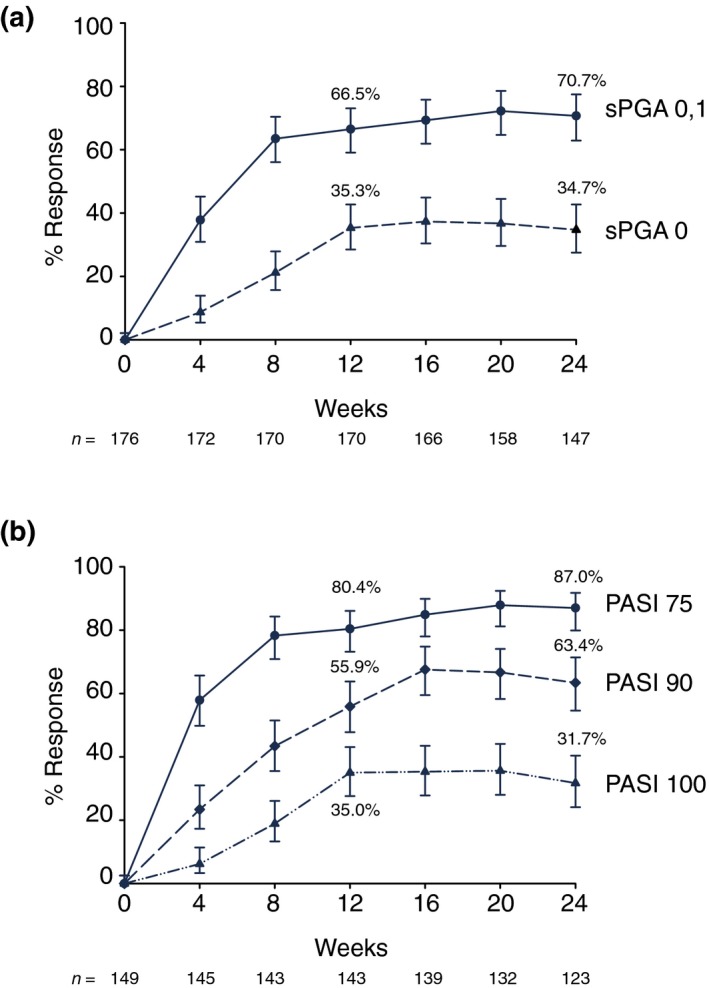
A total of 1226 treated patients achieved an sPGA 0, 1 at Week 12 and entered the maintenance phase; of these patients, 402 and 416 were rerandomized to PBO and IXEQ4W, respectively. Among patients interrupting treatment, 157 (82.2%) of IXEQ4W/PBO and 176 (83.4%) of IXEQ2W/PBO had an sPGA ≥3 by Week 60; median time to relapse was approximately 20 weeks irrespective of induction dose. At Week 60, continuously treated patients maintained high levels of PASI and sPGA responses (90.0% PASI 75 IXEQ2W/IXEQ4W; 81.9% sPGA 0, 1 IXEQ2W/IXEQ4W, non-responder imputation). After 24 weeks of retreatment with IXEQ4W (IXEQ2W/PBO/IXEQ4W and IXEQ4W/PBO/IXEQ4W), 87.0% (107 of 123) and 95.1% (97 of 102) (observed), respectively, of patients recaptured PASI 75 and 70.7% (104 of 147) and 82.3% (107 of 130) (observed) recaptured an sPGA 0, 1. Overall, adverse events in continuously treated and retreated patients were comparable.
High levels of response were sustained with continuous ixekizumab treatment through 60 weeks. Most patients who were withdrawn experienced disease relapse, and most of those patients recaptured response after 24 weeks of retreatment.
对于中度至重度银屑病患者,建议进行持续治疗;然而,在常规临床实践中治疗可能需要中断。
评估接受ixekizumab持续治疗的患者与中断治疗后再接受ixekizumab(IXE)治疗的患者的结局。
本分析使用了两项3期试验(UNCOVER-1和UNCOVER-2)汇总的数据。患者被随机分为安慰剂(PBO)组、每4周(Q4W)一次IXE组或每2周(Q2W)一次IXE组,治疗12周。在第12周时静态医师整体评估(sPGA)为0或1的患者被重新随机分为每4周一次IXE组、每12周一次IXE组(未展示)或PBO组。我们检查了持续治疗(IXEQ2W/IXEQ4W;IXEQ4W/IXEQ4W)或停药(IXEQ2W/PBO;IXEQ4W/PBO)的患者,以及疾病复发(sPGA≥3)后接受每4周一次IXE再治疗24周的患者的结局。
共有1226例接受治疗的患者在第12周时达到sPGA为0或1并进入维持阶段;在这些患者中,分别有402例和416例被重新随机分为PBO组和每4周一次IXE组。在中断治疗的患者中,到第60周时,每4周一次IXE/PBO组的157例(82.2%)和每2周一次IXE/PBO组的176例(83.4%)患者sPGA≥3;无论诱导剂量如何,复发的中位时间约为20周。在第60周时,持续治疗的患者维持了较高水平的银屑病面积和严重程度指数(PASI)及sPGA反应(每2周一次IXE/每4周一次IXE组中90.0%达到PASI 75;每2周一次IXE/每4周一次IXE组中81.9%达到sPGA为0或1,对无反应者进行了插补)。在接受每4周一次IXE再治疗24周后(每2周一次IXE/PBO/每4周一次IXE组和每4周一次IXE/PBO/每4周一次IXE组),分别有87.0%(123例中的107例)和95.1%(102例中的97例)(观察到的数据)的患者重新达到PASI 75,70.7%(147例中的104例)和82.3%(130例中的107例)(观察到的数据)的患者重新达到sPGA为0或1。总体而言,持续治疗和再治疗患者的不良事件具有可比性。
通过60周的ixekizumab持续治疗维持了高水平的反应。大多数停药的患者经历了疾病复发,并且这些患者中的大多数在再治疗24周后重新获得了反应。