Van de Vyver Julie, Abrams Dominic
Centre for the Study of Group Processes, School of Psychology, University of Kent , Canterbury , UK.
J Posit Psychol. 2017 Mar 4;12(2):178-185. doi: 10.1080/17439760.2016.1163410. Epub 2016 May 17.
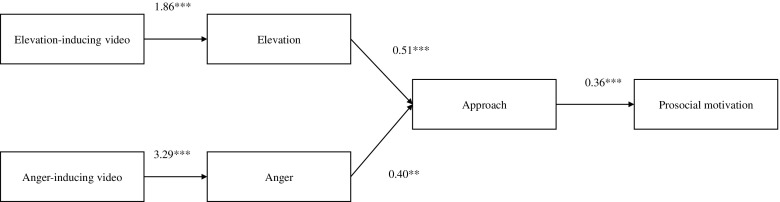
Two studies were designed to test whether moral elevation should be conceptualized as an approach-oriented emotion. The studies examined the relationship between moral elevation and the behavioral activation and inhibition systems. Study 1 ( = 80) showed that individual differences in moral elevation were associated with individual differences in behavioral activation but not inhibition. Study 2 ( = 78) showed that an elevation-inducing video promoted equally high levels of approach orientation as an anger-inducing video and significantly higher levels of approach orientation than a control video. Furthermore, the elevation-inducing stimulus (vs. the control condition) significantly promoted prosocial motivation and this effect was sequentially mediated by feelings of moral elevation followed by an approach-oriented state. Overall the results show unambiguous support for the proposal that moral elevation is an approach-oriented emotion. Applied and theoretical implications are discussed.
两项研究旨在测试道德升华是否应被概念化为一种趋近导向的情绪。这些研究考察了道德升华与行为激活和抑制系统之间的关系。研究1(n = 80)表明,道德升华的个体差异与行为激活的个体差异相关,但与抑制无关。研究2(n = 78)表明,一段引发升华感的视频与一段引发愤怒的视频一样,能促进同样高水平的趋近导向,且其引发的趋近导向水平显著高于对照视频。此外,引发升华感的刺激(与对照条件相比)显著促进了亲社会动机,且这一效应依次由道德升华感介导,随后是趋近导向状态。总体而言,结果明确支持了道德升华是一种趋近导向情绪这一观点。文中还讨论了其应用和理论意义。