Choi Hansol, Kim Hyeon Chang, Lee Joo Young, Lee Ju-Mi, Choi Dong Phil, Suh Il
Department of Public Health, Yonsei University Graduate School, Seoul, Korea.
Cardiovascular and Metabolic Disease Etiology Research Center, Yonsei University College of Medicine, Seoul, Korea.
Korean J Intern Med. 2017 Mar;32(2):323-334. doi: 10.3904/kjim.2015.400. Epub 2017 Feb 15.
BACKGROUND/AIMS: Sleep duration affects health in various ways. The objective of this study was to investigate the associations of sleep duration with chronic kidney disease (CKD) in a Korean adult population.
This cross-sectional analysis was conducted for total of 1,360 participants who completed baseline health examinations for the Korean Genome and Epidemiology Study-Kangwha study in 2010 to 2011. Sleep habits were measured by an interviewer-assisted questionnaire. Sleep duration was calculated based on the number of hours per day participants had slept over the past 1 year. CKD was defined as either proteinuria or estimated glomerular filtration rate (eGFR) < 60 mL/min/1.73 m. Multiple logistic regression models were applied to examine associations between sleep duration and CKD.
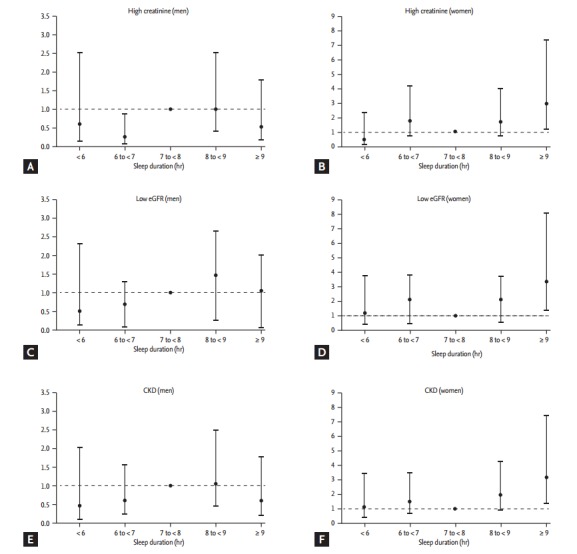
Women with very long sleep duration (≥ 9 hours/day) were at significantly increased odds for having high serum creatinine (odds ratio [OR], 2.936; 95% confidence interval [CI], 1.176 to 7.326), low eGFR (OR, 3.320; 95% CI, 1.372 to 8.034), and CKD (OR, 3.112; 95% CI, 1.315 to 7.363), compared those with a typical sleep duration (7 to < 8 hours/day), after adjusting for sociodemographic status, socioeconomic status, health behaviors, comorbidities, and sleep quality. Among women, for every 1 hour increase in sleep duration per day, there was a 24.6% increase in the presence of CKD (OR, 1.246; 95% CI, 1.019 to 1.523). However, among men, sleep duration was not significantly associated with CKD.
Very long sleep duration was independently associated with a higher prevalence of CKD among Korean women. Gender may influence this association.
背景/目的:睡眠时间会以多种方式影响健康。本研究的目的是调查韩国成年人群中睡眠时间与慢性肾脏病(CKD)之间的关联。
对2010年至2011年完成韩国基因组与流行病学研究——江华岛研究基线健康检查的1360名参与者进行了横断面分析。睡眠习惯通过访员协助的问卷进行测量。睡眠时间根据参与者过去1年每天的睡眠时间计算得出。CKD定义为蛋白尿或估算肾小球滤过率(eGFR)<60 mL/(min/1.73 m²)。应用多元逻辑回归模型来检验睡眠时间与CKD之间的关联。
在调整了社会人口统计学状况、社会经济状况、健康行为、合并症和睡眠质量后,睡眠时间极长(≥9小时/天)的女性血清肌酐升高(优势比[OR],2.936;95%置信区间[CI],1.176至7.326)、eGFR降低(OR,3.320;95%CI,1.372至8.034)以及患CKD(OR,3.112;95%CI,1.315至7.363)的几率显著增加,与睡眠时间正常(7至<8小时/天)的女性相比。在女性中,每天睡眠时间每增加1小时,患CKD的几率增加24.6%(OR,1.246;95%CI,1.019至1.523)。然而,在男性中,睡眠时间与CKD无显著关联。
睡眠时间极长与韩国女性中CKD的较高患病率独立相关。性别可能会影响这种关联。