N'Diaye Awa, Gannesen Andrei, Borrel Valérie, Maillot Olivier, Enault Jeremy, Racine Pierre-Jean, Plakunov Vladimir, Chevalier Sylvie, Lesouhaitier Olivier, Feuilloley Marc G J
Laboratory of Microbiology Signals and Microenvironment (LMSM), Normandie Université Rouen , Evreux , France.
Laboratory of Microbiology Signals and Microenvironment (LMSM), Normandie Université Rouen, Evreux, France; Winogradsky Institute of Microbiology, Research Center of Biotechnology of Russian Academy of Science, Moscow, Russia.
Front Endocrinol (Lausanne). 2017 Jan 30;8:15. doi: 10.3389/fendo.2017.00015. eCollection 2017.
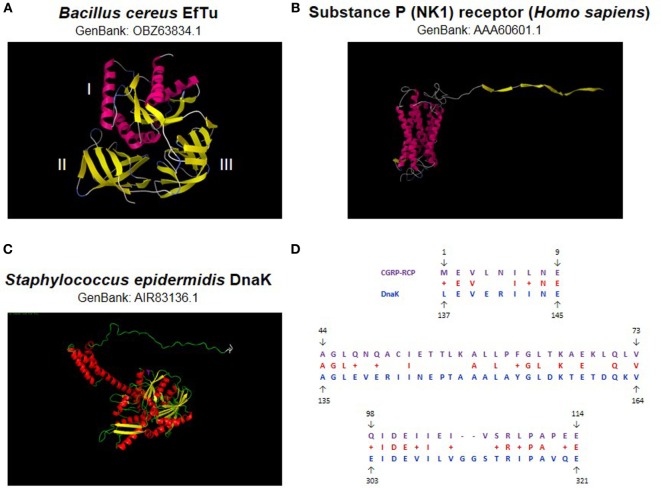
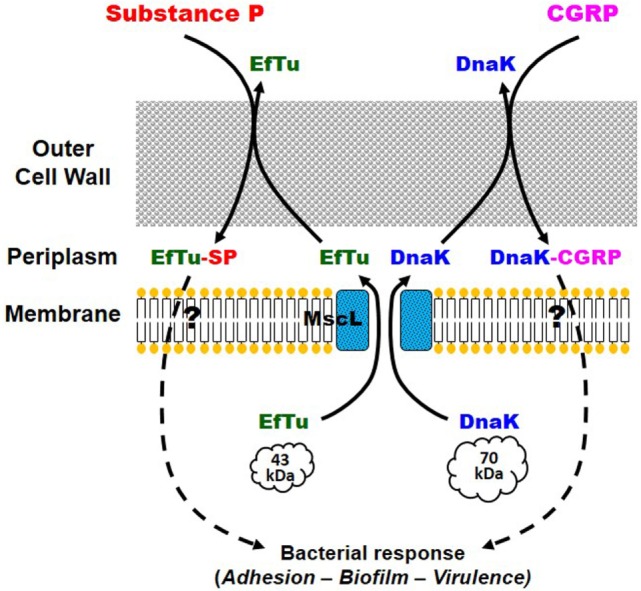
Neurohormones diffuse in sweat and epidermis leading skin bacterial microflora to be largely exposed to these host factors. Bacteria can sense a multitude of neurohormones, but their role in skin homeostasis was only investigated recently. The first study focused on substance P (SP), a neuropeptide produced in abundance by skin nerve terminals. SP is without effect on the growth of Gram-positive (, and ) and Gram-negative () bacteria. However, SP is stimulating the virulence of and . The action of SP is highly specific with a threshold below the nanomolar level. Mechanisms involved in the response to SP are different between bacteria although they are all leading to increased adhesion and/or virulence. The moonlighting protein EfTu was identified as the SP-binding site in and . In skin nerve terminals, SP is co-secreted with the calcitonin gene-related peptide (CGRP), which was shown to modulate the virulence of . This effect is antagonized by SP. Identification of the CGRP sensor, DnaK, allowed understanding this phenomenon as EfTu and DnaK are apparently exported from the bacterium through a common system before acting as SP and CGRP sensors. Many other neuropeptides are expressed in skin, and their potential effects on skin bacteria remain to be investigated. Integration of these host signals by the cutaneous microbiota now appears as a key parameter in skin homeostasis.
神经激素在汗液和表皮中扩散,使皮肤细菌微生物群大量暴露于这些宿主因子。细菌能够感知多种神经激素,但其在皮肤稳态中的作用直到最近才得到研究。第一项研究聚焦于P物质(SP),一种由皮肤神经末梢大量产生的神经肽。SP对革兰氏阳性菌( ,和 )和革兰氏阴性菌( )的生长没有影响。然而,SP会刺激 和 的毒力。SP的作用具有高度特异性,阈值低于纳摩尔水平。尽管细菌对SP的反应机制都会导致粘附和/或毒力增加,但它们之间存在差异。兼职蛋白EfTu被确定为 和 中的SP结合位点。在皮肤神经末梢,SP与降钙素基因相关肽(CGRP)共同分泌,CGRP已被证明可调节 的毒力。这种作用被SP拮抗。CGRP传感器DnaK的鉴定使我们能够理解这一现象,因为EfTu和DnaK显然是通过一个共同系统从细菌中输出,然后才作为SP和CGRP传感器发挥作用。皮肤中还表达了许多其他神经肽,它们对皮肤细菌的潜在影响仍有待研究。皮肤微生物群对这些宿主信号的整合现在似乎是皮肤稳态的一个关键参数。