Lamberts Morten, Staerk Laila, Olesen Jonas Bjerring, Fosbøl Emil Loldrup, Hansen Morten Lock, Harboe Louise, Lefevre Cinira, Evans David, Gislason Gunnar Hilmar
Department of Cardiology, Copenhagen University Hospital Herlev and Gentofte, Hellerup, Denmark
Department of Cardiology, Heart Center, Copenhagen University Hospital Rigshospitalet, Copenhagen, Denmark.
J Am Heart Assoc. 2017 Feb 14;6(2):e004517. doi: 10.1161/JAHA.116.004517.
The nonvitamin K antagonist oral anticoagulants have recently become available as an alternative to warfarin as stroke prophylaxis in atrial fibrillation, but data on real-life patient experience, including bleeding risk, are lacking. Our objective was to compare major bleeding events and nonpersistence between the nonvitamin K antagonist oral anticoagulant apixaban and other nonvitamin K antagonist oral anticoagulants (dabigatran and rivaroxaban) and warfarin in a contemporary, nation-wide cohort of patients with nonvalvular atrial fibrillation.
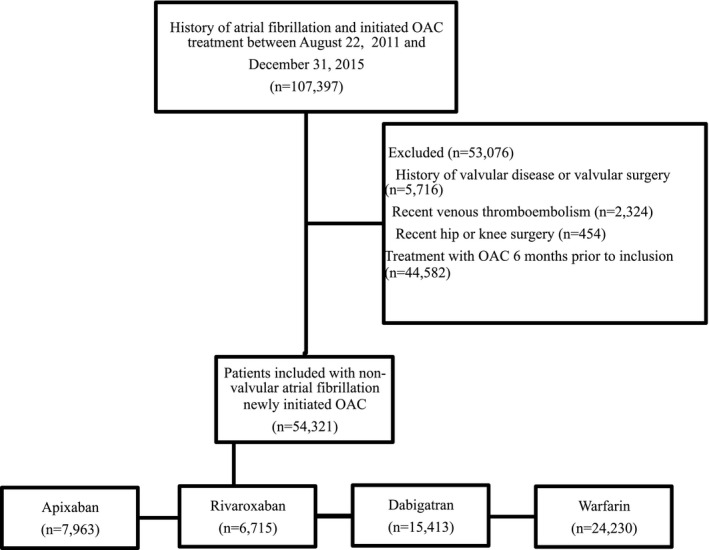
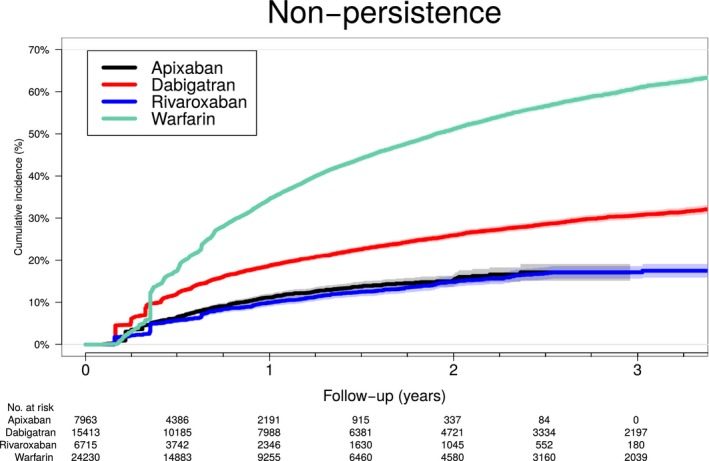
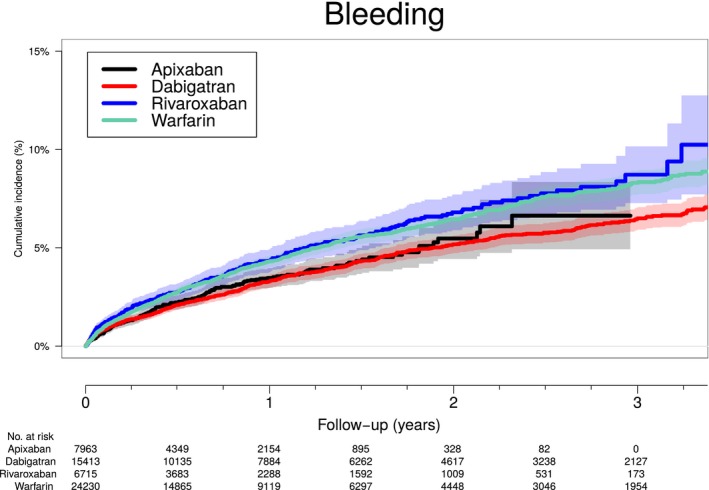
Of 54 321 patients (median age, 73 years; 56% male; mean CHADS-VASc score, 2.9), 7963, 6715, 15 413, and 24 230 patients initiated apixaban, rivaroxaban, dabigatran, and warfarin, respectively. Apixaban and rivaroxaban initiators were older, less often male, with higher HAS-BLED and CHADS-VASc scores compared with dabigatran and warfarin initiators. A total of 2418 patients (4.5%) experienced a major bleeding event over all available follow-up. In this period, rivaroxaban (hazard ratio [HR] [95% CI], 1.49 [1.27-1.77]), dabigatran (HR, 1.17 [1.00-1.38]), and warfarin (HR, 1.23 [1.05-1.43]) users were significantly more likely to bleed than apixaban users. Findings were similar when restricted to the first 30 days after OAC initiation. Risk of nonpersistence was higher for dabigatran (HR, 1.45 [1.33-1.59]) and warfarin initiators (HR, 1.22 [1.12-1.33]), but not for rivaroxaban initiators (HR, 1.07 [0.96-1.20]) compared with apixaban initiators.
In a real-world cohort of nonvalvular atrial fibrillation patients, apixaban had a lower adjusted major bleeding risk compared with rivaroxaban, dabigatran, and warfarin. Apixaban had a lower risk of nonpersistence compared with dabigatran and warfarin and similar risk compared with rivaroxaban.
非维生素K拮抗剂口服抗凝剂最近已可作为华法林的替代品,用于心房颤动的卒中预防,但缺乏包括出血风险在内的真实患者体验数据。我们的目的是在一个当代全国性非瓣膜性心房颤动患者队列中,比较非维生素K拮抗剂口服抗凝剂阿哌沙班与其他非维生素K拮抗剂口服抗凝剂(达比加群和利伐沙班)及华法林之间的主要出血事件和停药情况。
在54321例患者(年龄中位数73岁;56%为男性;CHADS-VASc评分均值2.9)中,分别有7963例、6715例、15413例和24230例患者开始使用阿哌沙班、利伐沙班、达比加群和华法林。与开始使用达比加群和华法林的患者相比,开始使用阿哌沙班和利伐沙班的患者年龄更大,男性比例更低,HAS-BLED和CHADS-VASc评分更高。在所有可用的随访期间,共有2418例患者(4.5%)发生了主要出血事件。在此期间,利伐沙班(风险比[HR][95%CI],1.49[1.27 - 1.77])、达比加群(HR,1.17[1.00 - 1.38])和华法林(HR,1.23[1.05 - 1.43])使用者发生出血的可能性显著高于阿哌沙班使用者。当仅限于口服抗凝剂开始使用后的前30天时,结果相似。与开始使用阿哌沙班的患者相比,达比加群(HR,1.45[1.33 - 1.59])和华法林使用者(HR,1.22[1.12 - 1.33])停药风险更高,但利伐沙班使用者(HR,1.07[0.96 - 1.20])并非如此。
在一个非瓣膜性心房颤动患者的真实队列中,与利伐沙班、达比加群和华法林相比,阿哌沙班调整后的主要出血风险更低。与达比加群和华法林相比,阿哌沙班的停药风险更低,与利伐沙班相比风险相似。