Division of Clinical Pharmacology and Toxicology, Department of Biomedicine and Department of Clinical Research, University Hospital Basel, Hebelstrasse 2, 4031, Basel, Switzerland.
Laboratory Medicine, University Hospital Basel, Basel, Switzerland.
Clin Pharmacokinet. 2017 Oct;56(10):1219-1230. doi: 10.1007/s40262-017-0513-9.
Lysergic acid diethylamide (LSD) is used recreationally and in clinical research. The aim of the present study was to characterize the pharmacokinetics and exposure-response relationship of oral LSD.
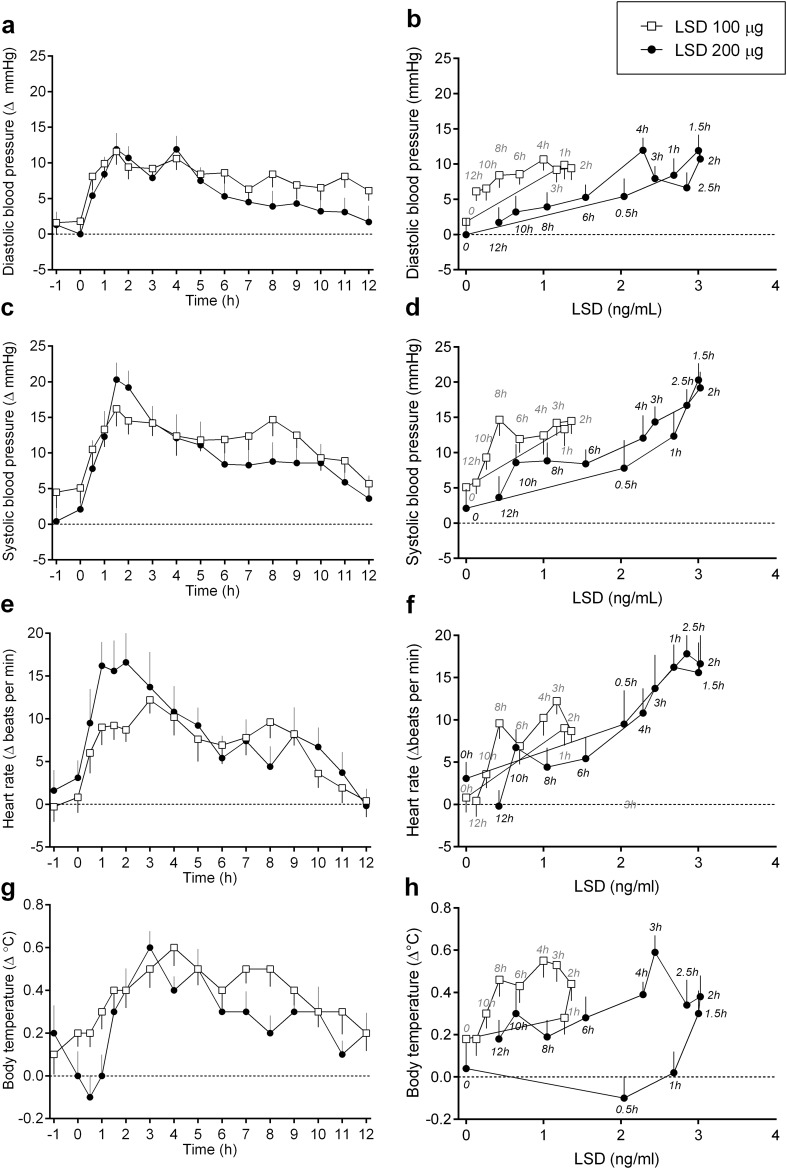
We analyzed pharmacokinetic data from two published placebo-controlled, double-blind, cross-over studies using oral administration of LSD 100 and 200 µg in 24 and 16 subjects, respectively. The pharmacokinetics of the 100-µg dose is shown for the first time and data for the 200-µg dose were reanalyzed and included. Plasma concentrations of LSD, subjective effects, and vital signs were repeatedly assessed. Pharmacokinetic parameters were determined using compartmental modeling. Concentration-effect relationships were described using pharmacokinetic-pharmacodynamic modeling.
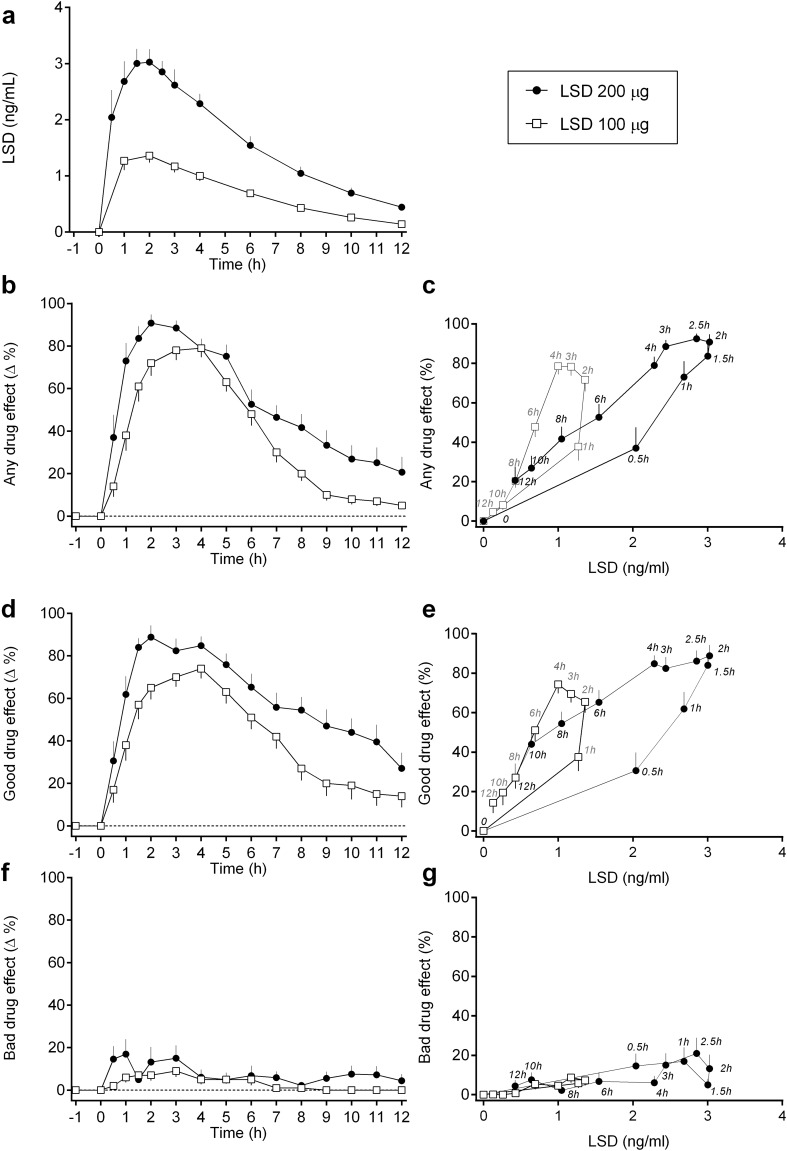
Geometric mean (95% confidence interval) maximum plasma concentration values of 1.3 (1.2-1.9) and 3.1 (2.6-4.0) ng/mL were reached 1.4 and 1.5 h after administration of 100 and 200 µg LSD, respectively. The plasma half-life was 2.6 h (2.2-3.4 h). The subjective effects lasted (mean ± standard deviation) 8.2 ± 2.1 and 11.6 ± 1.7 h for the 100- and 200-µg LSD doses, respectively. Subjective peak effects were reached 2.8 and 2.5 h after administration of LSD 100 and 200 µg, respectively. A close relationship was observed between the LSD concentration and subjective response within subjects, with moderate counterclockwise hysteresis. Half-maximal effective concentration values were in the range of 1 ng/mL. No correlations were found between plasma LSD concentrations and the effects of LSD across subjects at or near maximum plasma concentration and within dose groups.
The present pharmacokinetic data are important for the evaluation of clinical study findings (e.g., functional magnetic resonance imaging studies) and the interpretation of LSD intoxication. Oral LSD presented dose-proportional pharmacokinetics and first-order elimination up to 12 h. The effects of LSD were related to changes in plasma concentrations over time, with no evidence of acute tolerance.
NCT02308969, NCT01878942.
麦角酸二乙酰胺(LSD)被用于娱乐和临床研究。本研究旨在描述 LSD 口服后的药代动力学和暴露-反应关系。
我们分析了两项已发表的安慰剂对照、双盲、交叉研究中的药代动力学数据,这些研究分别使用 LSD 100μg 和 200μg 进行口服给药,各有 24 名和 16 名受试者。首次呈现了 100μg 剂量的药代动力学数据,并重新分析了 200μg 剂量的数据并纳入其中。反复评估 LSD 的血浆浓度、主观效应和生命体征。使用房室模型确定药代动力学参数。使用药代动力学-药效学模型描述浓度-效应关系。
LSD 100μg 和 200μg 给药后 1.4 和 1.5 小时,分别达到 1.3(1.2-1.9)和 3.1(2.6-4.0)ng/mL 的几何均数(95%置信区间)最大血浆浓度值。血浆半衰期为 2.6 小时(2.2-3.4 小时)。主观效应持续时间(平均值±标准差)分别为 LSD 100μg 和 200μg 剂量的 8.2±2.1 和 11.6±1.7 小时。LSD 100μg 和 200μg 给药后 2.8 和 2.5 小时达到主观峰值效应。在个体内,观察到 LSD 浓度与主观反应之间存在密切关系,呈中度逆时针滞后。半数有效浓度值在 1ng/mL 范围内。在接近最大血浆浓度和剂量组内,未发现 LSD 血浆浓度与 LSD 对受试者的影响之间存在相关性。
本药代动力学数据对于评估临床研究结果(例如功能磁共振成像研究)和解释 LSD 中毒具有重要意义。口服 LSD 呈现出剂量比例的药代动力学和直至 12 小时的一级消除。LSD 的作用与随时间变化的血浆浓度变化有关,没有急性耐受的证据。
NCT02308969,NCT01878942。