Thayer Zaneta M, Blair Irene V, Buchwald Dedra S, Manson Spero M
Department of Anthropology, Dartmouth College, NH, 03755.
Department of Psychology and Neuroscience, University of Colorado Boulder, CO, 80309.
Am J Phys Anthropol. 2017 May;163(1):122-128. doi: 10.1002/ajpa.23190. Epub 2017 Feb 15.
Hypertension prevalence is high among American Indians (AIs). AIs experience a substantial burden of interpersonal racial discrimination, which in other populations has been associated with higher blood pressure. The purpose of this study is to understand whether racial discrimination experiences are associated with higher blood pressure in AIs.
We used the Everyday Discrimination Scale to evaluate the relationship between discrimination and measured blood pressure among 77 AIs from two reservation communities in the Northern Plains. We used multivariate linear regression to evaluate the association of racial discrimination with systolic and diastolic blood pressure, respectively. Racial discrimination, systolic blood pressure, and diastolic blood pressure were analyzed as continuous variables. All analyses adjusted for sex, waist circumference, age, posttraumatic stress disorder status, and education.
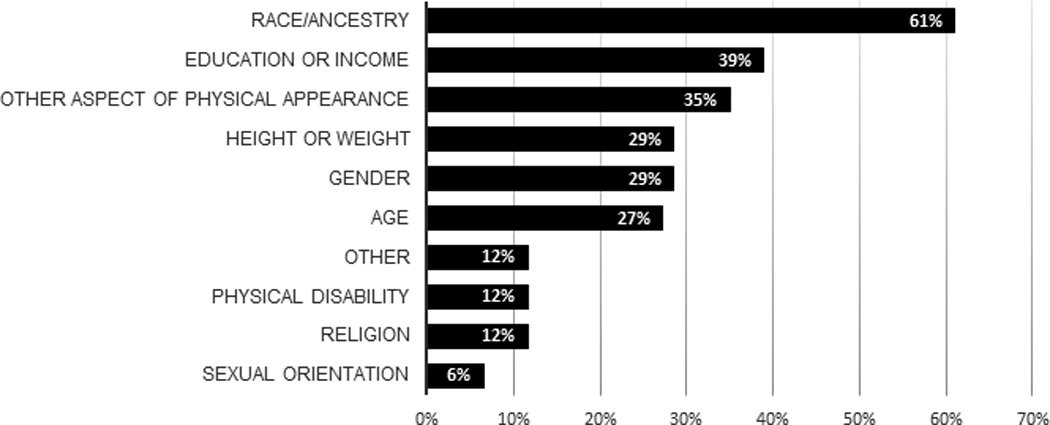
We found that 61% of participants experienced discrimination that they attributed to their race or ancestry. Racial discrimination was associated with significantly higher diastolic blood pressure (β = 0.22, SE = 0.09, p = .02), and with a similar non-significant trend toward higher systolic blood pressure (β = 0.25, SE = 0.15, p = .09).
The results of this analysis suggest that racial discrimination may contribute to higher diastolic blood pressure within Native communities. These findings highlight one pathway through which the social environment can shape patterns of biology and health in AI and other socially and politically marginalized groups.
美国印第安人(AI)的高血压患病率很高。AI承受着人际种族歧视的沉重负担,在其他人群中,这种歧视与更高的血压有关。本研究的目的是了解种族歧视经历是否与AI人群中更高的血压有关。
我们使用日常歧视量表来评估来自北部平原两个保留地社区的77名AI人群中歧视与测量血压之间的关系。我们使用多元线性回归分别评估种族歧视与收缩压和舒张压的关联。种族歧视、收缩压和舒张压作为连续变量进行分析。所有分析均对性别、腰围、年龄、创伤后应激障碍状态和教育程度进行了调整。
我们发现61%的参与者经历了他们认为归因于其种族或血统的歧视。种族歧视与舒张压显著升高相关(β = 0.22,标准误 = 0.09,p = 0.02),与收缩压升高有类似的非显著趋势(β = 0.25,标准误 = 0.15,p = 0.09)。
该分析结果表明,种族歧视可能导致原住民社区舒张压升高。这些发现突出了社会环境塑造AI及其他社会和政治边缘化群体生物学和健康模式的一种途径。