Venkatesan Sudhir, Myles Puja R, Leonardi-Bee Jo, Muthuri Stella G, Al Masri Malak, Andrews Nick, Bantar Carlos, Dubnov-Raz Gal, Gérardin Patrick, Koay Evelyn S C, Loh Tze Ping, Memish Ziad, Miller Elizabeth, Oliva Maria E, Rath Barbara A, Schweiger Brunhilde, Tang Julian W, Tran Dat, Vidmar Tjasa, Waight Pauline A, Nguyen-Van-Tam Jonathan S
Division of Epidemiology and Public Health, University of Nottingham, and.
MRC Unit for Lifelong Health and Ageing, University College London, United Kingdom.
Clin Infect Dis. 2017 May 15;64(10):1328-1334. doi: 10.1093/cid/cix127.
While evidence exists to support the effectiveness of neuraminidase inhibitors (NAIs) in reducing mortality when given to hospitalized patients with A(H1N1)pdm09 virus infection, the impact of outpatient treatment on hospitalization has not been clearly established. We investigated the impact of outpatient NAI treatment on subsequent hospitalization in patients with A(H1N1)pdm09 virus infection.
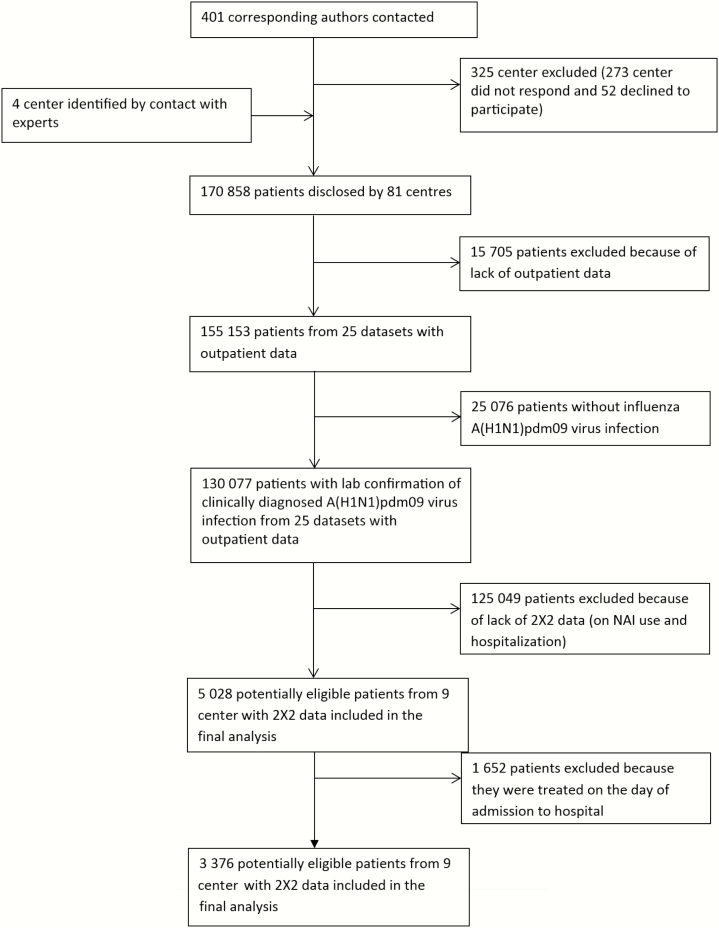
We assembled general community and outpatient data from 9 clinical centers in different countries collected between January 2009 and December 2010. We standardized data from each study center to create a pooled dataset and then used mixed-effects logistic regression modeling to determine the effect of NAI treatment on hospitalization. We adjusted for NAI treatment propensity and preadmission antibiotic use, including "study center" as a random intercept to account for differences in baseline hospitalization rate between centers.
We included 3376 patients with influenza A(H1N1)pdm09, of whom 3085 (91.4%) had laboratory-confirmed infection. Eight hundred seventy-three patients (25.8%) received outpatient or community-based NAI treatment, 928 of 2395 (38.8%) with available data had dyspnea or respiratory distress, and hospitalizations occurred in 1705 (50.5%). After adjustment for preadmission antibiotics and NAI treatment propensity, preadmission NAI treatment was associated with decreased odds of hospital admission compared to no NAI treatment (adjusted odds ratio, 0.24; 95% confidence interval, 0.20-0.30).
In a population with confirmed or suspected A(H1N1)pdm09 and at high risk of hospitalization, outpatient or community-based NAI treatment significantly reduced the likelihood of requiring hospital admission. These data suggest that community patients with severe influenza should receive NAI treatment.
虽然有证据支持神经氨酸酶抑制剂(NAIs)用于治疗甲型H1N1流感大流行病毒感染的住院患者时可降低死亡率,但其门诊治疗对住院率的影响尚未明确。我们研究了门诊NAI治疗对甲型H1N1流感大流行病毒感染患者后续住院率的影响。
我们收集了2009年1月至2010年12月期间来自不同国家9个临床中心的普通社区和门诊数据。我们对每个研究中心的数据进行标准化处理以创建一个汇总数据集,然后使用混合效应逻辑回归模型来确定NAI治疗对住院率的影响。我们对NAI治疗倾向和入院前抗生素使用情况进行了校正,将“研究中心”作为随机截距以考虑各中心之间基线住院率的差异。
我们纳入了3376例甲型H1N1流感大流行患者,其中3085例(91.4%)有实验室确诊感染。873例患者(25.8%)接受了门诊或社区NAI治疗,在有可用数据的2395例患者中,928例(38.8%)出现呼吸困难或呼吸窘迫,1705例(50.5%)发生了住院。在校正入院前抗生素使用情况和NAI治疗倾向后,与未接受NAI治疗相比,入院前接受NAI治疗与住院几率降低相关(校正优势比,0.24;95%置信区间,0.20 - 0.30)。
在确诊或疑似甲型H1N1流感大流行且有高住院风险的人群中,门诊或社区NAI治疗显著降低了住院需求的可能性。这些数据表明,患有严重流感的社区患者应接受NAI治疗。