Chan Sam C C, Lam Tommy L H, Fong Kenneth N K, Pang Marco Y C, Chan Chetwyn C H
Department of Rehabilitation Sciences, The Hong Kong Polytechnic University, Hong Kong, China; Applied Cognitive Neuroscience Laboratory, The Hong Kong Polytechnic University, Hong Kong, China.
Department of Rehabilitation Sciences, The Hong Kong Polytechnic University, Hong Kong, China.
Dement Geriatr Cogn Dis Extra. 2016 Dec 15;6(3):568-579. doi: 10.1159/000453546. eCollection 2016 Sep-Dec.
This study examined the neural processes associated with the generalization of the effect of context-specific (CS) training to noncontextual situations among individuals with mild cognitive impairment (MCI).
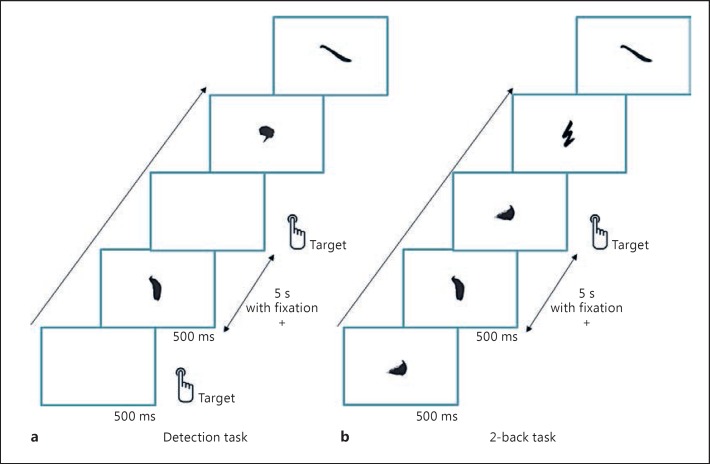
Fourteen and 16 participants with MCI were randomly allocated to a Chinese calligraphy writing (CW) training or a control group, respectively. The CW participants learned how to write Chinese strokes in a semicursive style to construct characters, tapping on working memory functions. The control group, on the other hand, learned how to use a tablet computer without emphasis on working memory functions. They then performed two 2-back tasks with CS semicursive strokes and non-context-specific (NCS) digits. Event-related electroencephalogram signals were concurrently recorded.
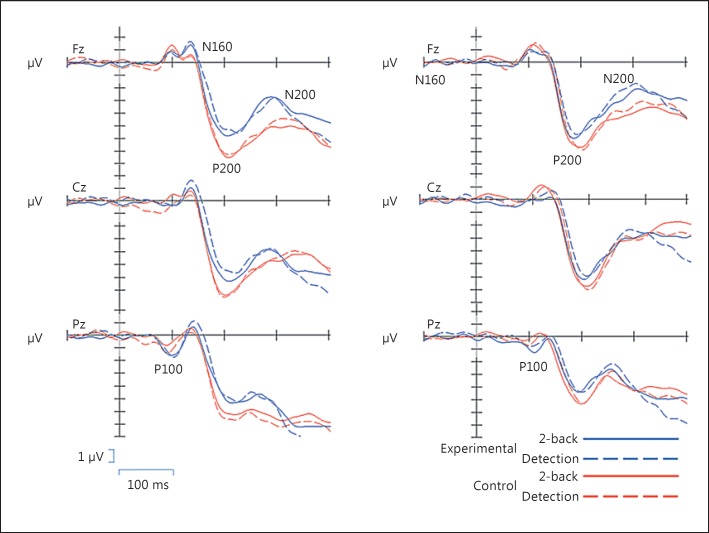
The CW participants had a significantly shorter reaction time in the CS than in the NCS task ( < 0.05). They showed significantly longer latency in working memory updating (N200; 11 = 4.70, = 0.05) and shorter latency in the evaluation of visual representation (P300; 12 = 4.67; = 0.05) than the control group when performing the 2-back CS task. Shorter P300 latency was also revealed in the 2-back NCS task (12 = 5.15, = 0.041), suggesting a possible generalization of the training effect among the CW participants.
The results suggest that CS working memory is likely to be generalized to NCS domains among individuals with MCI. Future research should extend the scope of the generalization and apply it beyond experimental conditions.
本研究考察了轻度认知障碍(MCI)个体中与情境特定(CS)训练效果泛化至非情境情况相关的神经过程。
14名和16名MCI参与者分别被随机分配至中国书法书写(CW)训练组或对照组。CW组参与者学习如何以半草书风格书写中国笔画以构成汉字,从而利用工作记忆功能。另一方面,对照组学习如何使用平板电脑,不强调工作记忆功能。然后他们对CS半草书笔画和非情境特定(NCS)数字执行两项2-back任务。同时记录事件相关脑电图信号。
CW组参与者在CS任务中的反应时间显著短于NCS任务(<0.05)。在执行2-back CS任务时,与对照组相比,他们在工作记忆更新方面显示出显著更长的潜伏期(N200;<下标11>=4.70,=0.05),而在视觉表征评估方面潜伏期更短(P300;<下标12>=4.67;=0.05)。在2-back NCS任务中也发现了更短的P300潜伏期(<下标12>=5.15,=0.041),表明训练效果可能在CW组参与者中发生了泛化。
结果表明,CS工作记忆可能在MCI个体中泛化至NCS领域。未来研究应扩大泛化范围并将其应用于实验条件之外。