Catalano Onofrio Antonio, Horn Gary Lloyd, Signore Alberto, Iannace Carlo, Lepore Maria, Vangel Mark, Luongo Angelo, Catalano Marco, Lehman Constance, Salvatore Marco, Soricelli Andrea, Catana Ciprian, Mahmood Umar, Rosen Bruce Robert
Martinos Center for Biomedical Imaging, Harvard Medical School, Massachusetts General Hospital, 149 13th Street, Charlestown, MA 02129, USA.
Abdominal Imaging, Harvard Medical School, Massachusetts General Hospital, 55 Fruit Street, Boston, MA 02114, USA.
Br J Cancer. 2017 Mar 28;116(7):893-902. doi: 10.1038/bjc.2017.26. Epub 2017 Feb 16.
Differences in genetics and receptor expression (phenotypes) of invasive ductal breast cancer (IDC) impact on prognosis and treatment response. Immunohistochemistry (IHC), the most used technique for IDC phenotyping, has some limitations including its invasiveness. We explored the possibility of contrast-enhanced positron emission tomography magnetic resonance (CE-FDG PET/MR) to discriminate IDC phenotypes.
21 IDC patients with IHC assessment of oestrogen receptor (ER), progesterone receptor (PR), human epidermal growth factor-2 (HER2), and antigen Ki-67 (Ki67) underwent CE-FDG PET/MR. Magnetic resonance-perfusion biomarkers, apparent diffusion coefficient (ADC), and standard uptake value (SUV) were compared with IHC markers and phenotypes, using a Student's t-test and one-way ANOVA.
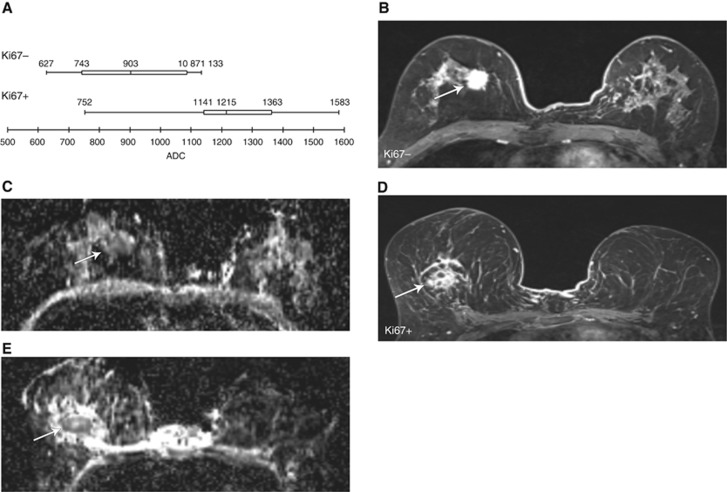
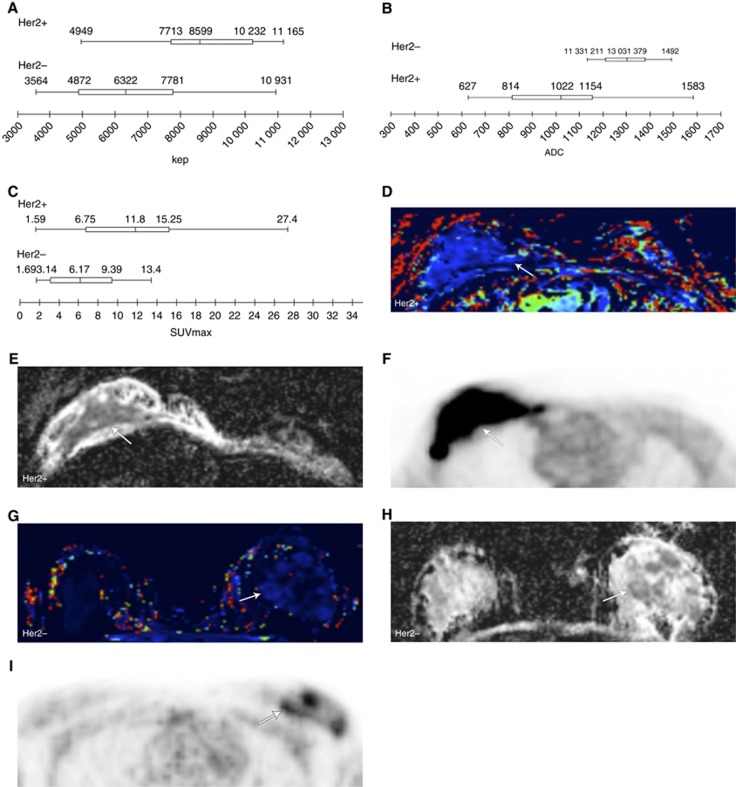
ER/PR- tumours demonstrated higher Kep and SUV than ER or PR+ tumours. HER2- tumours displayed higher ADC, Kep, and SUV than HER2+tumours. Only ADC discriminated Ki67⩽14% tumours (lower ADC) from Ki67>14% tumours. PET/MR biomarkers correlated with IHC phenotype in 13 out of 21 patients (62%; P=0.001).
Positron emission tomography magnetic resonance might non-invasively help discriminate IDC phenotypes, helping to optimise individual therapy options.
浸润性导管癌(IDC)的基因和受体表达(表型)差异会影响预后和治疗反应。免疫组织化学(IHC)是IDC表型分析最常用的技术,但存在一些局限性,包括其侵入性。我们探讨了对比增强正电子发射断层扫描磁共振(CE-FDG PET/MR)鉴别IDC表型的可能性。
21例接受了雌激素受体(ER)、孕激素受体(PR)、人表皮生长因子-2(HER2)和抗原Ki-67(Ki67)免疫组织化学评估的IDC患者接受了CE-FDG PET/MR检查。使用学生t检验和单因素方差分析,将磁共振灌注生物标志物、表观扩散系数(ADC)和标准摄取值(SUV)与免疫组织化学标志物及表型进行比较。
ER/PR阴性肿瘤的 Kep 和 SUV 高于 ER 或 PR 阳性肿瘤。HER2 阴性肿瘤的 ADC、Kep 和 SUV 高于 HER2 阳性肿瘤。只有 ADC 能够区分 Ki67≤14%的肿瘤(较低的 ADC)和 Ki67>14%的肿瘤。21例患者中有13例(62%;P=0.001)的PET/MR生物标志物与免疫组织化学表型相关。
正电子发射断层扫描磁共振可能有助于无创鉴别IDC表型,从而有助于优化个体化治疗方案。